

The Motion-Sensing Hairs of Arthropods
117
restoring constant, S, both affect the values of the hair maximum deflection
resonance frequency, mres((J)• and the maximum hair deflection at resonance
frequency, Bres· However, to the approximations made in the analysis, Eqs. (20a,
20b) show that the effects of RandS are completely decoupled for mresrv; and Vres!
It is also clear that both mres((J) and mresrv; depend on S to the 112 power and on L to
the -3/2 power, and that both Bres and Vres depend linearly on U0 •
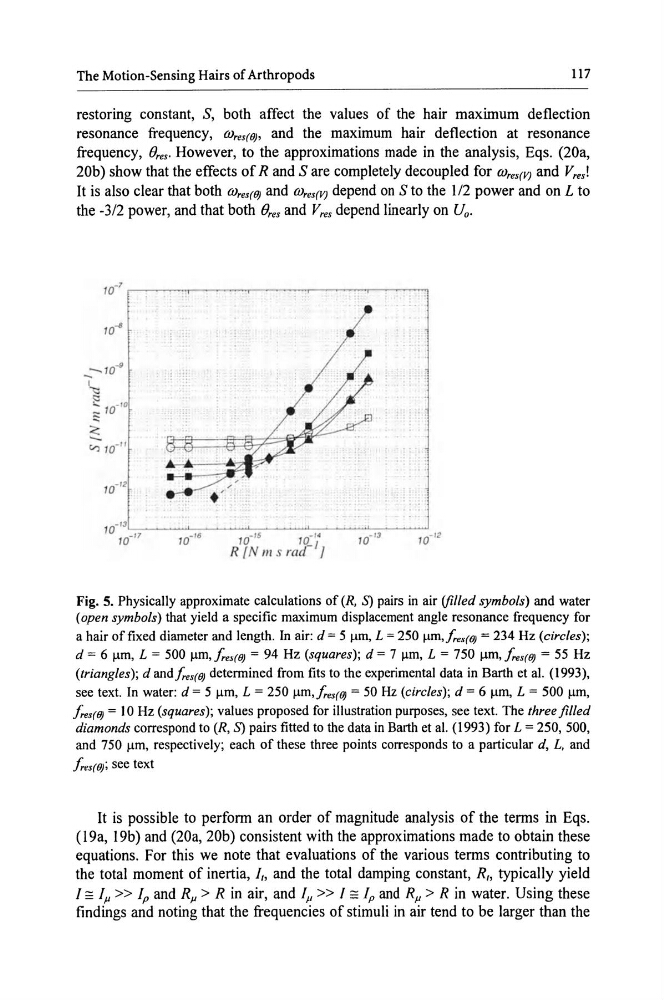
Fig. 5. Physically approximate calculations of (R, S) pairs in air (filled symbols) and water
(open symbols) that yield a specific maximum displacement angle resonance frequency for
a hair of fixed diameter and length. In air: d = 5 !-liD, L = 250 1-lm,fres(O) = 234 Hz (circles);
d = 6 !-liD, L = 500 1-lm, fres(B) =94Hz (squares); d = 7 J.Lm, L = 750 1-lm, fres((J) =55 Hz
(triangles); d andfres(O ) determined from fits to the experimental data in Barth et al. (1993),
see text. In water: d = 5 1-1m, L = 250 1-lm,fres((J) = 50 Hz (circles); d = 6 1-1m, L = 500 !-liD,
Ires( B) = I 0 Hz (squares); values proposed for illustration purposes, see text. The three filled
diamonds correspond to (R, S) pairs fitted to the data in Barth et al. (1993) for L = 250, 500,
and 750 !-liD, respectively; each of these three points corresponds to a particular d, L, and
fres(O ); see text
It is possible to perform an order of magnitude analysis of the terms in Eqs.
(19a, l9b) and (20a, 20b) consistent with the approximations made to obtain these
equations. For this we note that evaluations of the various terms contributing to
the total moment of inertia, I, and the total damping constant, R,, typically yield
I = I" >> Ip and R" > R in air, and I">> I :::: Ip and R" > R in water. Using these
findings and noting that the frequencies of stimuli in air tend to be larger than the
117
restoring constant, S, both affect the values of the hair maximum deflection
resonance frequency, mres((J)• and the maximum hair deflection at resonance
frequency, Bres· However, to the approximations made in the analysis, Eqs. (20a,
20b) show that the effects of RandS are completely decoupled for mresrv; and Vres!
It is also clear that both mres((J) and mresrv; depend on S to the 112 power and on L to
the -3/2 power, and that both Bres and Vres depend linearly on U0 •
Fig. 5. Physically approximate calculations of (R, S) pairs in air (filled symbols) and water
(open symbols) that yield a specific maximum displacement angle resonance frequency for
a hair of fixed diameter and length. In air: d = 5 !-liD, L = 250 1-lm,fres(O) = 234 Hz (circles);
d = 6 !-liD, L = 500 1-lm, fres(B) =94Hz (squares); d = 7 J.Lm, L = 750 1-lm, fres((J) =55 Hz
(triangles); d andfres(O ) determined from fits to the experimental data in Barth et al. (1993),
see text. In water: d = 5 1-1m, L = 250 1-lm,fres((J) = 50 Hz (circles); d = 6 1-1m, L = 500 !-liD,
Ires( B) = I 0 Hz (squares); values proposed for illustration purposes, see text. The three filled
diamonds correspond to (R, S) pairs fitted to the data in Barth et al. (1993) for L = 250, 500,
and 750 !-liD, respectively; each of these three points corresponds to a particular d, L, and
fres(O ); see text
It is possible to perform an order of magnitude analysis of the terms in Eqs.
(19a, l9b) and (20a, 20b) consistent with the approximations made to obtain these
equations. For this we note that evaluations of the various terms contributing to
the total moment of inertia, I, and the total damping constant, R,, typically yield
I = I" >> Ip and R" > R in air, and I">> I :::: Ip and R" > R in water. Using these
findings and noting that the frequencies of stimuli in air tend to be larger than the