

The Motion-Sensing Hairs of Arthropods
119
have comparable maximum angular velocities at resonance frequency. Although
the values ofthe numerical coefficients embedded in the relations in Table 1 have
been omitted for clarity, it can further be shown that Wres(V) > Wres((}) in both media,
as expected from inspection of Eqs. (19a) and (20a).
A measure of hair sensitivity to changes in fluid medium velocity is given by
LdV,./dU0 • This dimensionless quantity characterizes the rate of change of''hair tip
velocity with respect to a change in the amplitude of the far field fluid velocity
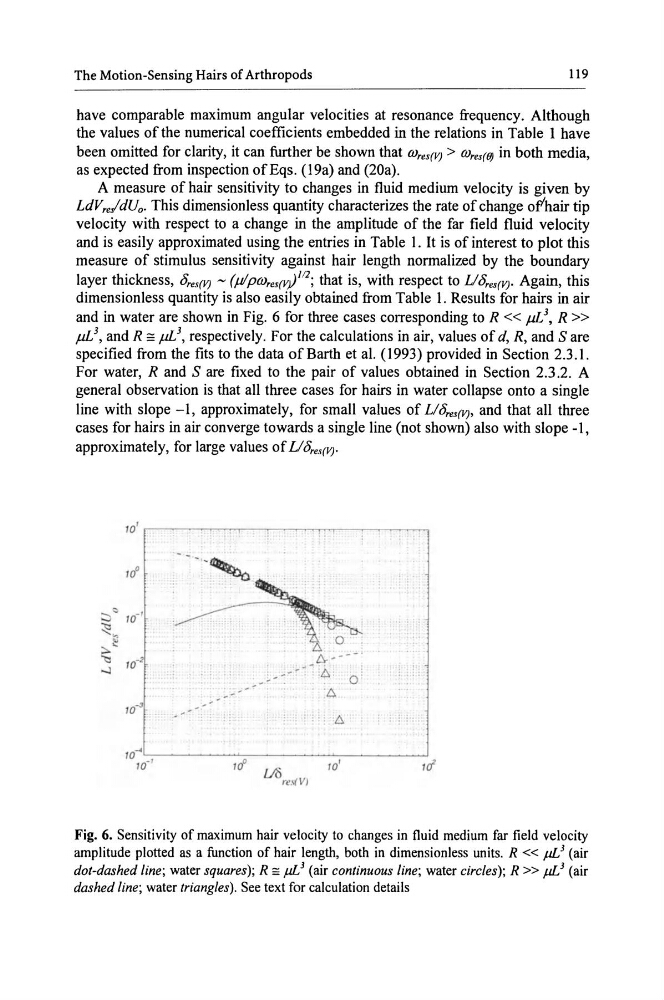
and is easily approximated using the entries in Table 1. It is of interest to plot this
measure of stimulus sensitivity against hair length normalized by the boundary
layer thickness, 8res(V) - (ji/pm,esrv/ 12 ; that is, with respect to U8,es(V) · Again, this
dimensionless quantity is also easily obtained from Table I. Results for hairs in air
and in water are shown in Fig. 6 for three cases corresponding toR << fJl}, R >>
pi}, and R = pL 3 , respectively. For the calculations in air, values of d, R, and S are
specified from the fits to the data of Barth et al. (1993) provided in Section 2.3 .1.
For water, R and S are fixed to the pair of values obtained in Section 2.3.2. A
general observation is that all three cases for hairs in water collapse onto a single
line with slope - 1, approximately, for small values of L18res(VJ• and that all three
cases for hairs in air converge towards a single line (not shown) also with slope -1,
approximately, for large values of L18res(VJ·
: ... , ..... -
· z::.
; ; ; ; ; = fl.
10-''-------_.....-----~------'
to·'
1Cf
ta'
t(/
uo re.
amplitude plotted as a function of hair length, both in dimensionless units. R << pL 3 (air
dot-dashed line; water squares); R = f.1L 3 (air continuous line; water circles); R >> f.1L 3 (air
dashed line; water triangles). See text for calculation details
119
have comparable maximum angular velocities at resonance frequency. Although
the values ofthe numerical coefficients embedded in the relations in Table 1 have
been omitted for clarity, it can further be shown that Wres(V) > Wres((}) in both media,
as expected from inspection of Eqs. (19a) and (20a).
A measure of hair sensitivity to changes in fluid medium velocity is given by
LdV,./dU0 • This dimensionless quantity characterizes the rate of change of''hair tip
velocity with respect to a change in the amplitude of the far field fluid velocity
and is easily approximated using the entries in Table 1. It is of interest to plot this
measure of stimulus sensitivity against hair length normalized by the boundary
layer thickness, 8res(V) - (ji/pm,esrv/ 12 ; that is, with respect to U8,es(V) · Again, this
dimensionless quantity is also easily obtained from Table I. Results for hairs in air
and in water are shown in Fig. 6 for three cases corresponding toR << fJl}, R >>
pi}, and R = pL 3 , respectively. For the calculations in air, values of d, R, and S are
specified from the fits to the data of Barth et al. (1993) provided in Section 2.3 .1.
For water, R and S are fixed to the pair of values obtained in Section 2.3.2. A
general observation is that all three cases for hairs in water collapse onto a single
line with slope - 1, approximately, for small values of L18res(VJ• and that all three
cases for hairs in air converge towards a single line (not shown) also with slope -1,
approximately, for large values of L18res(VJ·
: ... , ..... -
· z::.
; ; ; ; ; = fl.
10-''-------_.....-----~------'
to·'
1Cf
ta'
t(/
uo re.
amplitude plotted as a function of hair length, both in dimensionless units. R << pL 3 (air
dot-dashed line; water squares); R = f.1L 3 (air continuous line; water circles); R >> f.1L 3 (air
dashed line; water triangles). See text for calculation details