

llO
Joseph A. C. Humphrey et al.
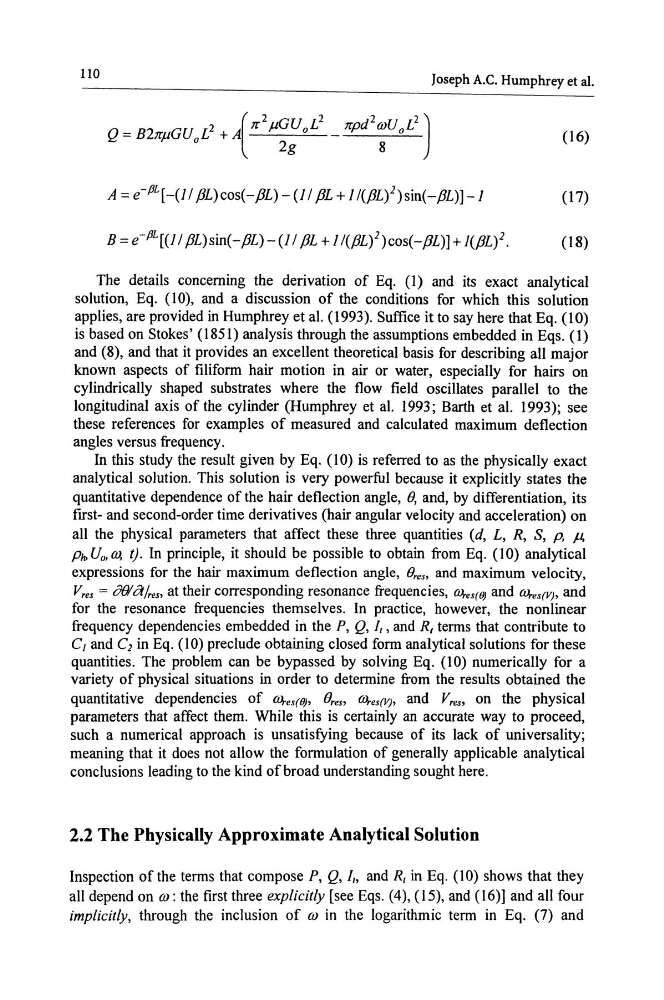
(16)
A= e-PL [ -(1 I f3L) cos( -f3L)- (1 I f3L + ll(f3L) 2 ) sin( -f3L)] -1
(17)
B = e-PL[(J I f3L)sin( -f3L)- (I I f3L +I l(f3L) 2 )cos( -f3L)] + l(f3L) 2 .
(18)
The details concerning the derivation of Eq. (1) and its exact analytical
solution, Eq. (10), and a discussion of the conditions for which this solution
applies, are provided in Humphrey eta!. (1993). Suffice it to say here that Eq. (10)
is based on Stokes' ( 1851) analysis through the assumptions embedded in Eqs. (1)
and (8), and that it provides an excellent theoretical basis for describing all major
known aspects of filiform hair motion in air or water, especially for hairs on
cylindrically shaped substrates where the flow field oscillates parallel to the
longitudinal axis of the cylinder (Humphrey et a!. 1993; Barth et a!. 1993); see
these references for examples of measured and calculated maximum deflection
angles versus frequency.
In this study the result given by Eq. (I 0) is referred to as the physically exact
analytical solution. This solution is very powerful because it explicitly states the
quantitative dependence of the hair deflection angle, 8, and, by differentiation, its
first- and second-order time derivatives (hair angular velocity and acceleration) on
all the physical parameters that affect these three quantities (d, L, R, S, p, 11.
p"'U0,rn, t). In principle, it should be possible to obtain from Eq. (10) analytical
expressions for the hair maximum deflection angle, Bres• and maximum velocity,
Vres = oBiet/,.., at their corresponding resonance frequencies, O+esro; and O+esrv;, and
for the resonance frequencies themselves. In practice, however, the nonlinear
frequency dependencies embedded in the P, Q, I1 , and R, terms that contribute to
C1 and C1 in Eq. (10) preclude obtaining closed form analytical solutions for these
quantities. The problem can be bypassed by solving Eq. (10) numerically for a
variety of physical situations in order to determine from the results obtained the
quantitative dependencies of O+es(IJ)• Bres. l4es(V)• and Vres. on the physical
parameters that affect them. While this is certainly an accurate way to proceed,
such a numerical approach is unsatisfying because of its lack of universality;
meaning that it does not allow the formulation of generally applicable analytical
conclusions leading to the kind of broad understanding sought here.
2.2 The Physically Approximate Analytical Solution
Inspection of the terms that compose P, Q, I, and R, in Eq. (1 0) shows that they
all depend on ro: the first three explicitly [see Eqs. (4), (15), and (16)] and all four
implicitly, through the inclusion of ro in the logarithmic term in Eq. (7) and
Joseph A. C. Humphrey et al.
(16)
A= e-PL [ -(1 I f3L) cos( -f3L)- (1 I f3L + ll(f3L) 2 ) sin( -f3L)] -1
(17)
B = e-PL[(J I f3L)sin( -f3L)- (I I f3L +I l(f3L) 2 )cos( -f3L)] + l(f3L) 2 .
(18)
The details concerning the derivation of Eq. (1) and its exact analytical
solution, Eq. (10), and a discussion of the conditions for which this solution
applies, are provided in Humphrey eta!. (1993). Suffice it to say here that Eq. (10)
is based on Stokes' ( 1851) analysis through the assumptions embedded in Eqs. (1)
and (8), and that it provides an excellent theoretical basis for describing all major
known aspects of filiform hair motion in air or water, especially for hairs on
cylindrically shaped substrates where the flow field oscillates parallel to the
longitudinal axis of the cylinder (Humphrey et a!. 1993; Barth et a!. 1993); see
these references for examples of measured and calculated maximum deflection
angles versus frequency.
In this study the result given by Eq. (I 0) is referred to as the physically exact
analytical solution. This solution is very powerful because it explicitly states the
quantitative dependence of the hair deflection angle, 8, and, by differentiation, its
first- and second-order time derivatives (hair angular velocity and acceleration) on
all the physical parameters that affect these three quantities (d, L, R, S, p, 11.
p"'U0,rn, t). In principle, it should be possible to obtain from Eq. (10) analytical
expressions for the hair maximum deflection angle, Bres• and maximum velocity,
Vres = oBiet/,.., at their corresponding resonance frequencies, O+esro; and O+esrv;, and
for the resonance frequencies themselves. In practice, however, the nonlinear
frequency dependencies embedded in the P, Q, I1 , and R, terms that contribute to
C1 and C1 in Eq. (10) preclude obtaining closed form analytical solutions for these
quantities. The problem can be bypassed by solving Eq. (10) numerically for a
variety of physical situations in order to determine from the results obtained the
quantitative dependencies of O+es(IJ)• Bres. l4es(V)• and Vres. on the physical
parameters that affect them. While this is certainly an accurate way to proceed,
such a numerical approach is unsatisfying because of its lack of universality;
meaning that it does not allow the formulation of generally applicable analytical
conclusions leading to the kind of broad understanding sought here.
2.2 The Physically Approximate Analytical Solution
Inspection of the terms that compose P, Q, I, and R, in Eq. (1 0) shows that they
all depend on ro: the first three explicitly [see Eqs. (4), (15), and (16)] and all four
implicitly, through the inclusion of ro in the logarithmic term in Eq. (7) and