

The Motion-Sensing Hairs of Arthropods
109
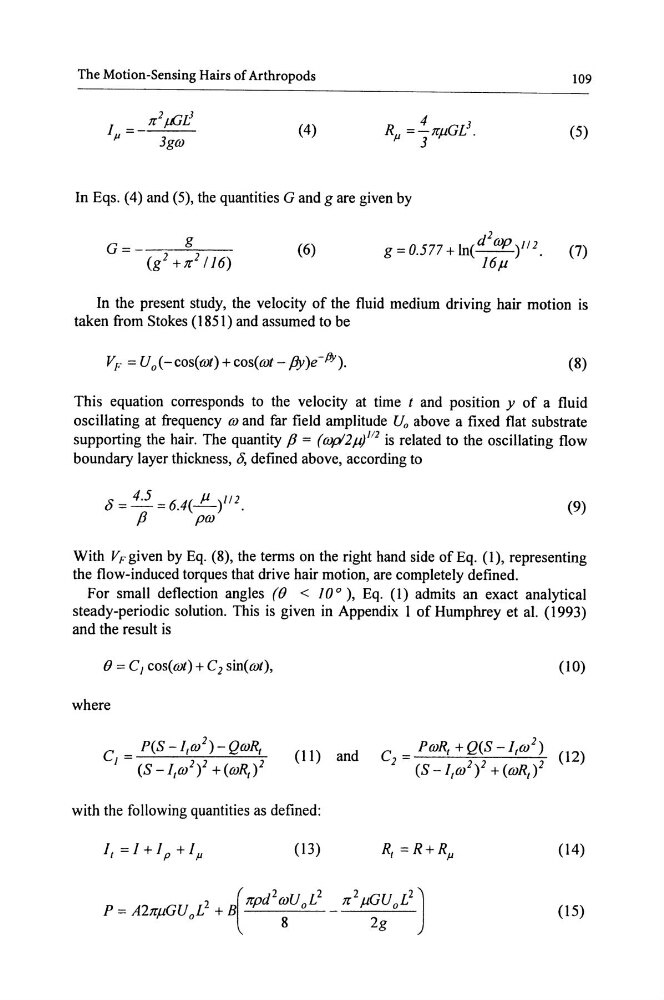
(4)
4
3
R 11 =-~rpGL .
3
(5)
In Eqs. (4) and (5), the quantities G and g are given by
(6)
In the present study, the velocity of the fluid medium driving hair motion is
taken from Stokes (1851) and assumed to be
(8)
This equation corresponds to the velocity at time t and position y of a fluid
oscillating at frequency OJ and far field amplitude Uo above a fixed flat substrate
supporting the hair. The quantity p = (0Jpi2Jl) 112 is related to the oscillating flow
boundary layer thickness, 8, defined above, according to
8 = 4.5 = 6.4( _!!__ )11 2.
p
pw
(9)
With VF given by Eq. (8), the terms on the right hand side of Eq. (1 ), representing
the flow-induced torques that drive hair motion, are completely defined.
For small deflection angles ((} < 10 ° ), Eq. (1) admits an exact analytical
steady-periodic solution. This is given in Appendix 1 of Humphrey et al. (1993)
and the result is
(10)
where
(11) and
with the following quantities as defined:
(13)
(14)
(15)
109
(4)
4
3
R 11 =-~rpGL .
3
(5)
In Eqs. (4) and (5), the quantities G and g are given by
(6)
In the present study, the velocity of the fluid medium driving hair motion is
taken from Stokes (1851) and assumed to be
(8)
This equation corresponds to the velocity at time t and position y of a fluid
oscillating at frequency OJ and far field amplitude Uo above a fixed flat substrate
supporting the hair. The quantity p = (0Jpi2Jl) 112 is related to the oscillating flow
boundary layer thickness, 8, defined above, according to
8 = 4.5 = 6.4( _!!__ )11 2.
p
pw
(9)
With VF given by Eq. (8), the terms on the right hand side of Eq. (1 ), representing
the flow-induced torques that drive hair motion, are completely defined.
For small deflection angles ((} < 10 ° ), Eq. (1) admits an exact analytical
steady-periodic solution. This is given in Appendix 1 of Humphrey et al. (1993)
and the result is
(10)
where
(11) and
with the following quantities as defined:
(13)
(14)
(15)