

108
Joseph A. C. Humphrey et al.
Humphrey et al. (1993, 1997) and Barth et al. (1993) have demonstrated two
very different ways to derive values for the hair torsional restoring constant, S, and
damping constant, R, from related experimental data. In one method the phase
difference between hair and air motion must be known as a function of the hair (or
flow) oscillation frequency. The other is based on knowing the variation of hair
maximum deflection angle with hair (or flow) oscillation frequency. Both methods
yield reasonable values of Sand R and a variation of the second has been applied
by Shimozawa et al. (1998) to d~rive values of Sand Rasa function ofhair length
for crickets. All the results support a dependence of S and R on hair length of the
form y = a Lh + c, where a, b, and c are experimentally determined positive
constants that differ for S and R, respectively. Both analytical and numerical
results show that increasing S or decreasing R works to increase hair resonance
frequency.
2 Physical and Analytical Considerations
2.1 The Equation of Angular Momentum for a Filiform Hair
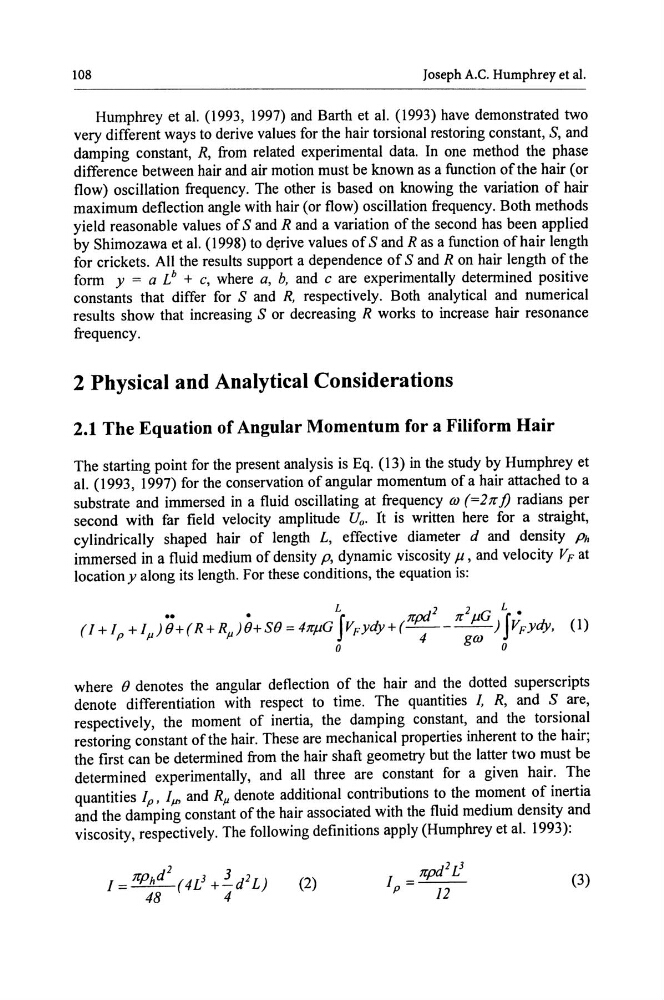
The starting point for the present analysis is Eq. (13) in the study by Humphrey et
al. ( 1993, 1997) for the conservation of angular momentum of a hair attached to a
substrate and immersed in a fluid oscillating at frequency m ( = 2Jr f) radians per
second with far field velocity amplitude U0 • rt is written here for a straight,
cylindrically shaped hair of length L, effective diameter d and density Ph
immersed in a fluid medium of density p, dynamic viscosity p, and velocity VF at
locationy along its length. For these conditions, the equation is:
where B denotes the angular deflection of the hair and the dotted superscripts
denote differentiation with respect to time. The quantities I, R, and S are,
respectively, the moment of inertia, the damping constant, and the torsional
restoring constant of the hair. These are mechanical properties inherent to the hair;
the first can be determined from the hair shaft geometry but the latter two must be
determined experimentally, and all three are constant for a given hair. The
quantities Ip, If., and R"' denote additional contributions to the moment of inertia
and the damping constant of the hair associated with the fluid medium density and
viscosity, respectively. The following definitions apply (Humphrey et al. 1993):
(2)
(3)
Joseph A. C. Humphrey et al.
Humphrey et al. (1993, 1997) and Barth et al. (1993) have demonstrated two
very different ways to derive values for the hair torsional restoring constant, S, and
damping constant, R, from related experimental data. In one method the phase
difference between hair and air motion must be known as a function of the hair (or
flow) oscillation frequency. The other is based on knowing the variation of hair
maximum deflection angle with hair (or flow) oscillation frequency. Both methods
yield reasonable values of Sand R and a variation of the second has been applied
by Shimozawa et al. (1998) to d~rive values of Sand Rasa function ofhair length
for crickets. All the results support a dependence of S and R on hair length of the
form y = a Lh + c, where a, b, and c are experimentally determined positive
constants that differ for S and R, respectively. Both analytical and numerical
results show that increasing S or decreasing R works to increase hair resonance
frequency.
2 Physical and Analytical Considerations
2.1 The Equation of Angular Momentum for a Filiform Hair
The starting point for the present analysis is Eq. (13) in the study by Humphrey et
al. ( 1993, 1997) for the conservation of angular momentum of a hair attached to a
substrate and immersed in a fluid oscillating at frequency m ( = 2Jr f) radians per
second with far field velocity amplitude U0 • rt is written here for a straight,
cylindrically shaped hair of length L, effective diameter d and density Ph
immersed in a fluid medium of density p, dynamic viscosity p, and velocity VF at
locationy along its length. For these conditions, the equation is:
where B denotes the angular deflection of the hair and the dotted superscripts
denote differentiation with respect to time. The quantities I, R, and S are,
respectively, the moment of inertia, the damping constant, and the torsional
restoring constant of the hair. These are mechanical properties inherent to the hair;
the first can be determined from the hair shaft geometry but the latter two must be
determined experimentally, and all three are constant for a given hair. The
quantities Ip, If., and R"' denote additional contributions to the moment of inertia
and the damping constant of the hair associated with the fluid medium density and
viscosity, respectively. The following definitions apply (Humphrey et al. 1993):
(2)
(3)