

The Motion-Sensing Hairs of Arthropods
111
through the dimensionless quantity fJL in Eqs. (17) and (18). However,
calculations of these terms for typical conditions corresponding to hairs in air and
water reveal that they are essentially constant for frequencies exceeding 50-7 5 Hz.
In order to proceed, we assume the terms are constant for the purpose (only) of
deriving physically approximate but analytically exact solutions for the resonance
frequencies, ~es(B) and Wres(Vh and their corresponding maximum angular
deflection, Ores, and maximum angular velocity, Vres, respectively. The validity of
the approach is determined via a posteriori verification.
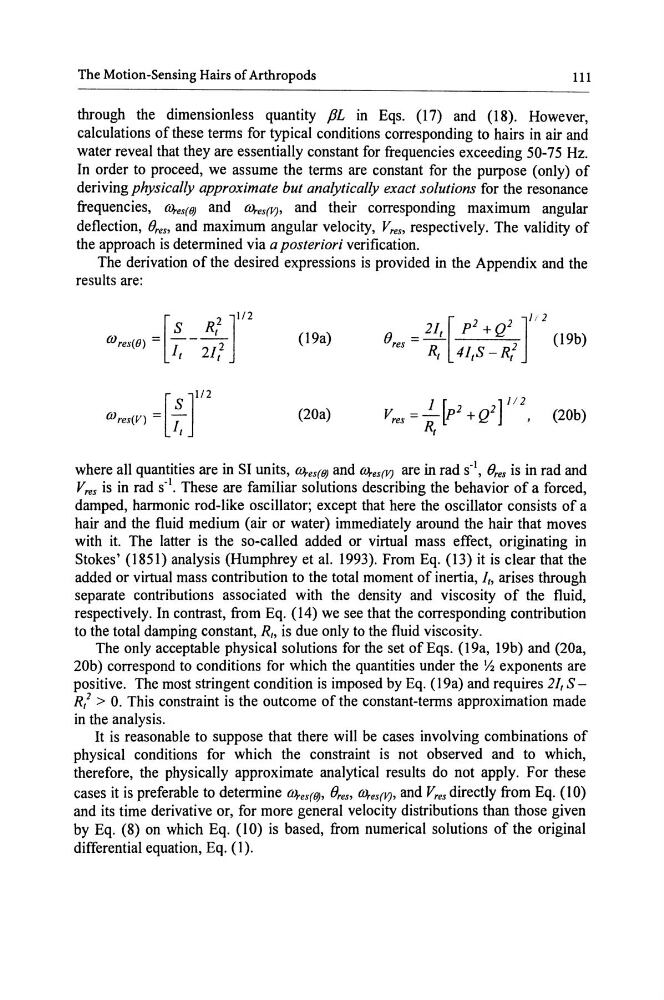
The derivation of the desired expressions is provided in the Appendix and the
results are:
(19a)
0 . = 211 p +Q
(19b)
[
2 2]} I 2
res
R 1 41 1 S - R/
[
]
1/2
O.Jres(V) = :
(20a)
(20b)
where all quantities are in SI units, Wres(B) and OJ,.es(V) are in rad s·I, Ores is in rad and
Vres is in rad s·'. These are familiar solutions describing the behavior of a forced,
damped, harmonic rod-like oscillator; except that here the oscillator consists of a
hair and the fluid medium (air or water) immediately around the hair that moves
with it. The latter is the so-called added or virtual mass effect, originating in
Stokes' (1851) analysis (Humphrey eta!. 1993). From Eq. (13) it is clear that the
added or virtual mass contribution to the total moment of inertia, /h arises through
separate contributions associated with the density and viscosity of the fluid,
respectively. In contrast, from Eq. (14) we see that the corresponding contribution
to the total damping constant, Rt. is due only to the fluid viscosity.
The only acceptable physical solutions for the set ofEqs. (19a, 19b) and (20a,
20b) correspond to conditions for which the quantities under the Yz exponents are
positive. The most stringent condition is imposed by Eq. ( 19a) and requires 21, SR/ > 0. This constraint is the outcome of the constant-terms approximation made
in the analysis.
It is reasonable to suppose that there will be cases involving combinations of
physical conditions for which the constraint is not observed and to which,
therefore, the physically approximate analytical results do not apply. For these
cases it is preferable to determine Wres(B!• 0,.., OJ,.es(l1• and Vres directly from Eq. (1 0)
and its time derivative or, for more general velocity distributions than those given
by Eq. (8) on which Eq. (10) is based, from numerical solutions of the original
differential equation, Eq. (1).
111
through the dimensionless quantity fJL in Eqs. (17) and (18). However,
calculations of these terms for typical conditions corresponding to hairs in air and
water reveal that they are essentially constant for frequencies exceeding 50-7 5 Hz.
In order to proceed, we assume the terms are constant for the purpose (only) of
deriving physically approximate but analytically exact solutions for the resonance
frequencies, ~es(B) and Wres(Vh and their corresponding maximum angular
deflection, Ores, and maximum angular velocity, Vres, respectively. The validity of
the approach is determined via a posteriori verification.
The derivation of the desired expressions is provided in the Appendix and the
results are:
(19a)
0 . = 211 p +Q
(19b)
[
2 2]} I 2
res
R 1 41 1 S - R/
[
]
1/2
O.Jres(V) = :
(20a)
(20b)
where all quantities are in SI units, Wres(B) and OJ,.es(V) are in rad s·I, Ores is in rad and
Vres is in rad s·'. These are familiar solutions describing the behavior of a forced,
damped, harmonic rod-like oscillator; except that here the oscillator consists of a
hair and the fluid medium (air or water) immediately around the hair that moves
with it. The latter is the so-called added or virtual mass effect, originating in
Stokes' (1851) analysis (Humphrey eta!. 1993). From Eq. (13) it is clear that the
added or virtual mass contribution to the total moment of inertia, /h arises through
separate contributions associated with the density and viscosity of the fluid,
respectively. In contrast, from Eq. (14) we see that the corresponding contribution
to the total damping constant, Rt. is due only to the fluid viscosity.
The only acceptable physical solutions for the set ofEqs. (19a, 19b) and (20a,
20b) correspond to conditions for which the quantities under the Yz exponents are
positive. The most stringent condition is imposed by Eq. ( 19a) and requires 21, SR/ > 0. This constraint is the outcome of the constant-terms approximation made
in the analysis.
It is reasonable to suppose that there will be cases involving combinations of
physical conditions for which the constraint is not observed and to which,
therefore, the physically approximate analytical results do not apply. For these
cases it is preferable to determine Wres(B!• 0,.., OJ,.es(l1• and Vres directly from Eq. (1 0)
and its time derivative or, for more general velocity distributions than those given
by Eq. (8) on which Eq. (10) is based, from numerical solutions of the original
differential equation, Eq. (1).