

The Ecology of Avian Acoustical Signals
93
distances and heights with the speaker and microphone always at the same height.
The data was analyzed for excess attenuation and signal-to-noise ratio.
Furthermore, we computed the blur ratio, the ratio between the energy of the
observed signal and the sum of the energy in the bird vocalization and the channel
noise. These measures represent the changes in most of the information-carrying
parameters in the sounds (Dabelsteen eta!. 1993).
20 ~
15
E
~10
(j)
I
5
Herpsilochmus dorsimaculatus
oL_~ ____ L _ _ _ _ _ ~------~------~------~
-2
0
2
4
6
8
Residual signal-to-noise ratio (dB)
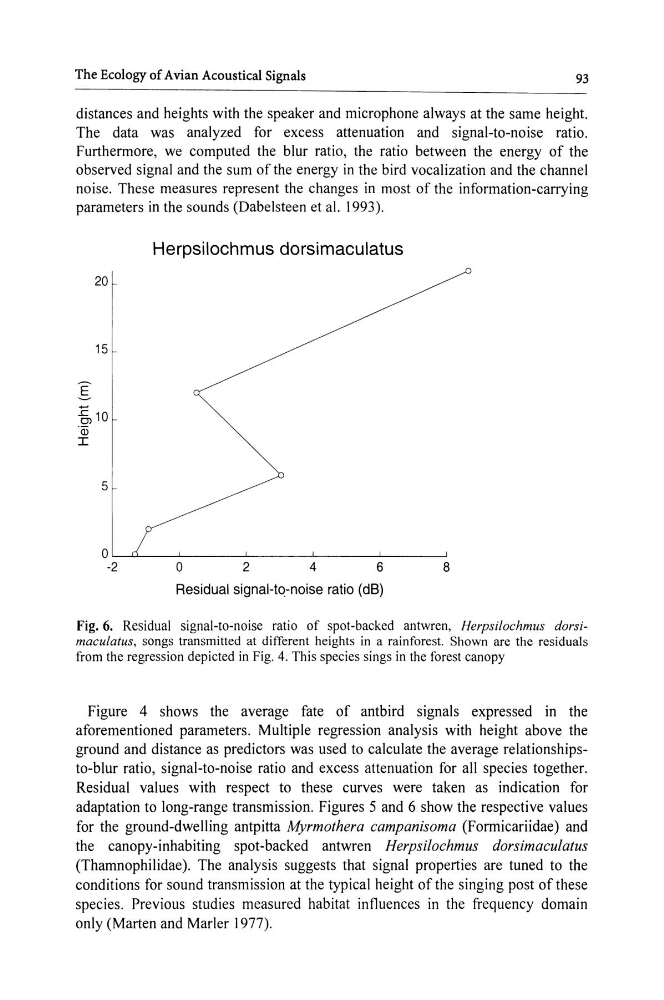
Fig. 6. Residual signal-to-noise ratio of spot-backed antwren, Herpsilochmus dorsimaculatus, songs transmitted at different heights in a rainforest. Shown are the residuals
from the regression depicted in Fig. 4. This species sings in the forest canopy
Figure 4 shows the average fate of antbird signals expressed in the
aforementioned parameters. Multiple regression analysis with height above the
ground and distance as predictors was used to calculate the average relationshipsto-blur ratio, signal-to-noise ratio and excess attenuation for all species together.
Residual values with respect to these curves were taken as indication for
adaptation to long-range transmission. Figures 5 and 6 show the respective values
for the ground-dwelling antpitta Myrmothera campanisoma (Formicariidae) and
the canopy-inhabiting spot-backed antwren Herpsilochmus dorsimaculatus
(Thamnophilidae ). The analysis suggests that signal properties are tuned to the
conditions for sound transmission at the typical height of the singing post of these
species. Previous studies measured habitat influences in the frequency domain
only (Marten and Marler 1977).
93
distances and heights with the speaker and microphone always at the same height.
The data was analyzed for excess attenuation and signal-to-noise ratio.
Furthermore, we computed the blur ratio, the ratio between the energy of the
observed signal and the sum of the energy in the bird vocalization and the channel
noise. These measures represent the changes in most of the information-carrying
parameters in the sounds (Dabelsteen eta!. 1993).
20 ~
15
E
~10
(j)
I
5
Herpsilochmus dorsimaculatus
oL_~ ____ L _ _ _ _ _ ~------~------~------~
-2
0
2
4
6
8
Residual signal-to-noise ratio (dB)
Fig. 6. Residual signal-to-noise ratio of spot-backed antwren, Herpsilochmus dorsimaculatus, songs transmitted at different heights in a rainforest. Shown are the residuals
from the regression depicted in Fig. 4. This species sings in the forest canopy
Figure 4 shows the average fate of antbird signals expressed in the
aforementioned parameters. Multiple regression analysis with height above the
ground and distance as predictors was used to calculate the average relationshipsto-blur ratio, signal-to-noise ratio and excess attenuation for all species together.
Residual values with respect to these curves were taken as indication for
adaptation to long-range transmission. Figures 5 and 6 show the respective values
for the ground-dwelling antpitta Myrmothera campanisoma (Formicariidae) and
the canopy-inhabiting spot-backed antwren Herpsilochmus dorsimaculatus
(Thamnophilidae ). The analysis suggests that signal properties are tuned to the
conditions for sound transmission at the typical height of the singing post of these
species. Previous studies measured habitat influences in the frequency domain
only (Marten and Marler 1977).