

92
Hans Winkler
Myrmothera campanisoma
20
15
5
0~----~------~------~~----~----~
-2
0
2
4
6
8
Residual signal-to-noise ratio (dB)
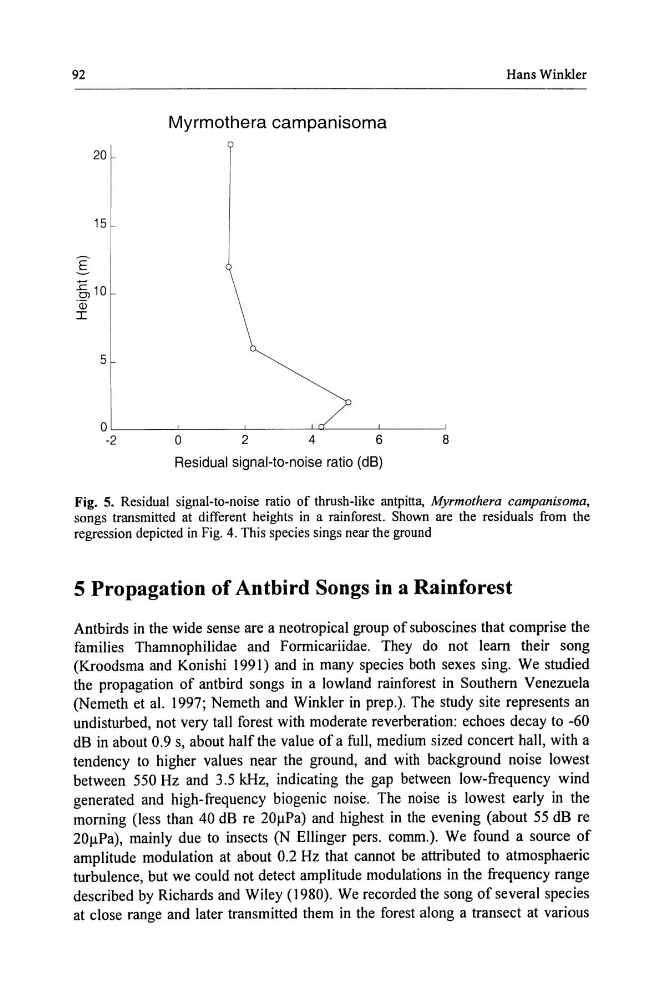
Fig. 5. Residual signal-to-noise ratio of thrush-like antpitta, Myrmothera campanisoma,
songs transmitted at different heights in a rainforest. Shown are the residuals from the
regression depicted in Fig. 4. This species sings near the ground
5 Propagation of Antbird Songs in a Rainforest
Antbirds in the wide sense are a neotropical group of suboscines that comprise the
families Thamnophilidae and Formicariidae. They do not learn their song
(Kroodsma and Konishi 1991) and in many species both sexes sing. We studied
the propagation of antbird songs in a lowland rainforest in Southern Venezuela
(Nemeth et al. 1997; Nemeth and Winkler in prep.). The study site represents an
undisturbed, not very tall forest with moderate reverberation: echoes decay to -60
dB in about 0.9 s, about half the value of a full, medium sized concert hall, with a
tendency to higher values near the ground, and with background noise lowest
between 550Hz and 3.5 kHz, indicating the gap between low-frequency wind
generated and high-frequency biogenic noise. The noise is lowest early in the
morning (less than 40 dB re 20f..1Pa) and highest in the evening (about 55 dB re
20f.lPa), mainly due to insects (N Ellinger pers. comm.). We found a source of
amplitude modulation at about 0.2 Hz that cannot be attributed to atmosphaeric
turbulence, but we could not detect amplitude modulations in the frequency range
described by Richards and Wiley (1980). We recorded the song of several species
at close range and later transmitted them in the forest along a transect at various
Hans Winkler
Myrmothera campanisoma
20
15
5
0~----~------~------~~----~----~
-2
0
2
4
6
8
Residual signal-to-noise ratio (dB)
Fig. 5. Residual signal-to-noise ratio of thrush-like antpitta, Myrmothera campanisoma,
songs transmitted at different heights in a rainforest. Shown are the residuals from the
regression depicted in Fig. 4. This species sings near the ground
5 Propagation of Antbird Songs in a Rainforest
Antbirds in the wide sense are a neotropical group of suboscines that comprise the
families Thamnophilidae and Formicariidae. They do not learn their song
(Kroodsma and Konishi 1991) and in many species both sexes sing. We studied
the propagation of antbird songs in a lowland rainforest in Southern Venezuela
(Nemeth et al. 1997; Nemeth and Winkler in prep.). The study site represents an
undisturbed, not very tall forest with moderate reverberation: echoes decay to -60
dB in about 0.9 s, about half the value of a full, medium sized concert hall, with a
tendency to higher values near the ground, and with background noise lowest
between 550Hz and 3.5 kHz, indicating the gap between low-frequency wind
generated and high-frequency biogenic noise. The noise is lowest early in the
morning (less than 40 dB re 20f..1Pa) and highest in the evening (about 55 dB re
20f.lPa), mainly due to insects (N Ellinger pers. comm.). We found a source of
amplitude modulation at about 0.2 Hz that cannot be attributed to atmosphaeric
turbulence, but we could not detect amplitude modulations in the frequency range
described by Richards and Wiley (1980). We recorded the song of several species
at close range and later transmitted them in the forest along a transect at various