

The Ecology of Avian Acoustical Signals
20
15
E
.E 10
CJ)
'iii
I
(f)
5
.15
.30
.45
Blur ratio
91
.60
.75
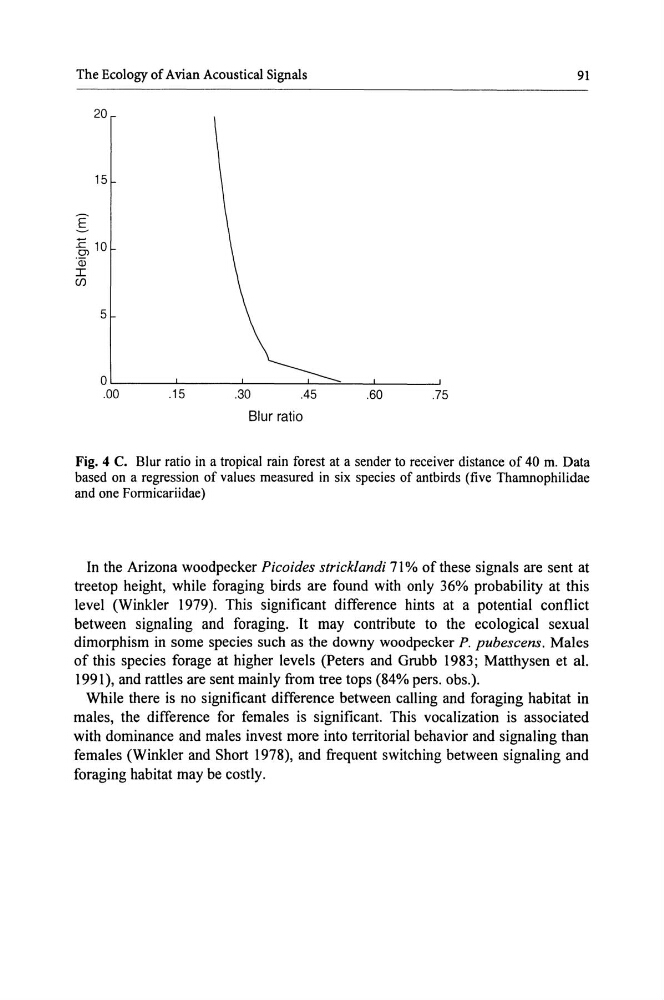
Fig. 4 C. Blur ratio in a tropical rain forest at a sender to receiver distance of 40 m. Data
based on a regression of values measured in six species of antbirds (five Thamnophilidae
and one Formicariidae)
In the Arizona woodpecker Picoides stricklandi 71% of these signals are sent at
treetop height, while foraging birds are found with only 36% probability at this
level (Winkler 1979). This significant difference hints at a potential conflict
between signaling and foraging. It may contribute to the ecological sexual
dimorphism in some species such as the downy woodpecker P. pubescens. Males
of this species forage at higher levels (Peters and Grubb 1983; Matthysen et al.
1991), and rattles are sent mainly from tree tops (84% pers. obs.).
While there is no significant difference between calling and foraging habitat in
males, the difference for females is significant. This vocalization is associated
with dominance and males invest more into territorial behavior and signaling than
females (Winkler and Short 1978), and frequent switching between signaling and
foraging habitat may be costly.
20
15
E
.E 10
CJ)
'iii
I
(f)
5
.15
.30
.45
Blur ratio
91
.60
.75
Fig. 4 C. Blur ratio in a tropical rain forest at a sender to receiver distance of 40 m. Data
based on a regression of values measured in six species of antbirds (five Thamnophilidae
and one Formicariidae)
In the Arizona woodpecker Picoides stricklandi 71% of these signals are sent at
treetop height, while foraging birds are found with only 36% probability at this
level (Winkler 1979). This significant difference hints at a potential conflict
between signaling and foraging. It may contribute to the ecological sexual
dimorphism in some species such as the downy woodpecker P. pubescens. Males
of this species forage at higher levels (Peters and Grubb 1983; Matthysen et al.
1991), and rattles are sent mainly from tree tops (84% pers. obs.).
While there is no significant difference between calling and foraging habitat in
males, the difference for females is significant. This vocalization is associated
with dominance and males invest more into territorial behavior and signaling than
females (Winkler and Short 1978), and frequent switching between signaling and
foraging habitat may be costly.