

94
Hans Winkler
250
0
200
Ci)
E
-:; 150
en c
~
•
c <1> 100
•
E
<1>
w
50
•
OL--------------L---------- --------~-.1
1.0
20.0
Singing post height (m)
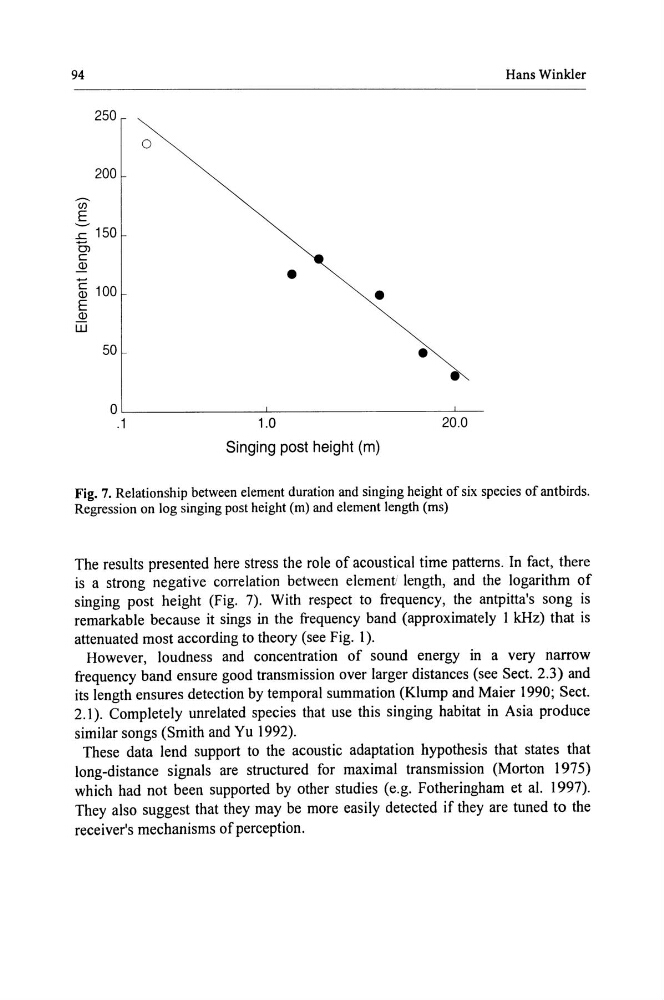
Fig. 7. Relationship between element duration and singing height of six species of ant birds.
Regression on log singing post height (m) and element length (ms)
The results presented here stress the role of acoustical time patterns. In fact, there
is a strong negative correlation between element! length, and the logarithm of
singing post height (Fig. 7). With respect to frequency, the antpitta's song is
remarkable because it sings in the frequency band (approximately I kHz) that is
attenuated most according to theory (see Fig. 1).
However, loudness and concentration of sound energy in a very narrow
frequency band ensure good transmission over larger distances (see Sect. 2.3) and
its length ensures detection by temporal summation (Klump and Maier 1990; Sect.
2.1 ). Completely unrelated species that use this singing habitat in Asia produce
similar songs (Smith and Yu 1992).
These data lend support to the acoustic adaptation hypothesis that states that
long-distance signals are structured for maximal transmission (Morton 1975)
which had not been supported by other studies (e.g. Fotheringham et al. 1997).
They also suggest that they may be more easily detected if they are tuned to the
receiver's mechanisms of perception.
Hans Winkler
250
0
200
Ci)
E
-:; 150
en c
~
•
c <1> 100
•
E
<1>
w
50
•
OL--------------L---------- --------~-.1
1.0
20.0
Singing post height (m)
Fig. 7. Relationship between element duration and singing height of six species of ant birds.
Regression on log singing post height (m) and element length (ms)
The results presented here stress the role of acoustical time patterns. In fact, there
is a strong negative correlation between element! length, and the logarithm of
singing post height (Fig. 7). With respect to frequency, the antpitta's song is
remarkable because it sings in the frequency band (approximately I kHz) that is
attenuated most according to theory (see Fig. 1).
However, loudness and concentration of sound energy in a very narrow
frequency band ensure good transmission over larger distances (see Sect. 2.3) and
its length ensures detection by temporal summation (Klump and Maier 1990; Sect.
2.1 ). Completely unrelated species that use this singing habitat in Asia produce
similar songs (Smith and Yu 1992).
These data lend support to the acoustic adaptation hypothesis that states that
long-distance signals are structured for maximal transmission (Morton 1975)
which had not been supported by other studies (e.g. Fotheringham et al. 1997).
They also suggest that they may be more easily detected if they are tuned to the
receiver's mechanisms of perception.