

Part F | 31.3
752 Part F Marine Derived Metabolites
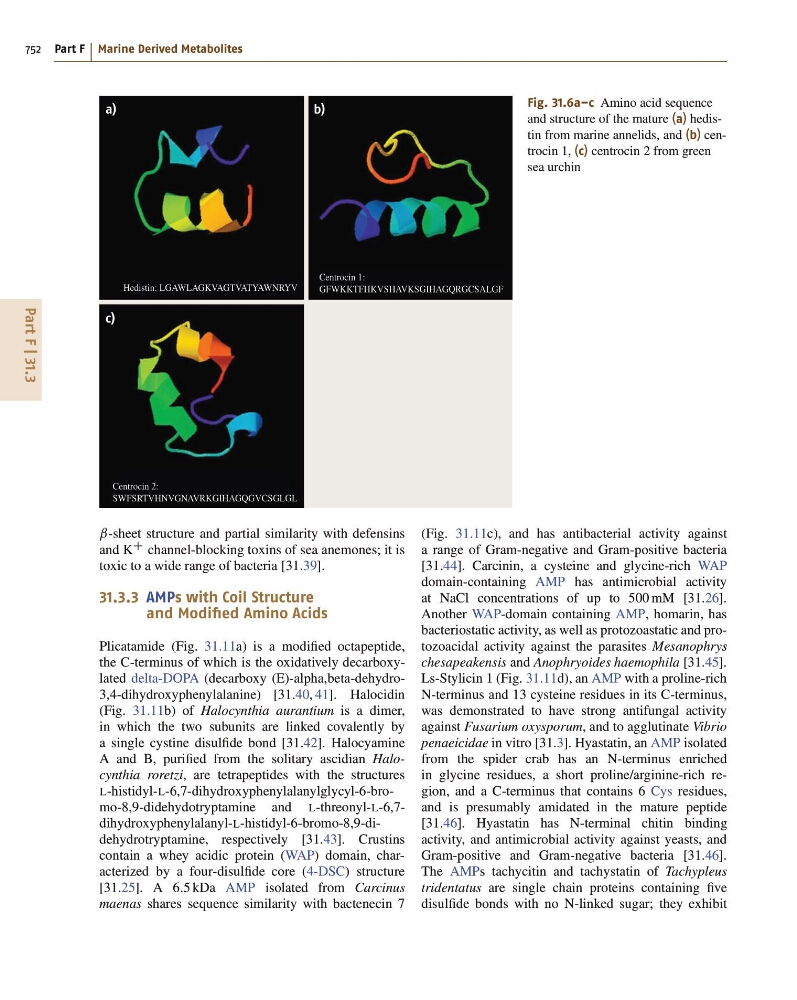
a)
b)
c)
Hedistin: LGAWLAGKVAGTVATYAWNRYV
Centrocin 1:
GFWKKTFHKVSHAVKSGIHAGQRGCSALGF
Centrocin 2:
SWFSRTVHNVGNAVRKGIHAGQGVCSGLGL
Fig. 31.6a–c Amino acid sequence
and structure of the mature (a) hedistin from marine annelids, and (b) centrocin 1, (c) centrocin 2 from green
sea urchin
ˇ-sheet structure and partial similarity with defensins
and K
C channel-blocking toxins of sea anemones; it is
toxic to a wide range of bacteria [31.39].
31.3.3 AMPs with Coil Structure
and Modified Amino Acids
Plicatamide (Fig. 31.11a) is a modified octapeptide,
the C-terminus of which is the oxidatively decarboxylated delta-DOPA (decarboxy (E)-alpha,beta-dehydro3,4-dihydroxyphenylalanine) [31.40, 41]. Halocidin
(Fig. 31.11b) of Halocynthia aurantium is a dimer,
in which the two subunits are linked covalently by
a single cystine disulfide bond [31.42]. Halocyamine
A and B, purified from the solitary ascidian Halocynthia roretzi, are tetrapeptides with the structures
L-histidyl-L-6,7-dihydroxyphenylalanylglycyl-6-bromo-8,9-didehydotryptamine
dihydroxyphenylalanyl-L-histidyl-6-bromo-8,9-didehydrotryptamine, respectively [31.43]. Crustins
contain a whey acidic protein (WAP) domain, characterized by a four-disulfide core (4-DSC) structure
[31.25]. A 6:5 kDa AMP isolated from Carcinus
maenas shares sequence similarity with bactenecin 7
(Fig. 31.11c), and has antibacterial activity against
a range of Gram-negative and Gram-positive bacteria
[31.44]. Carcinin, a cysteine and glycine-rich WAP
domain-containing AMP has antimicrobial activity
at NaCl concentrations of up to 500 mM [31.26].
Another WAP-domain containing AMP, homarin, has
bacteriostatic activity, as well as protozoastatic and protozoacidal activity against the parasites Mesanophrys
chesapeakensis and Anophryoides haemophila [31.45].
Ls-Stylicin 1 (Fig. 31.11d), an AMP with a proline-rich
N-terminus and 13 cysteine residues in its C-terminus,
was demonstrated to have strong antifungal activity
against Fusarium oxysporum, and to agglutinate Vibrio
penaeicidae in vitro [31.3]. Hyastatin, an AMP isolated
from the spider crab has an N-terminus enriched
in glycine residues, a short proline/arginine-rich region, and a C-terminus that contains 6 Cys residues,
and is presumably amidated in the mature peptide
[31.46]. Hyastatin has N-terminal chitin binding
activity, and antimicrobial activity against yeasts, and
Gram-positive and Gram-negative bacteria [31.46].
The AMPs tachycitin and tachystatin of Tachypleus
tridentatus are single chain proteins containing five
disulfide bonds with no N-linked sugar; they exhibit