

Antimicrobial Peptides from Marine Organisms 31.3 Characterization and Functions of AMP 751
Part F | 31.3
a)
b)
c)
d)
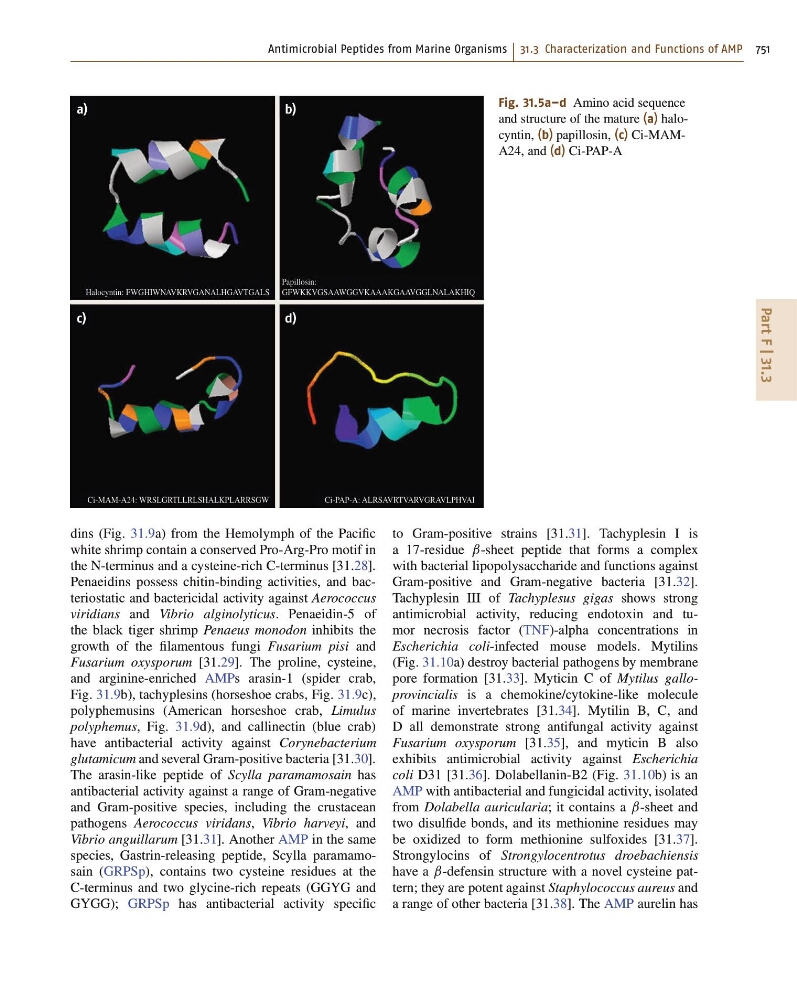
Halocyntin: FWGHIWNAVKRVGANALHGAVTGALS
Papillosin:
GFWKKVGSAAWGGVKAAAKGAAVGGLNALAKHIQ
Ci-MAM-A24: WRSLGRTLLRLSHALKPLARRSGW
Ci-PAP-A: ALRSAVRTVARVGRAVLPHVAI
Fig. 31.5a–d Amino acid sequence
and structure of the mature (a) halocyntin, (b) papillosin, (c) Ci-MAMA24, and (d) Ci-PAP-A
dins (Fig. 31.9a) from the Hemolymph of the Pacific
white shrimp contain a conserved Pro-Arg-Pro motif in
the N-terminus and a cysteine-rich C-terminus [31.28].
Penaeidins possess chitin-binding activities, and bacteriostatic and bactericidal activity against Aerococcus
viridians and Vibrio alginolyticus. Penaeidin-5 of
the black tiger shrimp Penaeus monodon inhibits the
growth of the filamentous fungi Fusarium pisi and
Fusarium oxysporum [31.29]. The proline, cysteine,
and arginine-enriched AMPs arasin-1 (spider crab,
Fig. 31.9b), tachyplesins (horseshoe crabs, Fig. 31.9c),
polyphemusins (American horseshoe crab, Limulus
polyphemus, Fig. 31.9d), and callinectin (blue crab)
have antibacterial activity against Corynebacterium
glutamicum and several Gram-positive bacteria [31.30].
The arasin-like peptide of Scylla paramamosain has
antibacterial activity against a range of Gram-negative
and Gram-positive species, including the crustacean
pathogens Aerococcus viridans, Vibrio harveyi, and
Vibrio anguillarum [31.31]. Another AMP in the same
species, Gastrin-releasing peptide, Scylla paramamosain (GRPSp), contains two cysteine residues at the
C-terminus and two glycine-rich repeats (GGYG and
GYGG); GRPSp has antibacterial activity specific
to Gram-positive strains [31.31]. Tachyplesin I is
a 17-residue ˇ-sheet peptide that forms a complex
with bacterial lipopolysaccharide and functions against
Gram-positive and Gram-negative bacteria [31.32].
Tachyplesin III of Tachyplesus gigas shows strong
antimicrobial activity, reducing endotoxin and tumor necrosis factor (TNF)-alpha concentrations in
Escherichia coli-infected mouse models. Mytilins
(Fig. 31.10a) destroy bacterial pathogens by membrane
pore formation [31.33]. Myticin C of Mytilus galloprovincialis is a chemokine/cytokine-like molecule
of marine invertebrates [31.34]. Mytilin B, C, and
D all demonstrate strong antifungal activity against
Fusarium oxysporum [31.35], and myticin B also
exhibits antimicrobial activity against Escherichia
coli D31 [31.36]. Dolabellanin-B2 (Fig. 31.10b) is an
AMP with antibacterial and fungicidal activity, isolated
from Dolabella auricularia; it contains a ˇ-sheet and
two disulfide bonds, and its methionine residues may
be oxidized to form methionine sulfoxides [31.37].
Strongylocins of Strongylocentrotus droebachiensis
have a ˇ-defensin structure with a novel cysteine pattern; they are potent against Staphylococcus aureus and
a range of other bacteria [31.38]. The AMP aurelin has