

Part F | 31.3
750 Part F Marine Derived Metabolites
a)
b)
c)
d)
Clavanin A: VFQFLGKIIHHVGNFVHGFSHVF
Clavanin B: VFQFLGRIIHHVGNFVHGFSHVF
Clavanin C: VFHLLGKIIHHVGNFVYGFSHVF
Clavanin D: AFKLLGRIIHHVGNFVYGFSHVF
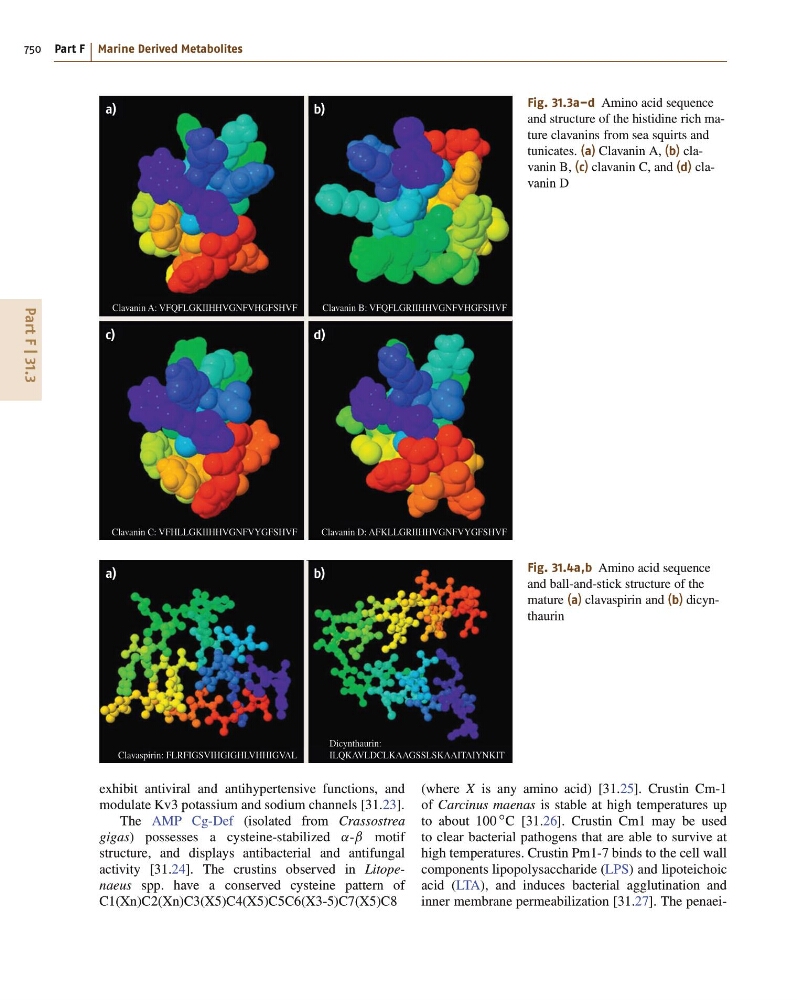
Fig. 31.3a–d Amino acid sequence
and structure of the histidine rich mature clavanins from sea squirts and
tunicates. (a) Clavanin A, (b) clavanin B, (c) clavanin C, and (d) clavanin D
a)
b)
Clavaspirin: FLRFIGSVIHGIGHLVHHIGVAL
Dicynthaurin:
ILQKAVLDCLKAAGSSLSKAAITAIYNKIT
Fig. 31.4a,b Amino acid sequence
and ball-and-stick structure of the
mature (a) clavaspirin and (b) dicynthaurin
exhibit antiviral and antihypertensive functions, and
modulate Kv3 potassium and sodium channels [31.23].
The AMP Cg-Def (isolated from Crassostrea
gigas) possesses a cysteine-stabilized ˛-ˇ motif
structure, and displays antibacterial and antifungal
activity [31.24]. The crustins observed in Litopenaeus spp. have a conserved cysteine pattern of
C1(Xn)C2(Xn)C3(X5)C4(X5)C5C6(X3-5)C7(X5)C8
(where X is any amino acid) [31.25]. Crustin Cm-1
of Carcinus maenas is stable at high temperatures up
to about 100
ı C [31.26]. Crustin Cm1 may be used
to clear bacterial pathogens that are able to survive at
high temperatures. Crustin Pm1-7 binds to the cell wall
components lipopolysaccharide (LPS) and lipoteichoic
acid (LTA), and induces bacterial agglutination and
inner membrane permeabilization [31.27]. The penaei-