

Antimicrobial Peptides from Marine Organisms 31.3 Characterization and Functions of AMP 749
Part F | 31.3
a)
b)
d)
c)
e)
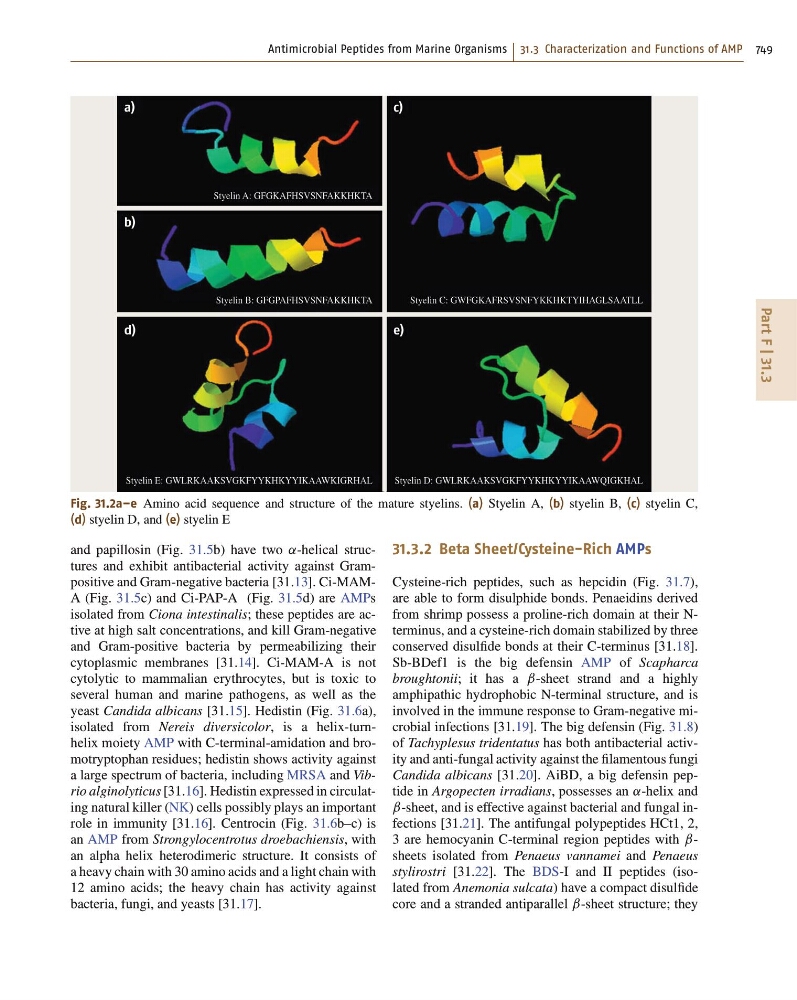
Styelin A: GFGKAFHSVSNFAKKHKTA
Styelin B: GFGPAFHSVSNFAKKHKTA
Styelin C: GWFGKAFRSVSNFYKKHKTYIHAGLSAATLL
Styelin E: GWLRKAAKSVGKFYYKHKYYIKAAWKIGRHAL
Styelin D: GWLRKAAKSVGKFYYKHKYYIKAAWQIGKHAL
Fig. 31.2a–e Amino acid sequence and structure of the mature styelins. (a) Styelin A, (b) styelin B, (c) styelin C,
(d) styelin D, and (e) styelin E
and papillosin (Fig. 31.5b) have two ˛-helical structures and exhibit antibacterial activity against Grampositive and Gram-negative bacteria [31.13]. Ci-MAMA (Fig. 31.5c) and Ci-PAP-A (Fig. 31.5d) are AMPs
isolated from Ciona intestinalis; these peptides are active at high salt concentrations, and kill Gram-negative
and Gram-positive bacteria by permeabilizing their
cytoplasmic membranes [31.14]. Ci-MAM-A is not
cytolytic to mammalian erythrocytes, but is toxic to
several human and marine pathogens, as well as the
yeast Candida albicans [31.15]. Hedistin (Fig. 31.6a),
isolated from Nereis diversicolor, is a helix-turnhelix moiety AMP with C-terminal-amidation and bromotryptophan residues; hedistin shows activity against
a large spectrum of bacteria, including MRSA and Vibrio alginolyticus [31.16]. Hedistin expressed in circulating natural killer (NK) cells possibly plays an important
role in immunity [31.16]. Centrocin (Fig. 31.6b–c) is
an AMP from Strongylocentrotus droebachiensis, with
an alpha helix heterodimeric structure. It consists of
a heavy chain with 30 amino acids and a light chain with
12 amino acids; the heavy chain has activity against
bacteria, fungi, and yeasts [31.17].
31.3.2 Beta Sheet/Cysteine-Rich AMPs
Cysteine-rich peptides, such as hepcidin (Fig. 31.7),
are able to form disulphide bonds. Penaeidins derived
from shrimp possess a proline-rich domain at their Nterminus, and a cysteine-rich domain stabilized by three
conserved disulfide bonds at their C-terminus [31.18].
Sb-BDef1 is the big defensin AMP of Scapharca
broughtonii; it has a ˇ-sheet strand and a highly
amphipathic hydrophobic N-terminal structure, and is
involved in the immune response to Gram-negative microbial infections [31.19]. The big defensin (Fig. 31.8)
of Tachyplesus tridentatus has both antibacterial activity and anti-fungal activity against the filamentous fungi
Candida albicans [31.20]. AiBD, a big defensin peptide in Argopecten irradians, possesses an ˛-helix and
ˇ-sheet, and is effective against bacterial and fungal infections [31.21]. The antifungal polypeptides HCt1, 2,
3 are hemocyanin C-terminal region peptides with ˇsheets isolated from Penaeus vannamei and Penaeus
stylirostri [31.22]. The BDS-I and II peptides (isolated from Anemonia sulcata) have a compact disulfide
core and a stranded antiparallel ˇ-sheet structure; they