

Part F | 31.3
748 Part F Marine Derived Metabolites
31.2 Isolation of Antimicrobial Peptides
Biochemical, bioinformatic, and genetic approaches
have been used to identify and isolate AMPs. A biochemical approach involving solid phase extraction,
followed by reverse phase high-performance liquid
chromatography (HPLC) and size exclusion chromatography, was utilized to isolate a 2:7 kDa AMP from
Penaeus vannamei, and 7:9 kDa and 8:3 kDa AMPs
from Penaeus stylirostris [31.1].
The samples were acidified to a pH of up to 4:0
and then neutralized, before being stepwise eluted with
5, 40, and 80% aceto-nitrile water and subsequently
lyopolized. Then fractions from reverse phase HPLC
were collected separately, and the antimicrobial activity of the fractions were determined; active fractions
were then further purified by size exclusion chromatography. Bioinformatics has been used to predict AMPs
by in silico analysis; by comparing a candidate sequence to those of AMPs in an available database,
it has been possible to identify AMPs like CsHepcidin from the half-smooth tongue sole, Cynoglossus
semilaevis [31.2]. Finally, a genetic approach involving
analysis of the transcriptome from shrimp Litopenaeus
stylirostris that survived Vibrio penaeicidae infection
was used to identify the AMP Ls-stylicin [31.3].
31.3 Characterization and Functions of AMP
Nuclear magnetic resonance (NMR) spectroscopy has
been used to reveal the three-dimensional structure of
AMPs [31.4]. Based on their structure, AMPs can be
divided into five groups: peptides with ˛-helix structures, peptides with ˇ-sheets and cysteines, peptides
enriched for regular amino acids, peptides enriched
for modified and rare amino acids, and ring structured
amino acid peptides (which may result in a cyclic structure) [31.5]. Most marine AMPs of the ˇ-sheet class
exhibit antimicrobial function against Gram-positive
and Gram-negative bacteria, and a few exhibit antiviral and antifungal activities. The ˛-helix AMPs are
well known for their antimicrobial function at very
low concentrations, but this comes with the drawback of high cytotoxicity. Cyclic AMPs form a ring
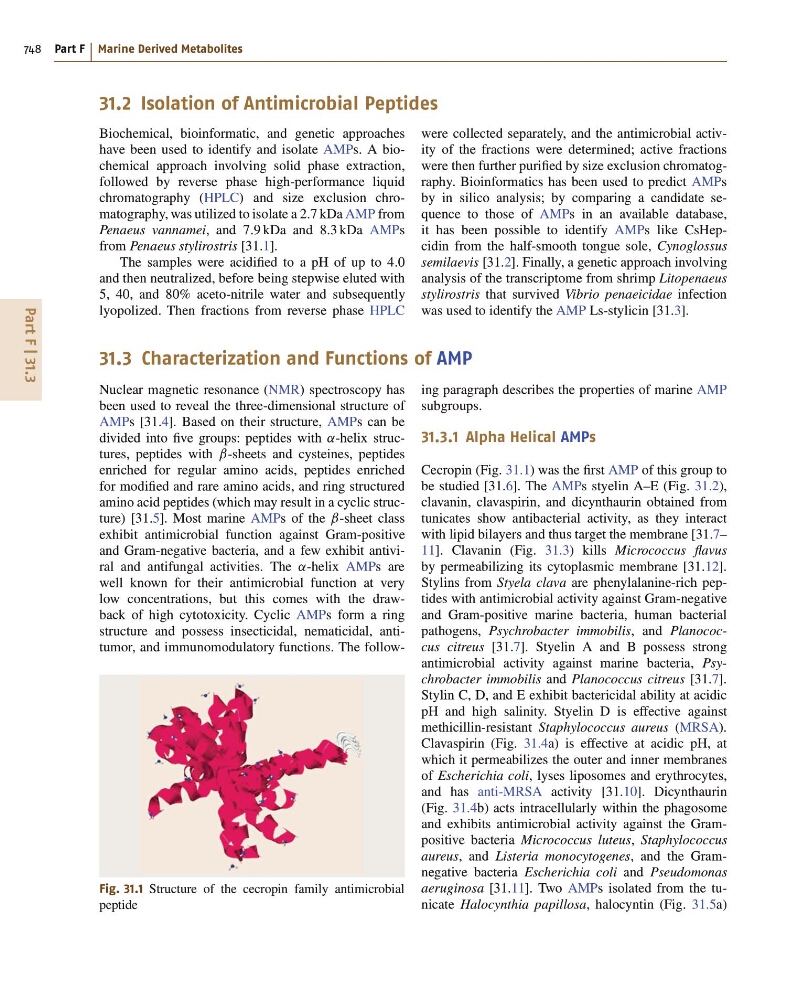
structure and possess insecticidal, nematicidal, antitumor, and immunomodulatory functions. The followFig. 31.1 Structure of the cecropin family antimicrobial
peptide
ing paragraph describes the properties of marine AMP
subgroups.
31.3.1 Alpha Helical AMPs
Cecropin (Fig. 31.1) was the first AMP of this group to
be studied [31.6]. The AMPs styelin A–E (Fig. 31.2),
clavanin, clavaspirin, and dicynthaurin obtained from
tunicates show antibacterial activity, as they interact
with lipid bilayers and thus target the membrane [31.7–
11]. Clavanin (Fig. 31.3) kills Micrococcus flavus
by permeabilizing its cytoplasmic membrane [31.12].
Stylins from Styela clava are phenylalanine-rich peptides with antimicrobial activity against Gram-negative
and Gram-positive marine bacteria, human bacterial
pathogens, Psychrobacter immobilis, and Planococcus citreus [31.7]. Styelin A and B possess strong
antimicrobial activity against marine bacteria, Psychrobacter immobilis and Planococcus citreus [31.7].
Stylin C, D, and E exhibit bactericidal ability at acidic
pH and high salinity. Styelin D is effective against
methicillin-resistant Staphylococcus aureus (MRSA).
Clavaspirin (Fig. 31.4a) is effective at acidic pH, at
which it permeabilizes the outer and inner membranes
of Escherichia coli, lyses liposomes and erythrocytes,
and has anti-MRSA activity [31.10]. Dicynthaurin
(Fig. 31.4b) acts intracellularly within the phagosome
and exhibits antimicrobial activity against the Grampositive bacteria Micrococcus luteus, Staphylococcus
aureus, and Listeria monocytogenes, and the Gramnegative bacteria Escherichia coli and Pseudomonas
aeruginosa [31.11]. Two AMPs isolated from the tunicate Halocynthia papillosa, halocyntin (Fig. 31.5a)