

Diversity of Marine Phototrophs References 33
Part A | 3
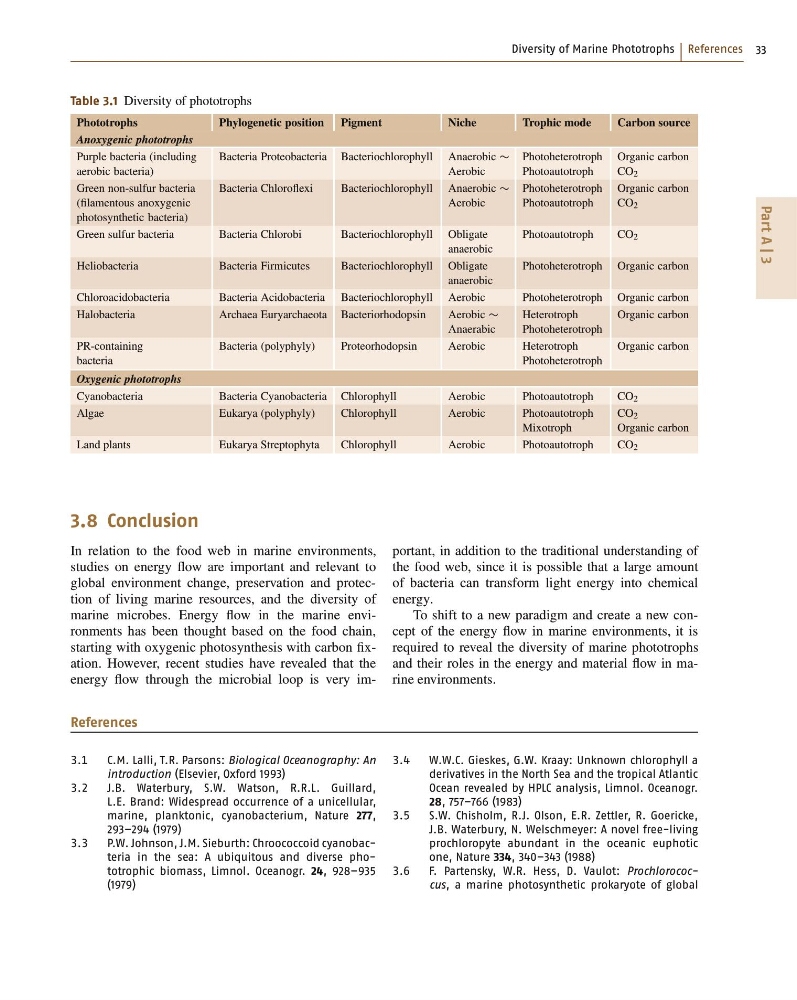
Table 3.1 Diversity of phototrophs
Phototrophs
Phylogenetic position Pigment
Niche
Trophic mode
Carbon source
Anoxygenic phototrophs
Purple bacteria (including
aerobic bacteria)
Bacteria Proteobacteria Bacteriochlorophyll Anaerobic
Aerobic
Photoheterotroph
Photoautotroph
Organic carbon
CO 2
Green non-sulfur bacteria
(filamentous anoxygenic
photosynthetic bacteria)
Bacteria Chloroflexi
Bacteriochlorophyll Anaerobic
Aerobic
Photoheterotroph
Photoautotroph
Organic carbon
CO 2
Green sulfur bacteria
Bacteria Chlorobi
Bacteriochlorophyll Obligate
anaerobic
Photoautotroph
CO 2
Heliobacteria
Bacteria Firmicutes
Bacteriochlorophyll Obligate
anaerobic
Photoheterotroph Organic carbon
Chloroacidobacteria
Bacteria Acidobacteria Bacteriochlorophyll Aerobic
Photoheterotroph Organic carbon
Halobacteria
Archaea Euryarchaeota Bacteriorhodopsin
Aerobic
Anaerabic
Heterotroph
Photoheterotroph
Organic carbon
PR-containing
bacteria
Bacteria (polyphyly)
Proteorhodopsin
Aerobic
Heterotroph
Photoheterotroph
Organic carbon
Oxygenic phototrophs
Cyanobacteria
Bacteria Cyanobacteria Chlorophyll
Aerobic
Photoautotroph
CO 2
Algae
Eukarya (polyphyly)
Chlorophyll
Aerobic
Photoautotroph
Mixotroph
CO 2
Organic carbon
Land plants
Eukarya Streptophyta
Chlorophyll
Aerobic
Photoautotroph
CO 2
3.8 Conclusion
In relation to the food web in marine environments,
studies on energy flow are important and relevant to
global environment change, preservation and protection of living marine resources, and the diversity of
marine microbes. Energy flow in the marine environments has been thought based on the food chain,
starting with oxygenic photosynthesis with carbon fixation. However, recent studies have revealed that the
energy flow through the microbial loop is very important, in addition to the traditional understanding of
the food web, since it is possible that a large amount
of bacteria can transform light energy into chemical
energy.
To shift to a new paradigm and create a new concept of the energy flow in marine environments, it is
required to reveal the diversity of marine phototrophs
and their roles in the energy and material flow in marine environments.
References
3.1
C.M. Lalli, T.R. Parsons: Biological Oceanography: An
introduction (Elsevier, Oxford 1993)
3.2
J.B. Waterbury, S.W. Watson, R.R.L. Guillard,
L.E. Brand: Widespread occurrence of a unicellular,
marine, planktonic, cyanobacterium, Nature 277,
293–294 (1979)
3.3
P.W. Johnson, J.M. Sieburth: Chroococcoid cyanobacteria in the sea: A ubiquitous and diverse phototrophic biomass, Limnol. Oceanogr. 24, 928–935
(1979)
3.4
W.W.C. Gieskes, G.W. Kraay: Unknown chlorophyll a
derivatives in the North Sea and the tropical Atlantic
Ocean revealed by HPLC analysis, Limnol. Oceanogr.
28, 757–766 (1983)
3.5
S.W. Chisholm, R.J. Olson, E.R. Zettler, R. Goericke,
J.B. Waterbury, N. Welschmeyer: A novel free-living
prochloropyte abundant in the oceanic euphotic
one, Nature 334, 340–343 (1988)
3.6
F. Partensky, W.R. Hess, D. Vaulot: Prochlorococcus, a marine photosynthetic prokaryote of global
Part A | 3
Table 3.1 Diversity of phototrophs
Phototrophs
Phylogenetic position Pigment
Niche
Trophic mode
Carbon source
Anoxygenic phototrophs
Purple bacteria (including
aerobic bacteria)
Bacteria Proteobacteria Bacteriochlorophyll Anaerobic
Aerobic
Photoheterotroph
Photoautotroph
Organic carbon
CO 2
Green non-sulfur bacteria
(filamentous anoxygenic
photosynthetic bacteria)
Bacteria Chloroflexi
Bacteriochlorophyll Anaerobic
Aerobic
Photoheterotroph
Photoautotroph
Organic carbon
CO 2
Green sulfur bacteria
Bacteria Chlorobi
Bacteriochlorophyll Obligate
anaerobic
Photoautotroph
CO 2
Heliobacteria
Bacteria Firmicutes
Bacteriochlorophyll Obligate
anaerobic
Photoheterotroph Organic carbon
Chloroacidobacteria
Bacteria Acidobacteria Bacteriochlorophyll Aerobic
Photoheterotroph Organic carbon
Halobacteria
Archaea Euryarchaeota Bacteriorhodopsin
Aerobic
Anaerabic
Heterotroph
Photoheterotroph
Organic carbon
PR-containing
bacteria
Bacteria (polyphyly)
Proteorhodopsin
Aerobic
Heterotroph
Photoheterotroph
Organic carbon
Oxygenic phototrophs
Cyanobacteria
Bacteria Cyanobacteria Chlorophyll
Aerobic
Photoautotroph
CO 2
Algae
Eukarya (polyphyly)
Chlorophyll
Aerobic
Photoautotroph
Mixotroph
CO 2
Organic carbon
Land plants
Eukarya Streptophyta
Chlorophyll
Aerobic
Photoautotroph
CO 2
3.8 Conclusion
In relation to the food web in marine environments,
studies on energy flow are important and relevant to
global environment change, preservation and protection of living marine resources, and the diversity of
marine microbes. Energy flow in the marine environments has been thought based on the food chain,
starting with oxygenic photosynthesis with carbon fixation. However, recent studies have revealed that the
energy flow through the microbial loop is very important, in addition to the traditional understanding of
the food web, since it is possible that a large amount
of bacteria can transform light energy into chemical
energy.
To shift to a new paradigm and create a new concept of the energy flow in marine environments, it is
required to reveal the diversity of marine phototrophs
and their roles in the energy and material flow in marine environments.
References
3.1
C.M. Lalli, T.R. Parsons: Biological Oceanography: An
introduction (Elsevier, Oxford 1993)
3.2
J.B. Waterbury, S.W. Watson, R.R.L. Guillard,
L.E. Brand: Widespread occurrence of a unicellular,
marine, planktonic, cyanobacterium, Nature 277,
293–294 (1979)
3.3
P.W. Johnson, J.M. Sieburth: Chroococcoid cyanobacteria in the sea: A ubiquitous and diverse phototrophic biomass, Limnol. Oceanogr. 24, 928–935
(1979)
3.4
W.W.C. Gieskes, G.W. Kraay: Unknown chlorophyll a
derivatives in the North Sea and the tropical Atlantic
Ocean revealed by HPLC analysis, Limnol. Oceanogr.
28, 757–766 (1983)
3.5
S.W. Chisholm, R.J. Olson, E.R. Zettler, R. Goericke,
J.B. Waterbury, N. Welschmeyer: A novel free-living
prochloropyte abundant in the oceanic euphotic
one, Nature 334, 340–343 (1988)
3.6
F. Partensky, W.R. Hess, D. Vaulot: Prochlorococcus, a marine photosynthetic prokaryote of global