

Part F | 30.4
738 Part F Marine Derived Metabolites
OH
R = α-linked
mono, di-, tri-, and tetraglucose
O
O
O
OH
1
2
3
1-phenyl-1,2-ethanediol
O
O
O
HO
HO
O
HO
OH
HO
HO
O
HO OH
HO
H 3 C
OH
O
O
O
OH
R
O
HO
O
CH 3
H 3 C
CH 3
CH 3
O
O
O
HO
HO
O
HO
O
HO
HO
O
HO
OH
HO
HO
O
HO OH
HO
H 3 C
OH
OH
2-(3-hydroxyphenyl)-ethanol
OH
OH
2-(2-hydroxyphenyl)ethanol
OH
OH
Hydroxytyrosol
OH
OH
HO
4-(2-methoxyethyl)-phenol
O CH 3
HO
2-phenyl ethanol
OH
Tyrosol
OH
HO
N-acetyl-L-tyrosine ethyl ester
O
HO
NH
Ac
O CH 3
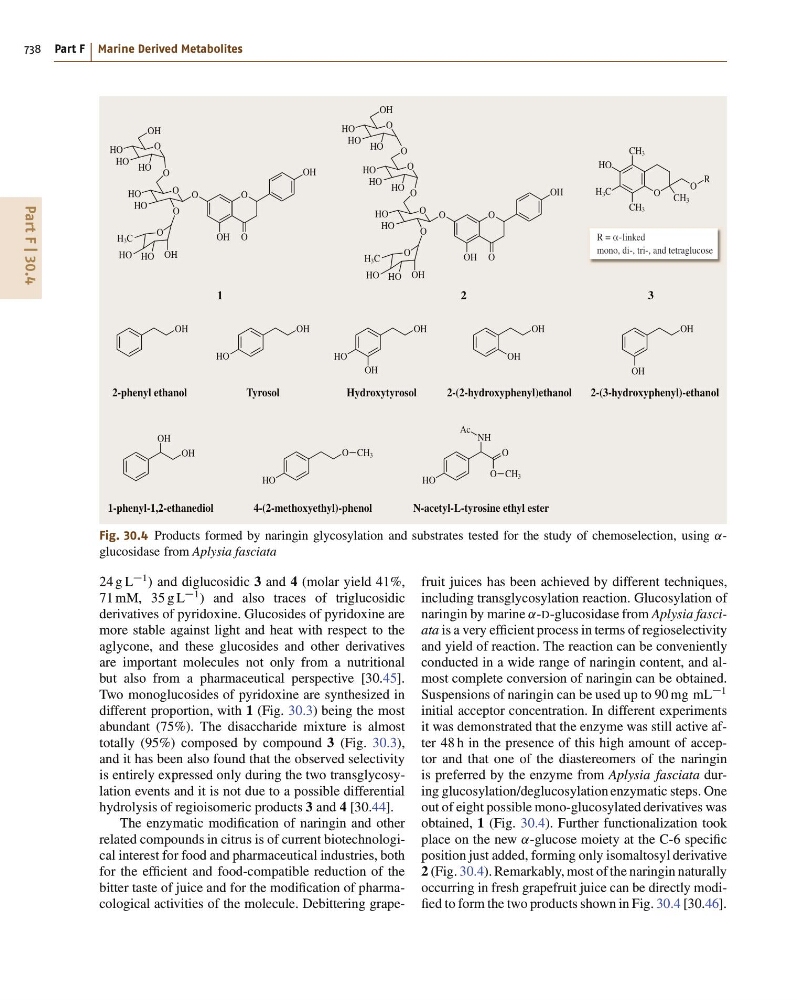
Fig. 30.4 Products formed by naringin glycosylation and substrates tested for the study of chemoselection, using ˛glucosidase from Aplysia fasciata
24 g L
1 ) and diglucosidic 3 and 4 (molar yield 41%,
71 mM, 35 g L
1 ) and also traces of triglucosidic
derivatives of pyridoxine. Glucosides of pyridoxine are
more stable against light and heat with respect to the
aglycone, and these glucosides and other derivatives
are important molecules not only from a nutritional
but also from a pharmaceutical perspective [30.45].
Two monoglucosides of pyridoxine are synthesized in
different proportion, with 1 (Fig. 30.3) being the most
abundant (75%). The disaccharide mixture is almost
totally (95%) composed by compound 3 (Fig. 30.3),
and it has been also found that the observed selectivity
is entirely expressed only during the two transglycosylation events and it is not due to a possible differential
hydrolysis of regioisomeric products 3 and 4 [30.44].
The enzymatic modification of naringin and other
related compounds in citrus is of current biotechnological interest for food and pharmaceutical industries, both
for the efficient and food-compatible reduction of the
bitter taste of juice and for the modification of pharmacological activities of the molecule. Debittering grapefruit juices has been achieved by different techniques,
including transglycosylation reaction. Glucosylation of
naringin by marine ˛-D-glucosidase from Aplysia fasciata is a very efficient process in terms of regioselectivity
and yield of reaction. The reaction can be conveniently
conducted in a wide range of naringin content, and almost complete conversion of naringin can be obtained.
Suspensions of naringin can be used up to 90 mg mL
1
initial acceptor concentration. In different experiments
it was demonstrated that the enzyme was still active after 48 h in the presence of this high amount of acceptor and that one of the diastereomers of the naringin
is preferred by the enzyme from Aplysia fasciata during glucosylation/deglucosylation enzymatic steps. One
out of eight possible mono-glucosylated derivatives was
obtained, 1 (Fig. 30.4). Further functionalization took
place on the new ˛-glucose moiety at the C-6 specific
position just added, forming only isomaltosyl derivative
2 (Fig. 30.4). Remarkably, most of the naringin naturally
occurring in fresh grapefruit juice can be directly modified to form the two products shown in Fig. 30.4 [30.46].