

Biocatalysts from Aplysia 30.4 Glycoside Hydrolases Present in the Genus Aplysia 737
Part F | 30.4
O
O
1
2
OH
HO
O
O
OH
OH
HO
HO
HO
HO
O
OH
HO
HO
HO
O
OH
OH
OH
O
O
O
H
OH
OH
OH
OH
OH
HO
HO
O
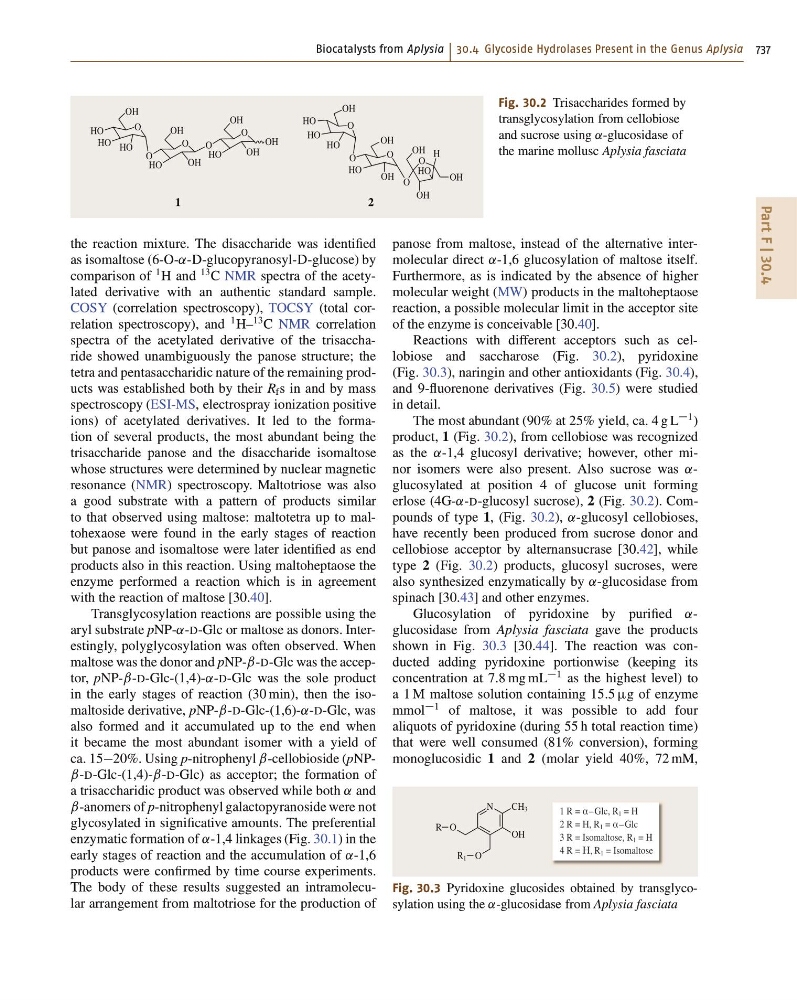
Fig. 30.2 Trisaccharides formed by
transglycosylation from cellobiose
and sucrose using ˛-glucosidase of
the marine mollusc Aplysia fasciata
the reaction mixture. The disaccharide was identified
as isomaltose (6-O-˛-D-glucopyranosyl-D-glucose) by
comparison of
1 H and
13 C NMR spectra of the acetylated derivative with an authentic standard sample.
COSY (correlation spectroscopy), TOCSY (total correlation spectroscopy), and
1 H–
13 C NMR correlation
spectra of the acetylated derivative of the trisaccharide showed unambiguously the panose structure; the
tetra and pentasaccharidic nature of the remaining products was established both by their R f s in and by mass
spectroscopy (ESI-MS, electrospray ionization positive
ions) of acetylated derivatives. It led to the formation of several products, the most abundant being the
trisaccharide panose and the disaccharide isomaltose
whose structures were determined by nuclear magnetic
resonance (NMR) spectroscopy. Maltotriose was also
a good substrate with a pattern of products similar
to that observed using maltose: maltotetra up to maltohexaose were found in the early stages of reaction
but panose and isomaltose were later identified as end
products also in this reaction. Using maltoheptaose the
enzyme performed a reaction which is in agreement
with the reaction of maltose [30.40].
Transglycosylation reactions are possible using the
aryl substrate pNP-˛-D-Glc or maltose as donors. Interestingly, polyglycosylation was often observed. When
maltose was the donor and pNP-ˇ-D-Glc was the acceptor, pNP-ˇ-D-Glc-(1,4)-˛-D-Glc was the sole product
in the early stages of reaction (30 min), then the isomaltoside derivative, pNP-ˇ-D-Glc-(1,6)-˛-D-Glc, was
also formed and it accumulated up to the end when
it became the most abundant isomer with a yield of
ca. 1520%. Using p-nitrophenyl ˇ-cellobioside (pNPˇ-D-Glc-(1,4)-ˇ-D-Glc) as acceptor; the formation of
a trisaccharidic product was observed while both ˛ and
ˇ-anomers of p-nitrophenyl galactopyranoside were not
glycosylated in significative amounts. The preferential
enzymatic formation of ˛-1,4 linkages (Fig. 30.1) in the
early stages of reaction and the accumulation of ˛-1,6
products were confirmed by time course experiments.
The body of these results suggested an intramolecular arrangement from maltotriose for the production of
panose from maltose, instead of the alternative intermolecular direct ˛-1,6 glucosylation of maltose itself.
Furthermore, as is indicated by the absence of higher
molecular weight (MW) products in the maltoheptaose
reaction, a possible molecular limit in the acceptor site
of the enzyme is conceivable [30.40].
Reactions with different acceptors such as cellobiose and saccharose (Fig. 30.2), pyridoxine
(Fig. 30.3), naringin and other antioxidants (Fig. 30.4),
and 9-fluorenone derivatives (Fig. 30.5) were studied
in detail.
The most abundant (90% at 25% yield, ca. 4 g L
1 )
product, 1 (Fig. 30.2), from cellobiose was recognized
as the ˛-1,4 glucosyl derivative; however, other minor isomers were also present. Also sucrose was ˛glucosylated at position 4 of glucose unit forming
erlose (4G-˛-D-glucosyl sucrose), 2 (Fig. 30.2). Compounds of type 1, (Fig. 30.2), ˛-glucosyl cellobioses,
have recently been produced from sucrose donor and
cellobiose acceptor by alternansucrase [30.42], while
type 2 (Fig. 30.2) products, glucosyl sucroses, were
also synthesized enzymatically by ˛-glucosidase from
spinach [30.43] and other enzymes.
Glucosylation of pyridoxine by purified ˛glucosidase from Aplysia fasciata gave the products
shown in Fig. 30.3 [30.44]. The reaction was conducted adding pyridoxine portionwise (keeping its
concentration at 7:8 mg mL
1 as the highest level) to
a 1 M maltose solution containing 15:5 g of enzyme
mmol
1 of maltose, it was possible to add four
aliquots of pyridoxine (during 55 h total reaction time)
that were well consumed (81% conversion), forming
monoglucosidic 1 and 2 (molar yield 40%, 72 mM,
CH 3
1 R = α–Glc, R 1 = H
2 R = H, R 1 = α–Glc
3 R = Isomaltose, R 1 = H
4 R = H, R 1 = Isomaltose
OH
O
R
N
O
R 1
Fig. 30.3 Pyridoxine glucosides obtained by transglycosylation using the ˛-glucosidase from Aplysia fasciata