

Part F | 30.4
736 Part F Marine Derived Metabolites
Products of various molecular structures, from simple alkyl glucosides to different complex oligosaccharides used in industrial applications, are enzymatically
synthesized by the use of ˛-glucosidases of bacterial,
fungal, animal, and vegetal origin [30.1]. The ˇ-Dglucosidase activity was the most abundant glycosyl hydrolase activity found in the visceral mass homogenate
of Aplysia fasciata. The purified enzyme gave only one
band of 69 kDa on SDS-PAGE (SDS: sodium dodecyl
sulphate, PAGE: polyacrylamide gel electrophoresis),
while the molecular mass of the native enzyme was
255 kDa, indicating that this protein is a homotetramer.
It showed a pH optimum at 5:8, and the optimum temperature at this pH was in the range 3644
ı C; pH 5:8
and 34
ı C were identified as the best conditions for
performing both hydrolytic and transglycosylation experiments [30.40]. Organic solvent resistance was also
of interest in view of the low solubility of aryl substrates
that can be used as donors and for conceivable use of
hydrophobic acceptors in transglycosylation reactions.
Enzymatic resistance to organic solvents was studied at
10% concentration. A good resistance of the enzyme to
dimethyl sulfoxide (DMSO, 80% residual activity after
24 h), high sensitivity to acetonitrile and dimethylformamide (DMF, total loss of activity after few minutes),
and an intermediate resistance to acetone (50% residual activity after 24 h) were recorded. The study of
substrate specificity started using starch, amylopectin,
amylose, isomaltose, panose, pullulan, and saccharose were not hydrolyzed by this enzyme, although
a feeble reaction using trehalose was observed. Moreover, no enzymatic hydration of glucal (with formation
of 2-deoxyglucose) was detectable. Nitrophenyl glucoside (pNP-˛-D-Glc) and the ˛-maltoside derivative
(pNP-˛-D-Glc-(1,4)-˛-D-Glc) were highly hydrolyzed,
while the ˇ-form (pNP-ˇ-D-Glc-(1,4)-˛-D-Glc) was
hydrolyzed to a lesser extent. The ˛-glucosidase from
Aplysia fasciata was very active on the ˛-1,4 glucosidic linkage, as it was assessed by measuring the
kinetic parameters for the hydrolysis of maltose (V max
115 U mg
1 , K M 5:70 mM, k cat 489 s
1 ), pNP-˛-D-Glc
(k M 0:26 mM, k cat 163 s
1 ), and pNP-ˇ-D-Glc-(1,4)˛-D-Glc (k M 2:06 mM, k cat 75:9 s
1 ). The ˛-1,6 glucosidic linkage was only poorly hydrolyzed as it was
noticed that the specific activity for maltose was 40
times higher than that for isomaltose (V max 2:9 U mg
1
by using 22 mM substrate). According to the Michaelis
constants for pNP-˛-D-Glc and maltose, it could be
suggested that the subsite C1 of this enzyme has a
higher affinity for the aryl group than for glucosyl
residue. Although the k cat value for maltose was three
times higher than that for pNP-˛-D-Glc, the catalytic
efficiency showed that in vitro the former is the preferred substrate for this enzyme (k cat =k M D 627 mM
1
s
1
/. A still good catalytic efficiency was observed in
the hydrolysis of pNP-ˇ-D-Glc-(1,4)-˛-Glc (k cat =K M
36:8 mM
1 s
1 ), while no hydrolytic activity was detected when the pure enzyme was incubated in the
presence of pNP-ˇ-D-Gal or pNP-ˇ-D-Man. This overall picture of substrate specificity, together with the fact
that this enzyme is not able to hydrate glucal, suggested
that the enzyme from Aplysia fasciata may belong to
family I type ˛-glucosidases [30.41], corresponding to
family 13 of glycoside hydrolases (GH), however sequence similarity studies are necessary to establish this.
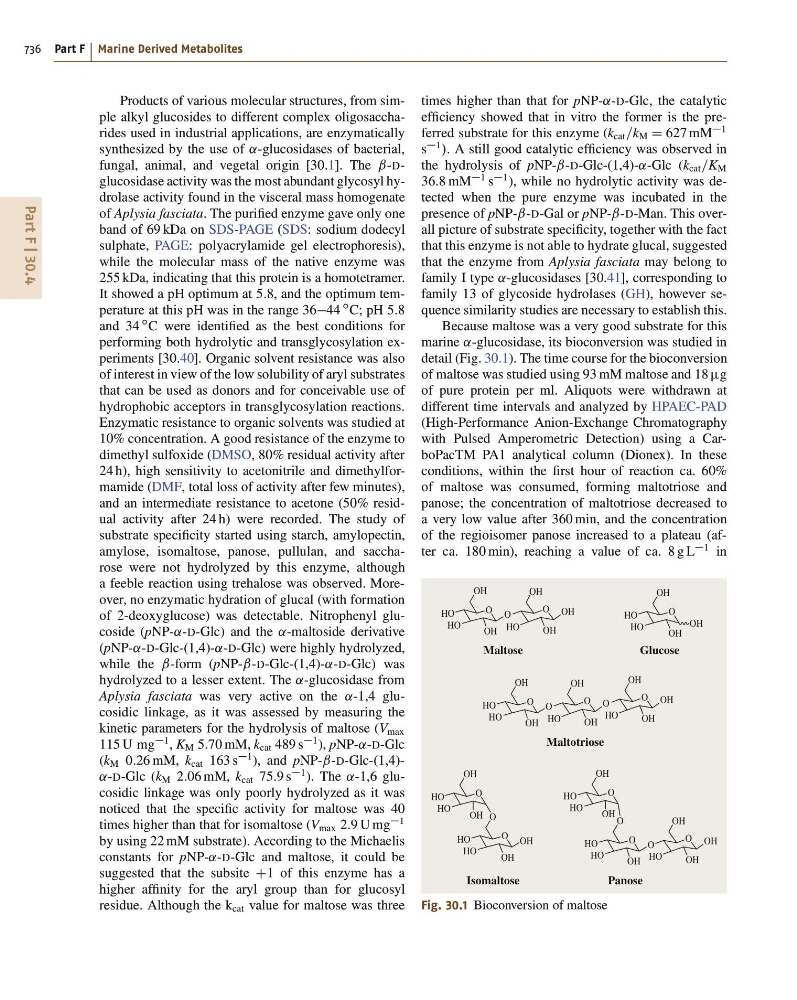
Because maltose was a very good substrate for this
marine ˛-glucosidase, its bioconversion was studied in
detail (Fig. 30.1). The time course for the bioconversion
of maltose was studied using 93 mM maltose and 18 g
of pure protein per ml. Aliquots were withdrawn at
different time intervals and analyzed by HPAEC-PAD
(High-Performance Anion-Exchange Chromatography
with Pulsed Amperometric Detection) using a CarboPacTM PA1 analytical column (Dionex). In these
conditions, within the first hour of reaction ca. 60%
of maltose was consumed, forming maltotriose and
panose; the concentration of maltotriose decreased to
a very low value after 360 min, and the concentration
of the regioisomer panose increased to a plateau (after ca. 180 min), reaching a value of ca. 8 g L
1 in
O O
Maltose
Panose
Maltotriose
OH
OH
O
OH
OH
OH
HO
HO
O
OH
OH
OH
HO
HO
O
OH
OH
HO
HO
O O
O
OH
HO
HO
O
O
Isomaltose
OH
OH
HO
HO
O
OH
Glucose
OH
OH
HO
HO
O OH
OH
HO
HO
O O
OH
OH
O
OH
OH
O
HO
HO
O
OH
OH
OH
HO
HO
Fig. 30.1 Bioconversion of maltose