

Drugs and Leads from the Ocean Through Biotechnology 29.5 Marine Natural Products: New and Recurrent Challenges 723
Part F | 29.5
are absent in S. pacifica. From these results salinosporamide K was isolated, which structurally resembles
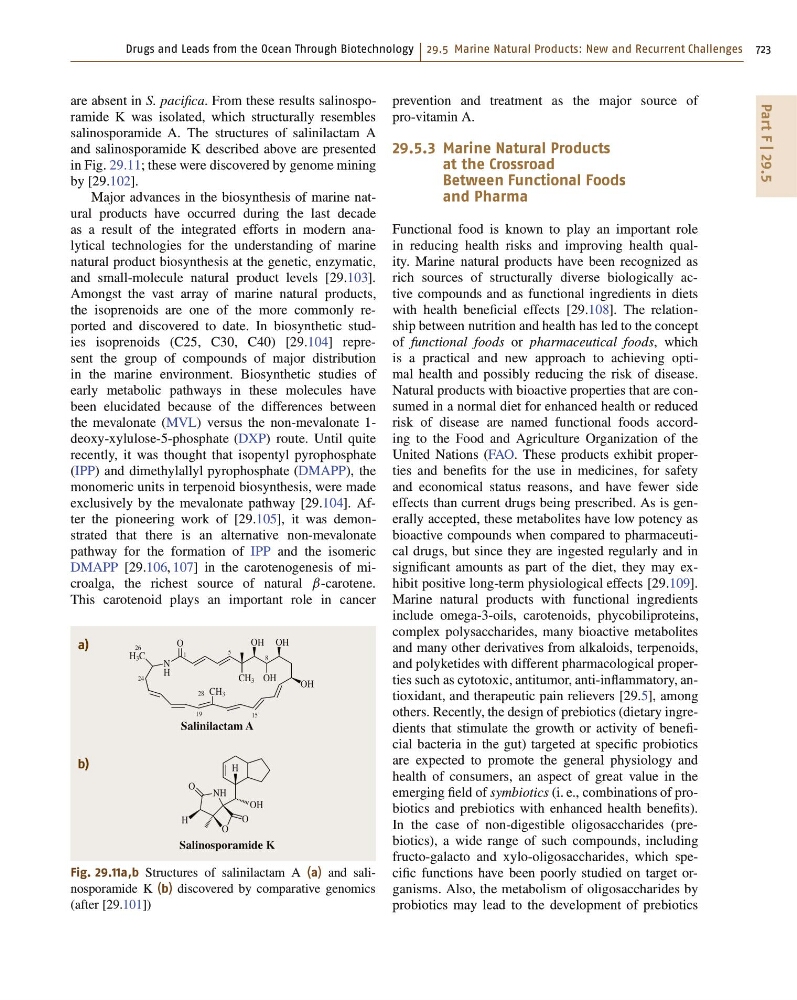
salinosporamide A. The structures of salinilactam A
and salinosporamide K described above are presented
in Fig. 29.11; these were discovered by genome mining
by [29.102].
Major advances in the biosynthesis of marine natural products have occurred during the last decade
as a result of the integrated efforts in modern analytical technologies for the understanding of marine
natural product biosynthesis at the genetic, enzymatic,
and small-molecule natural product levels [29.103].
Amongst the vast array of marine natural products,
the isoprenoids are one of the more commonly reported and discovered to date. In biosynthetic studies isoprenoids (C25, C30, C40) [29.104] represent the group of compounds of major distribution
in the marine environment. Biosynthetic studies of
early metabolic pathways in these molecules have
been elucidated because of the differences between
the mevalonate (MVL) versus the non-mevalonate 1deoxy-xylulose-5-phosphate (DXP) route. Until quite
recently, it was thought that isopentyl pyrophosphate
(IPP) and dimethylallyl pyrophosphate (DMAPP), the
monomeric units in terpenoid biosynthesis, were made
exclusively by the mevalonate pathway [29.104]. After the pioneering work of [29.105], it was demonstrated that there is an alternative non-mevalonate
pathway for the formation of IPP and the isomeric
DMAPP [29.106, 107] in the carotenogenesis of microalga, the richest source of natural ˇ-carotene.
This carotenoid plays an important role in cancer
N
H
CH 3
CH 3
Salinilactam A
Salinosporamide K
a)
b)
H 3 C
OH
OH
OH
O
H
NH
OH
O
O
H
O
26
24
1
5
8
28
19
15
OH
Fig. 29.11a,b Structures of salinilactam A (a) and salinosporamide K (b) discovered by comparative genomics
(after [29.101])
prevention and treatment as the major source of
pro-vitamin A.
29.5.3 Marine Natural Products
at the Crossroad
Between Functional Foods
and Pharma
Functional food is known to play an important role
in reducing health risks and improving health quality. Marine natural products have been recognized as
rich sources of structurally diverse biologically active compounds and as functional ingredients in diets
with health beneficial effects [29.108]. The relationship between nutrition and health has led to the concept
of functional foods or pharmaceutical foods, which
is a practical and new approach to achieving optimal health and possibly reducing the risk of disease.
Natural products with bioactive properties that are consumed in a normal diet for enhanced health or reduced
risk of disease are named functional foods according to the Food and Agriculture Organization of the
United Nations (FAO. These products exhibit properties and benefits for the use in medicines, for safety
and economical status reasons, and have fewer side
effects than current drugs being prescribed. As is generally accepted, these metabolites have low potency as
bioactive compounds when compared to pharmaceutical drugs, but since they are ingested regularly and in
significant amounts as part of the diet, they may exhibit positive long-term physiological effects [29.109].
Marine natural products with functional ingredients
include omega-3-oils, carotenoids, phycobiliproteins,
complex polysaccharides, many bioactive metabolites
and many other derivatives from alkaloids, terpenoids,
and polyketides with different pharmacological properties such as cytotoxic, antitumor, anti-inflammatory, antioxidant, and therapeutic pain relievers [29.5], among
others. Recently, the design of prebiotics (dietary ingredients that stimulate the growth or activity of beneficial bacteria in the gut) targeted at specific probiotics
are expected to promote the general physiology and
health of consumers, an aspect of great value in the
emerging field of symbiotics (i. e., combinations of probiotics and prebiotics with enhanced health benefits).
In the case of non-digestible oligosaccharides (prebiotics), a wide range of such compounds, including
fructo-galacto and xylo-oligosaccharides, which specific functions have been poorly studied on target organisms. Also, the metabolism of oligosaccharides by
probiotics may lead to the development of prebiotics