

Part F | 29.4
718 Part F Marine Derived Metabolites
squalamine exhibits potent bactericidal activity against
both Gram-negative and Gram-positive bacteria, and
induces osmotic lysis of protozoa. It was established
that it may be useful in the treatment in a topical eye
drop formulation, diseases characteristic of elderly people, and diseases related to vision disorders (macular
degeneration) [29.69, 70]. Squalamine has been shown
to interrupt and reverse the process of angiogenesis.
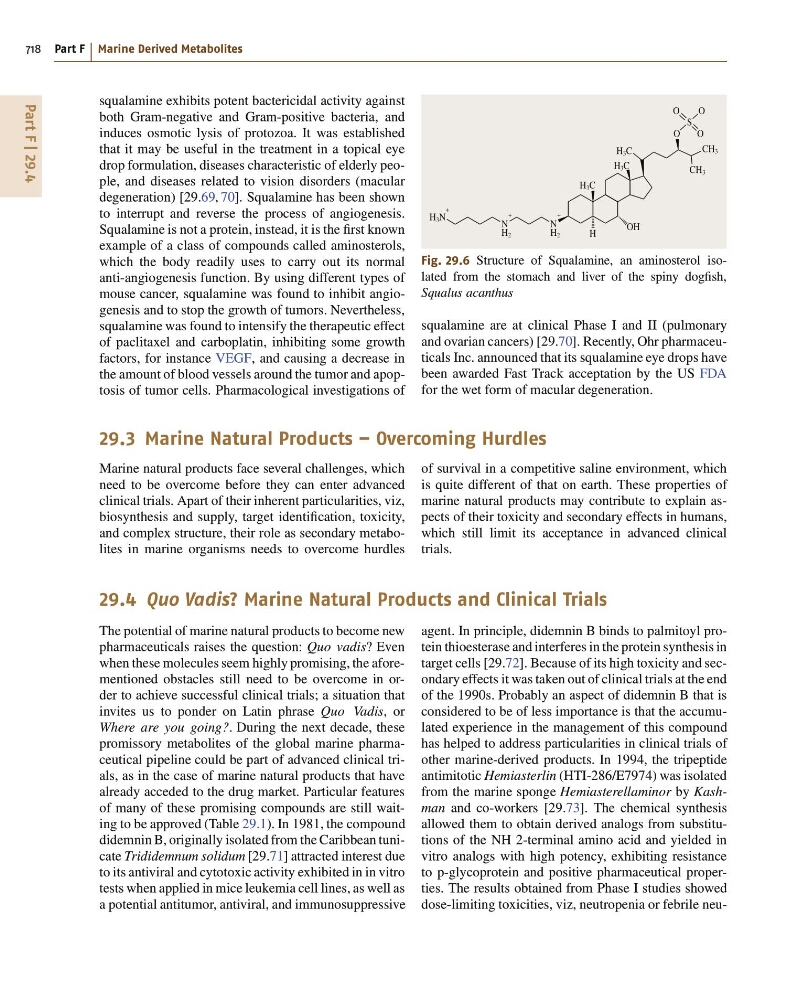
Squalamine is not a protein, instead, it is the first known
example of a class of compounds called aminosterols,
which the body readily uses to carry out its normal
anti-angiogenesis function. By using different types of
mouse cancer, squalamine was found to inhibit angiogenesis and to stop the growth of tumors. Nevertheless,
squalamine was found to intensify the therapeutic effect
of paclitaxel and carboplatin, inhibiting some growth
factors, for instance VEGF, and causing a decrease in
the amount of blood vessels around the tumor and apoptosis of tumor cells. Pharmacological investigations of
H 3 N
+
H 3 C
OH
H
H 3 C
H 3 C
CH 3
O
O
O
O
S
CH 3
N
H 2
+
N
H 2
+
Fig. 29.6 Structure of Squalamine, an aminosterol isolated from the stomach and liver of the spiny dogfish,
Squalus acanthus
squalamine are at clinical Phase I and II (pulmonary
and ovarian cancers) [29.70]. Recently, Ohr pharmaceuticals Inc. announced that its squalamine eye drops have
been awarded Fast Track acceptation by the US FDA
for the wet form of macular degeneration.
29.3 Marine Natural Products – Overcoming Hurdles
Marine natural products face several challenges, which
need to be overcome before they can enter advanced
clinical trials. Apart of their inherent particularities, viz,
biosynthesis and supply, target identification, toxicity,
and complex structure, their role as secondary metabolites in marine organisms needs to overcome hurdles
of survival in a competitive saline environment, which
is quite different of that on earth. These properties of
marine natural products may contribute to explain aspects of their toxicity and secondary effects in humans,
which still limit its acceptance in advanced clinical
trials.
29.4 Quo Vadis? Marine Natural Products and Clinical Trials
The potential of marine natural products to become new
pharmaceuticals raises the question: Quo vadis? Even
when these molecules seem highly promising, the aforementioned obstacles still need to be overcome in order to achieve successful clinical trials; a situation that
invites us to ponder on Latin phrase Quo Vadis, or
Where are you going?. During the next decade, these
promissory metabolites of the global marine pharmaceutical pipeline could be part of advanced clinical trials, as in the case of marine natural products that have
already acceded to the drug market. Particular features
of many of these promising compounds are still waiting to be approved (Table 29.1). In 1981, the compound
didemnin B, originally isolated from the Caribbean tunicate Trididemnum solidum [29.71] attracted interest due
to its antiviral and cytotoxic activity exhibited in in vitro
tests when applied in mice leukemia cell lines, as well as
a potential antitumor, antiviral, and immunosuppressive
agent. In principle, didemnin B binds to palmitoyl protein thioesterase and interferes in the protein synthesis in
target cells [29.72]. Because of its high toxicity and secondary effects it was taken out of clinical trials at the end
of the 1990s. Probably an aspect of didemnin B that is
considered to be of less importance is that the accumulated experience in the management of this compound
has helped to address particularities in clinical trials of
other marine-derived products. In 1994, the tripeptide
antimitotic Hemiasterlin (HTI-286/E7974) was isolated
from the marine sponge Hemiasterellaminor by Kashman and co-workers [29.73]. The chemical synthesis
allowed them to obtain derived analogs from substitutions of the NH 2-terminal amino acid and yielded in
vitro analogs with high potency, exhibiting resistance
to p-glycoprotein and positive pharmaceutical properties. The results obtained from Phase I studies showed
dose-limiting toxicities, viz, neutropenia or febrile neu-