

Drugs and Leads from the Ocean Through Biotechnology 29.2 Approved Marine Drugs as Pharmaceuticals 717
Part F | 29.2
Kahalalide F
NH
NH
N
NH
NH
NH
OH
NH 2
N
H
H
N
HN
NH
H
N
NH
HN
O
O
O
O
O
O
O
O
O
O
O
O
O
O
O
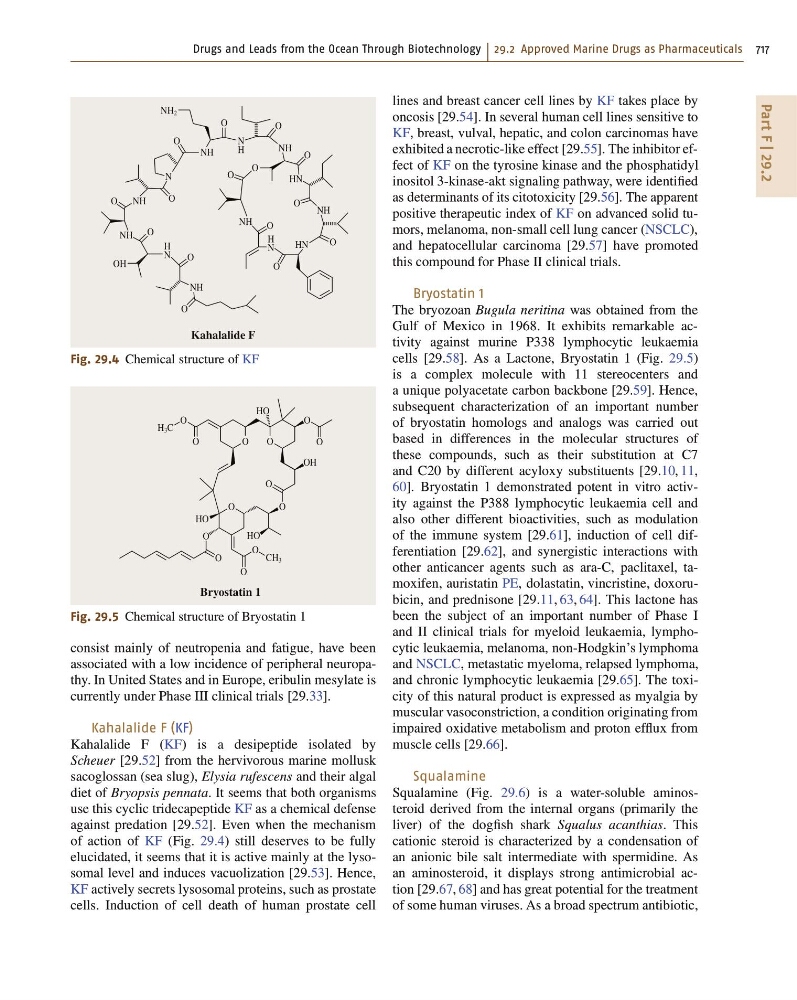
Fig. 29.4 Chemical structure of KF
Bryostatin 1
O
O
O
O
O
O
O
O
O
O
O
OH
HO
HO
HO
CH 3
H 3 C
O
O
Fig. 29.5 Chemical structure of Bryostatin 1
consist mainly of neutropenia and fatigue, have been
associated with a low incidence of peripheral neuropathy. In United States and in Europe, eribulin mesylate is
currently under Phase III clinical trials [29.33].
Kahalalide F (KF)
Kahalalide F (KF) is a desipeptide isolated by
Scheuer [29.52] from the hervivorous marine mollusk
sacoglossan (sea slug), Elysia rufescens and their algal
diet of Bryopsis pennata. It seems that both organisms
use this cyclic tridecapeptide KF as a chemical defense
against predation [29.52]. Even when the mechanism
of action of KF (Fig. 29.4) still deserves to be fully
elucidated, it seems that it is active mainly at the lysosomal level and induces vacuolization [29.53]. Hence,
KF actively secrets lysosomal proteins, such as prostate
cells. Induction of cell death of human prostate cell
lines and breast cancer cell lines by KF takes place by
oncosis [29.54]. In several human cell lines sensitive to
KF, breast, vulval, hepatic, and colon carcinomas have
exhibited a necrotic-like effect [29.55]. The inhibitor effect of KF on the tyrosine kinase and the phosphatidyl
inositol 3-kinase-akt signaling pathway, were identified
as determinants of its citotoxicity [29.56]. The apparent
positive therapeutic index of KF on advanced solid tumors, melanoma, non-small cell lung cancer (NSCLC),
and hepatocellular carcinoma [29.57] have promoted
this compound for Phase II clinical trials.
Bryostatin 1
The bryozoan Bugula neritina was obtained from the
Gulf of Mexico in 1968. It exhibits remarkable activity against murine P338 lymphocytic leukaemia
cells [29.58]. As a Lactone, Bryostatin 1 (Fig. 29.5)
is a complex molecule with 11 stereocenters and
a unique polyacetate carbon backbone [29.59]. Hence,
subsequent characterization of an important number
of bryostatin homologs and analogs was carried out
based in differences in the molecular structures of
these compounds, such as their substitution at C7
and C20 by different acyloxy substituents [29.10, 11,
60]. Bryostatin 1 demonstrated potent in vitro activity against the P388 lymphocytic leukaemia cell and
also other different bioactivities, such as modulation
of the immune system [29.61], induction of cell differentiation [29.62], and synergistic interactions with
other anticancer agents such as ara-C, paclitaxel, tamoxifen, auristatin PE, dolastatin, vincristine, doxorubicin, and prednisone [29.11, 63, 64]. This lactone has
been the subject of an important number of Phase I
and II clinical trials for myeloid leukaemia, lymphocytic leukaemia, melanoma, non-Hodgkin’s lymphoma
and NSCLC, metastatic myeloma, relapsed lymphoma,
and chronic lymphocytic leukaemia [29.65]. The toxicity of this natural product is expressed as myalgia by
muscular vasoconstriction, a condition originating from
impaired oxidative metabolism and proton efflux from
muscle cells [29.66].
Squalamine
Squalamine (Fig. 29.6) is a water-soluble aminosteroid derived from the internal organs (primarily the
liver) of the dogfish shark Squalus acanthias. This
cationic steroid is characterized by a condensation of
an anionic bile salt intermediate with spermidine. As
an aminosteroid, it displays strong antimicrobial action [29.67, 68] and has great potential for the treatment
of some human viruses. As a broad spectrum antibiotic,