

Part F | 29.2
716 Part F Marine Derived Metabolites
29.2.4 Marine Natural Products
in Advanced Clinical Trials
Aplidine
Aplidine is a marine depsipeptide that was first reported
in 1991 [29.40] by Rinehar and Lithgow-Bertelloni
from Aplidium albicans, a tunicate that thrives in the
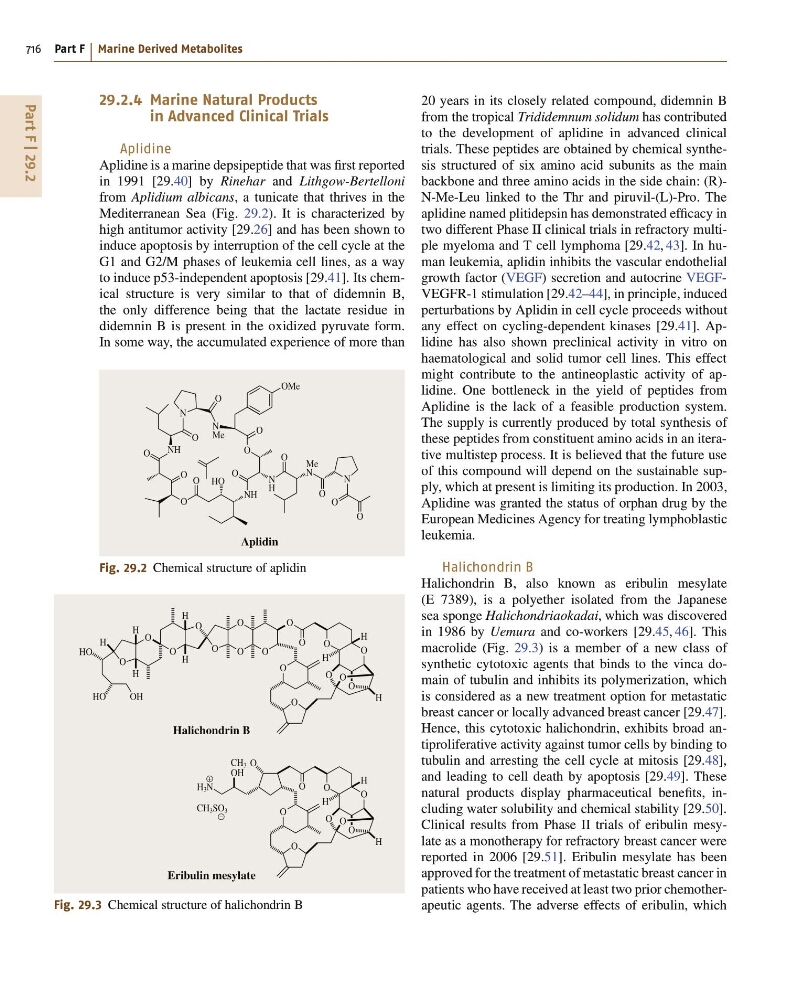
Mediterranean Sea (Fig. 29.2). It is characterized by
high antitumor activity [29.26] and has been shown to
induce apoptosis by interruption of the cell cycle at the
G1 and G2/M phases of leukemia cell lines, as a way
to induce p53-independent apoptosis [29.41]. Its chemical structure is very similar to that of didemnin B,
the only difference being that the lactate residue in
didemnin B is present in the oxidized pyruvate form.
In some way, the accumulated experience of more than
Aplidin
N
H
HO
NH
NH
OMe
O
N
Me
Me
N
O
O
O
O
O
O
O
N
O
O
O
O
O
N
Fig. 29.2 Chemical structure of aplidin
Eribulin mesylate
Halichondrin B
O
OH
HO
HO
H 3 N
CH 3 SO 3
O
O
O
O
H
H
O
O
O
O
O
O
O
O
H
O
O
H
CH 3
OH
H
O
O
H
H
H
O
O
O
O
O
O
O
H
O
O
H
H
+
–
Fig. 29.3 Chemical structure of halichondrin B
20 years in its closely related compound, didemnin B
from the tropical Trididemnum solidum has contributed
to the development of aplidine in advanced clinical
trials. These peptides are obtained by chemical synthesis structured of six amino acid subunits as the main
backbone and three amino acids in the side chain: (R)N-Me-Leu linked to the Thr and piruvil-(L)-Pro. The
aplidine named plitidepsin has demonstrated efficacy in
two different Phase II clinical trials in refractory multiple myeloma and T cell lymphoma [29.42, 43]. In human leukemia, aplidin inhibits the vascular endothelial
growth factor (VEGF) secretion and autocrine VEGFVEGFR-1 stimulation [29.42–44], in principle, induced
perturbations by Aplidin in cell cycle proceeds without
any effect on cycling-dependent kinases [29.41]. Aplidine has also shown preclinical activity in vitro on
haematological and solid tumor cell lines. This effect
might contribute to the antineoplastic activity of aplidine. One bottleneck in the yield of peptides from
Aplidine is the lack of a feasible production system.
The supply is currently produced by total synthesis of
these peptides from constituent amino acids in an iterative multistep process. It is believed that the future use
of this compound will depend on the sustainable supply, which at present is limiting its production. In 2003,
Aplidine was granted the status of orphan drug by the
European Medicines Agency for treating lymphoblastic
leukemia.
Halichondrin B
Halichondrin B, also known as eribulin mesylate
(E 7389), is a polyether isolated from the Japanese
sea sponge Halichondriaokadai, which was discovered
in 1986 by Uemura and co-workers [29.45, 46]. This
macrolide (Fig. 29.3) is a member of a new class of
synthetic cytotoxic agents that binds to the vinca domain of tubulin and inhibits its polymerization, which
is considered as a new treatment option for metastatic
breast cancer or locally advanced breast cancer [29.47].
Hence, this cytotoxic halichondrin, exhibits broad antiproliferative activity against tumor cells by binding to
tubulin and arresting the cell cycle at mitosis [29.48],
and leading to cell death by apoptosis [29.49]. These
natural products display pharmaceutical benefits, including water solubility and chemical stability [29.50].
Clinical results from Phase II trials of eribulin mesylate as a monotherapy for refractory breast cancer were
reported in 2006 [29.51]. Eribulin mesylate has been
approved for the treatment of metastatic breast cancer in
patients who have received at least two prior chemotherapeutic agents. The adverse effects of eribulin, which