

Part E | 28.3
698 Part E Marine Microbiology and Biotechnology
Phenylacetonitrile 1
Phenylacetic acid
2-Hydroxyphenyl
acetonitrile
2-Hydroxyphenylacetic acid 1a
Marine fungi
100% conversion
51% yield
4–8 days
mineral medium
124 rpm, 32 °C
CN
OH
CN
OH
OH
and/or
O
OH
O
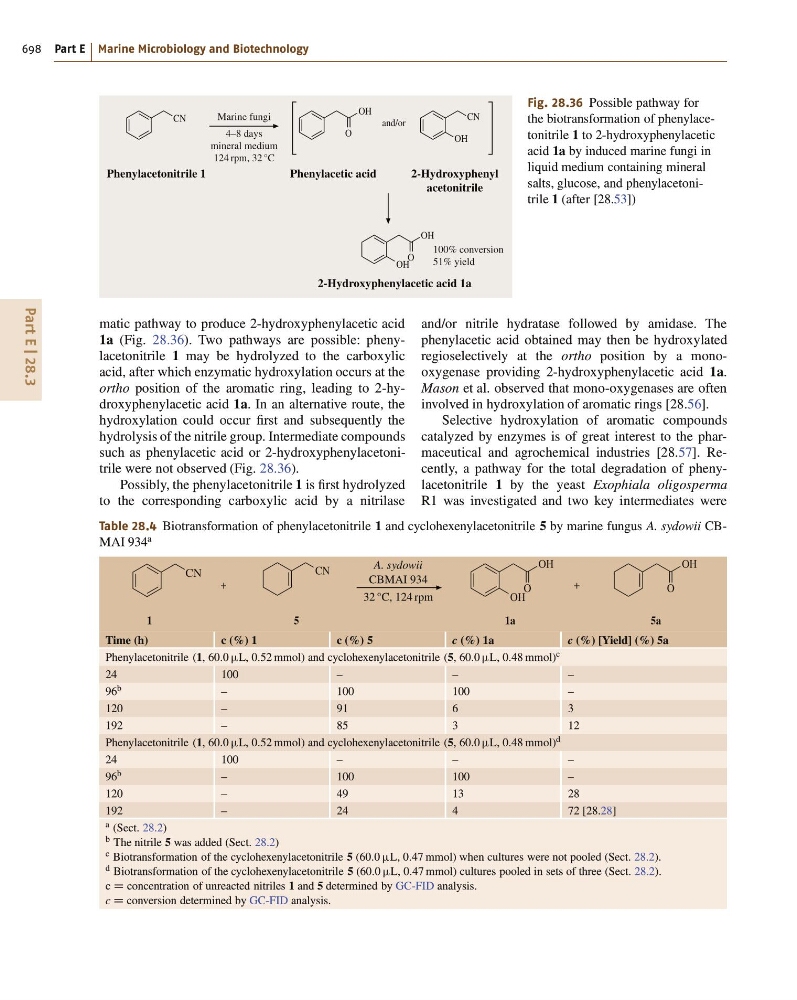
Fig. 28.36 Possible pathway for
the biotransformation of phenylacetonitrile 1 to 2-hydroxyphenylacetic
acid 1a by induced marine fungi in
liquid medium containing mineral
salts, glucose, and phenylacetonitrile 1 (after [28.53])
matic pathway to produce 2-hydroxyphenylacetic acid
1a (Fig. 28.36). Two pathways are possible: phenylacetonitrile 1 may be hydrolyzed to the carboxylic
acid, after which enzymatic hydroxylation occurs at the
ortho position of the aromatic ring, leading to 2-hydroxyphenylacetic acid 1a. In an alternative route, the
hydroxylation could occur first and subsequently the
hydrolysis of the nitrile group. Intermediate compounds
such as phenylacetic acid or 2-hydroxyphenylacetonitrile were not observed (Fig. 28.36).
Possibly, the phenylacetonitrile 1 is first hydrolyzed
to the corresponding carboxylic acid by a nitrilase
Table 28.4 Biotransformation of phenylacetonitrile 1 and cyclohexenylacetonitrile 5 by marine fungus A. sydowii CBMAI 934
a
CN
OH
OH
O
OH
O
CN
A. sydowii
CBMAI 934
32 °C, 124 rpm
1
5
+
+
1a
5a
Time (h)
c (%) 1
c (%) 5
c (%) 1a
c (%) [Yield] (%) 5a
Phenylacetonitrile (1, 60:0 L, 0:52 mmol) and cyclohexenylacetonitrile (5, 60:0 L, 0:48 mmol) c
24
100
–
–
–
96 b
–
100
100
–
120
–
91
6
3
192
–
85
3
12
Phenylacetonitrile (1, 60:0 L, 0:52 mmol) and cyclohexenylacetonitrile (5, 60:0 L, 0:48 mmol) d
24
100
–
–
–
96 b
–
100
100
–
120
–
49
13
28
192
–
24
4
72 [28.28]
a (Sect. 28.2)
b The nitrile 5 was added (Sect. 28.2)
c Biotransformation of the cyclohexenylacetonitrile 5 (60:0 L, 0:47 mmol) when cultures were not pooled (Sect. 28.2).
d Biotransformation of the cyclohexenylacetonitrile 5 (60:0 L, 0:47 mmol) cultures pooled in sets of three (Sect. 28.2).
c D concentration of unreacted nitriles 1 and 5 determined by GC-FID analysis.
c D conversion determined by GC-FID analysis.
and/or nitrile hydratase followed by amidase. The
phenylacetic acid obtained may then be hydroxylated
regioselectively at the ortho position by a monooxygenase providing 2-hydroxyphenylacetic acid 1a.
Mason et al. observed that mono-oxygenases are often
involved in hydroxylation of aromatic rings [28.56].
Selective hydroxylation of aromatic compounds
catalyzed by enzymes is of great interest to the pharmaceutical and agrochemical industries [28.57]. Recently, a pathway for the total degradation of phenylacetonitrile 1 by the yeast Exophiala oligosperma
R1 was investigated and two key intermediates were