

Biotransformation of Nitriles by Marine Fungi 28.3 Results and Discussion 699
Part E | 28.3
0
1
2
3
4
5
6
7
8
9
10
11
12
13
Time
Inten.
Time 11.755 Inten. 310 229
Time 8.681 Inten.
43 702
Time 8.285 Inten.
25 210
Time 7.303 Inten. –15 192
15
14
min
µV (×1 000 000)
µV (×1 000 000)
Chromatogram
3
2
1
0
1.5
1
0.5
0
µV (×10 000)
5
2.5
0
µV (×10 000)
2
1
0
µV (×10 000)
a)
b)
c)
d)
e)
5
2.5
0
CN
CN
F
F
OH
OH
O
OH
OH
O
OH
O
F
OH
O
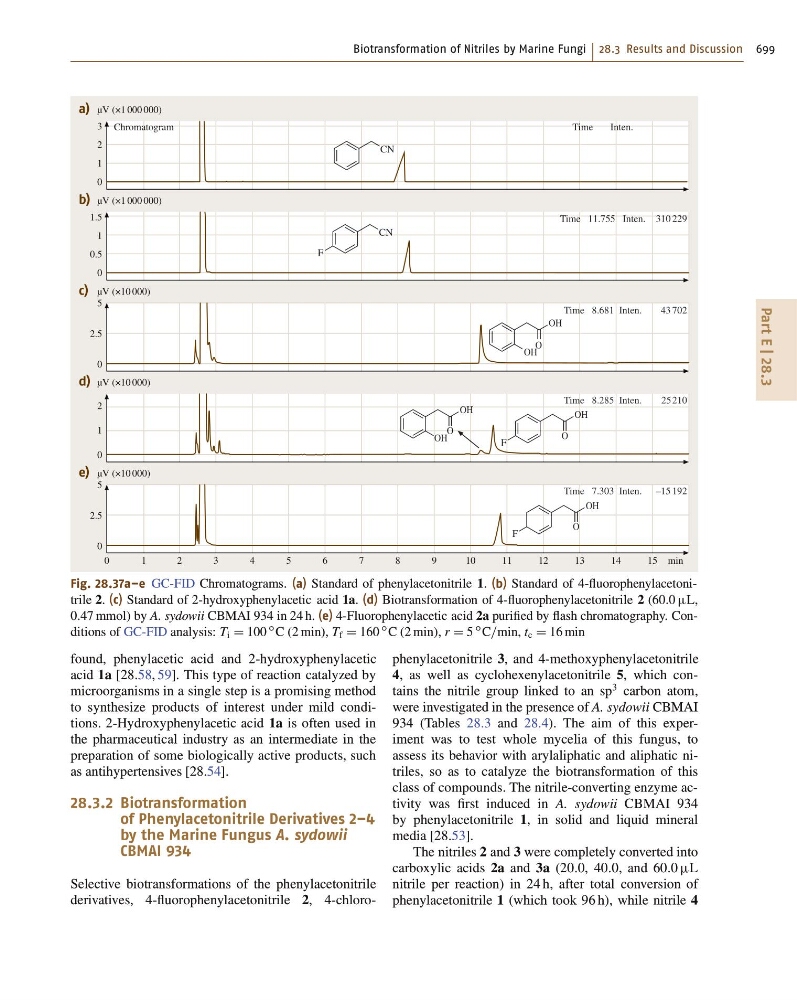
Fig. 28.37a–e GC-FID Chromatograms. (a) Standard of phenylacetonitrile 1. (b) Standard of 4-fluorophenylacetonitrile 2. (c) Standard of 2-hydroxyphenylacetic acid 1a. (d) Biotransformation of 4-fluorophenylacetonitrile 2 (60:0 L,
0:47 mmol) by A. sydowii CBMAI 934 in 24 h. (e) 4-Fluorophenylacetic acid 2a purified by flash chromatography. Conditions of GC-FID analysis: T i D 100
ı C (2 min), T f D 160
ı C (2 min), r D 5
ı C=min, t c D 16 min
found, phenylacetic acid and 2-hydroxyphenylacetic
acid 1a [28.58, 59]. This type of reaction catalyzed by
microorganisms in a single step is a promising method
to synthesize products of interest under mild conditions. 2-Hydroxyphenylacetic acid 1a is often used in
the pharmaceutical industry as an intermediate in the
preparation of some biologically active products, such
as antihypertensives [28.54].
28.3.2 Biotransformation
of Phenylacetonitrile Derivatives 2–4
by the Marine Fungus A. sydowii
CBMAI 934
Selective biotransformations of the phenylacetonitrile
derivatives, 4-fluorophenylacetonitrile 2, 4-chlorophenylacetonitrile 3, and 4-methoxyphenylacetonitrile
4, as well as cyclohexenylacetonitrile 5, which contains the nitrile group linked to an sp
3 carbon atom,
were investigated in the presence of A. sydowii CBMAI
934 (Tables 28.3 and 28.4). The aim of this experiment was to test whole mycelia of this fungus, to
assess its behavior with arylaliphatic and aliphatic nitriles, so as to catalyze the biotransformation of this
class of compounds. The nitrile-converting enzyme activity was first induced in A. sydowii CBMAI 934
by phenylacetonitrile 1, in solid and liquid mineral
media [28.53].
The nitriles 2 and 3 were completely converted into
carboxylic acids 2a and 3a (20:0, 40:0, and 60:0 L
nitrile per reaction) in 24 h, after total conversion of
phenylacetonitrile 1 (which took 96 h), while nitrile 4