

Biotransformation of Nitriles by Marine Fungi 28.3 Results and Discussion 697
Part E | 28.3
CN
0
1
2
3
4
5
6
7
8
9
10
11
12
13
Time 8.650 Inten. –13 465
Time 9.394 Inten. 100 000
Time 7.977 Inten.
40 743
Time 11.765 Inten.
45,644
Time 4.047 Inten. –404 900
15
14
min
µV (×100 000)
Chromatogram
2
1
0
µV (×10 000)
10
5
0
µV (×10 000)
5
2.5
0
µV (×10 000)
5
2.5
0
µV (×10 000)
a)
b)
c)
d)
e)
5
2.5
0
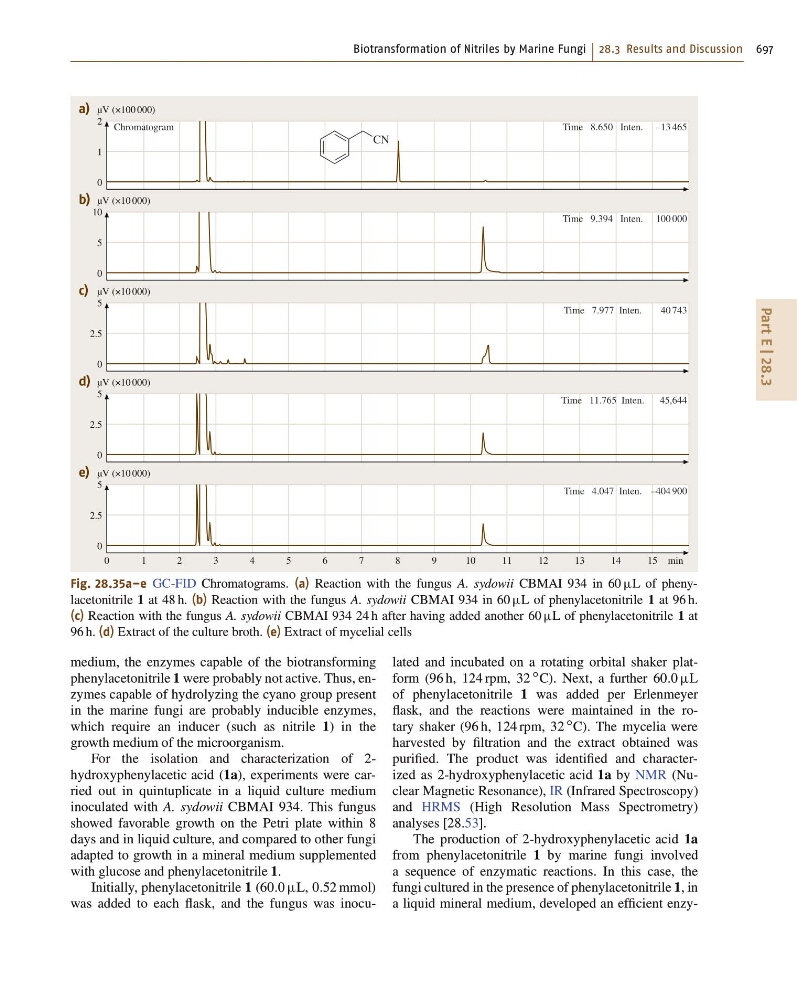
Fig. 28.35a–e GC-FID Chromatograms. (a) Reaction with the fungus A. sydowii CBMAI 934 in 60 L of phenylacetonitrile 1 at 48 h. (b) Reaction with the fungus A. sydowii CBMAI 934 in 60 L of phenylacetonitrile 1 at 96 h.
(c) Reaction with the fungus A. sydowii CBMAI 934 24 h after having added another 60 L of phenylacetonitrile 1 at
96 h. (d) Extract of the culture broth. (e) Extract of mycelial cells
medium, the enzymes capable of the biotransforming
phenylacetonitrile 1 were probably not active. Thus, enzymes capable of hydrolyzing the cyano group present
in the marine fungi are probably inducible enzymes,
which require an inducer (such as nitrile 1) in the
growth medium of the microorganism.
For the isolation and characterization of 2hydroxyphenylacetic acid (1a), experiments were carried out in quintuplicate in a liquid culture medium
inoculated with A. sydowii CBMAI 934. This fungus
showed favorable growth on the Petri plate within 8
days and in liquid culture, and compared to other fungi
adapted to growth in a mineral medium supplemented
with glucose and phenylacetonitrile 1.
Initially, phenylacetonitrile 1 (60:0 L, 0:52 mmol)
was added to each flask, and the fungus was inoculated and incubated on a rotating orbital shaker platform (96 h, 124 rpm, 32
ı C). Next, a further 60:0 L
of phenylacetonitrile 1 was added per Erlenmeyer
flask, and the reactions were maintained in the rotary shaker (96 h, 124 rpm, 32
ı C). The mycelia were
harvested by filtration and the extract obtained was
purified. The product was identified and characterized as 2-hydroxyphenylacetic acid 1a by NMR (Nuclear Magnetic Resonance), IR (Infrared Spectroscopy)
and HRMS (High Resolution Mass Spectrometry)
analyses [28.53].
The production of 2-hydroxyphenylacetic acid 1a
from phenylacetonitrile 1 by marine fungi involved
a sequence of enzymatic reactions. In this case, the
fungi cultured in the presence of phenylacetonitrile 1, in
a liquid mineral medium, developed an efficient enzy-