

Part E | 28.3
696 Part E Marine Microbiology and Biotechnology
28.3 Results and Discussion
28.3.1 Screening of Marine Fungi
with Phenylacetonitrile 1
in Solid and Liquid Media
Initially, the biotransformation of phenylacetonitrile 1
by marine fungi was conducted on solid culture media.
The microorganisms were grown on plates of a mineral
medium supplemented with glucose and phenylacetonitrile 1, as carbon and nitrogen sources, respectively. The
growth of the fungal colonies was observed on the surface of agar containing phenylacetonitrile 1 (5:0 L,
0:04 mmol) per plate at 32
ı C for 8 days. Table 28.1
summarizes the results of the qualitative growth test
of 12 marine fungi on the solid culture media in the
presence of phenylacetonitrile 1. Eight strains exhibited
good colony formation, while four isolates (P. miczynskii CBMAI 930, P. oxalicum CBMAI 1185, P. citrinum
CBMAI 1186, and Cladosporium sp. CBMAI 1237) did
not grow under these conditions (Table 28.1).
Control experiments were conducted on the 12
strains by inoculating the mineral agar medium supplemented with glucose and without addition of phenylacetonitrile 1. In these experiments, more of the marine
fungi grew on the agar. This result was important for the
selection of marine fungi with a potential for biotransformation of phenylacetonitrile 1, since there strains
used 1 effectively as a nitrogen source. The conditions
described here were responsible for the excellent results
obtained in the biotransformation of phenylacetonitrile
1. The marine fungi cultured with phenylacetonitrile
1 at a concentration of 5:0 L per plate were evaluA. sydowii
CBMAI 934 (5 µL)
A. sydowii
CBMAI 934 (10 µL)
A. sydowii
CBMAI 934 (15 µL)
A. sydowii
CBMAI 934 (20 µL)
A. sydowii
CBMAI 934 (control)
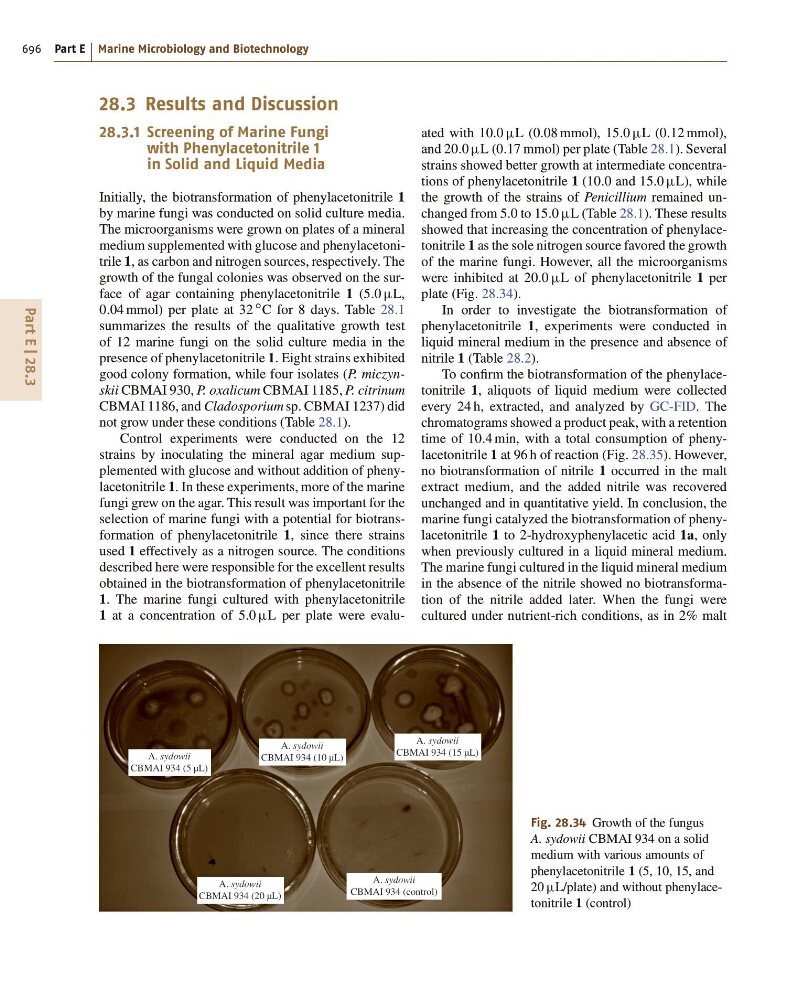
Fig. 28.34 Growth of the fungus
A. sydowii CBMAI 934 on a solid
medium with various amounts of
phenylacetonitrile 1 (5, 10, 15, and
20 L/plate) and without phenylacetonitrile 1 (control)
ated with 10:0 L (0:08 mmol), 15:0 L (0:12 mmol),
and 20:0 L (0:17 mmol) per plate (Table 28.1). Several
strains showed better growth at intermediate concentrations of phenylacetonitrile 1 (10:0 and 15:0 L), while
the growth of the strains of Penicillium remained unchanged from 5:0 to 15:0 L (Table 28.1). These results
showed that increasing the concentration of phenylacetonitrile 1 as the sole nitrogen source favored the growth
of the marine fungi. However, all the microorganisms
were inhibited at 20:0 L of phenylacetonitrile 1 per
plate (Fig. 28.34).
In order to investigate the biotransformation of
phenylacetonitrile 1, experiments were conducted in
liquid mineral medium in the presence and absence of
nitrile 1 (Table 28.2).
To confirm the biotransformation of the phenylacetonitrile 1, aliquots of liquid medium were collected
every 24 h, extracted, and analyzed by GC-FID. The
chromatograms showed a product peak, with a retention
time of 10:4 min, with a total consumption of phenylacetonitrile 1 at 96 h of reaction (Fig. 28.35). However,
no biotransformation of nitrile 1 occurred in the malt
extract medium, and the added nitrile was recovered
unchanged and in quantitative yield. In conclusion, the
marine fungi catalyzed the biotransformation of phenylacetonitrile 1 to 2-hydroxyphenylacetic acid 1a, only
when previously cultured in a liquid mineral medium.
The marine fungi cultured in the liquid mineral medium
in the absence of the nitrile showed no biotransformation of the nitrile added later. When the fungi were
cultured under nutrient-rich conditions, as in 2% malt