

Biotransformation of Nitriles by Marine Fungi 28.1 Overview 689
Part E | 28.1
OH
O
CN
Acrylonitrile
Acrylic acid
390 g/L
R. rhodochrous J1
24 h
Fig. 28.26 Hydrolysis of acrylonitrile by Rhodococcus
rhodochrous J1
OH
HO
O
CN
HO
Glycolonitrile
Glycolic acid
yield 96.5%
Alcaligenes sp.
ECU0401
14 h
Fig. 28.27 Hydrolysis of glycolonitrile by Alcaligenes
sp. ECU0401
colic acid has many applications in cosmetic products
and is also an important ingredient in the processing
of metals, automotive oil additives, and biodegradable
polymers [28.48].
28.1.6 Biodegradation of Nitriles
Nitriles are highly toxic, carcinogenic, and mutagenic.
Therefore, it is necessary to control the disposal of
organonitriles into the environment and to monitor their
presence there.
Typically, compounds such as acrylonitrile, acetonitrile, benzonitrile, and so on are widely used in laboratories and industry as solvents or as intermediates for
pharmaceuticals (chiral blocks), plastics, synthetic rubber, and pesticides and herbicides, such as bromoxynil
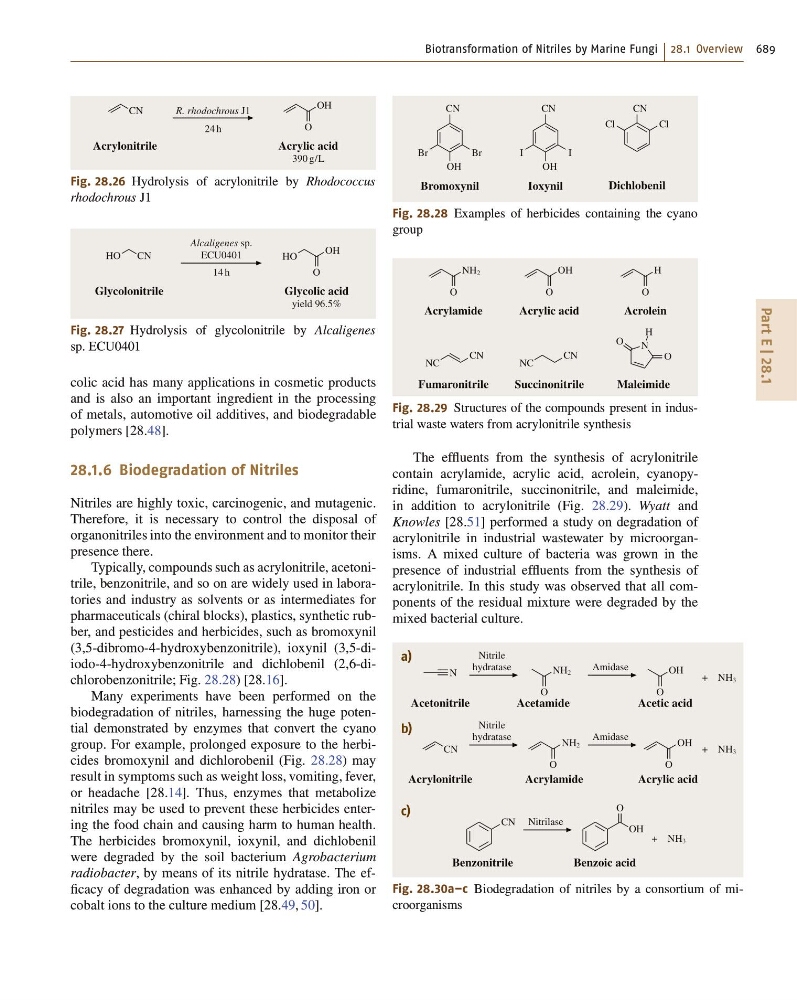
(3,5-dibromo-4-hydroxybenzonitrile), ioxynil (3,5-diiodo-4-hydroxybenzonitrile and dichlobenil (2,6-dichlorobenzonitrile; Fig. 28.28) [28.16].
Many experiments have been performed on the
biodegradation of nitriles, harnessing the huge potential demonstrated by enzymes that convert the cyano
group. For example, prolonged exposure to the herbicides bromoxynil and dichlorobenil (Fig. 28.28) may
result in symptoms such as weight loss, vomiting, fever,
or headache [28.14]. Thus, enzymes that metabolize
nitriles may be used to prevent these herbicides entering the food chain and causing harm to human health.
The herbicides bromoxynil, ioxynil, and dichlobenil
were degraded by the soil bacterium Agrobacterium
radiobacter, by means of its nitrile hydratase. The efficacy of degradation was enhanced by adding iron or
cobalt ions to the culture medium [28.49, 50].
Bromoxynil
CN
OH
Br
Br
Ioxynil
CN
OH
I
I
Dichlobenil
CN
Cl
Cl
Fig. 28.28 Examples of herbicides containing the cyano
group
H
O
Acrolein
CN
NC
Fumaronitrile
CN
NC
Succinonitrile
O
O
N
H
Maleimide
OH
O
Acrylic acid
NH 2
O
Acrylamide
Fig. 28.29 Structures of the compounds present in industrial waste waters from acrylonitrile synthesis
The effluents from the synthesis of acrylonitrile
contain acrylamide, acrylic acid, acrolein, cyanopyridine, fumaronitrile, succinonitrile, and maleimide,
in addition to acrylonitrile (Fig. 28.29). Wyatt and
Knowles [28.51] performed a study on degradation of
acrylonitrile in industrial wastewater by microorganisms. A mixed culture of bacteria was grown in the
presence of industrial effluents from the synthesis of
acrylonitrile. In this study was observed that all components of the residual mixture were degraded by the
mixed bacterial culture.
a)
b)
c)
Nitrile
hydratase
Acetonitrile
Acetamide
Amidase
Nitrile
hydratase
Acrylonitrile
Acrylamide
Amidase
+ NH 3
+ NH 3
Benzonitrile
Benzoic acid
Nitrilase
CN
OH
+ NH 3
O
Acrylic acid
OH
O
NH 2
O
Acetic acid
OH
O
CN
NH 2
O
N
Fig. 28.30a–c Biodegradation of nitriles by a consortium of microorganisms