

Part E | 28.2
690 Part E Marine Microbiology and Biotechnology
Arylaliphatic nitriles
Aliphatic nitriles
R 3
R 1 = R 2 = R 3 = H, phenylacetonitrile 1
R 1 = R 2 = H, R 3 = F, 4-fluorophenylacetonitrile 2
R 1 = R 2 = H, R 3 = Cl, 4-chlorophenylacetonitrile 3
R 1 = R 2 = H, R 3 = OCH 3 , 4-methoxyphenylacetonitrile 4
R 1 = R 2 = R 3 = R 4 = H, benzonitrile 6
R 1 = Cl, R 2 = R 3 = R 4 = H, 2-chlorobenzonitrile 7
R 1 = R 2 = R 4 = H, R 3 = OH, 4-hydroxybenzonitrile 8
R 1 = R 2 = R 4 = H, R 3 = OMe, 4-methoxybenzonitrile 9
R 1 = R 3 = H, R 2 = R 4 = OMe, 3,5-dimethoxybenzonitrile 10
2-nitrobenzonitrile 11
3-nitrobenzonitrile 12
4-nitrobenzonitrile 13
R 1
CN
R 2
R 3
R 4
R 1
CN
R 2
CN
O 2 N
CN
Aromatic nitriles
Cyclohexenylacetonitrile 5
2-cyanopyridine 14
4-cyanopyridine 15
N
CN
N
CN
Hetero(aromatic) nitriles
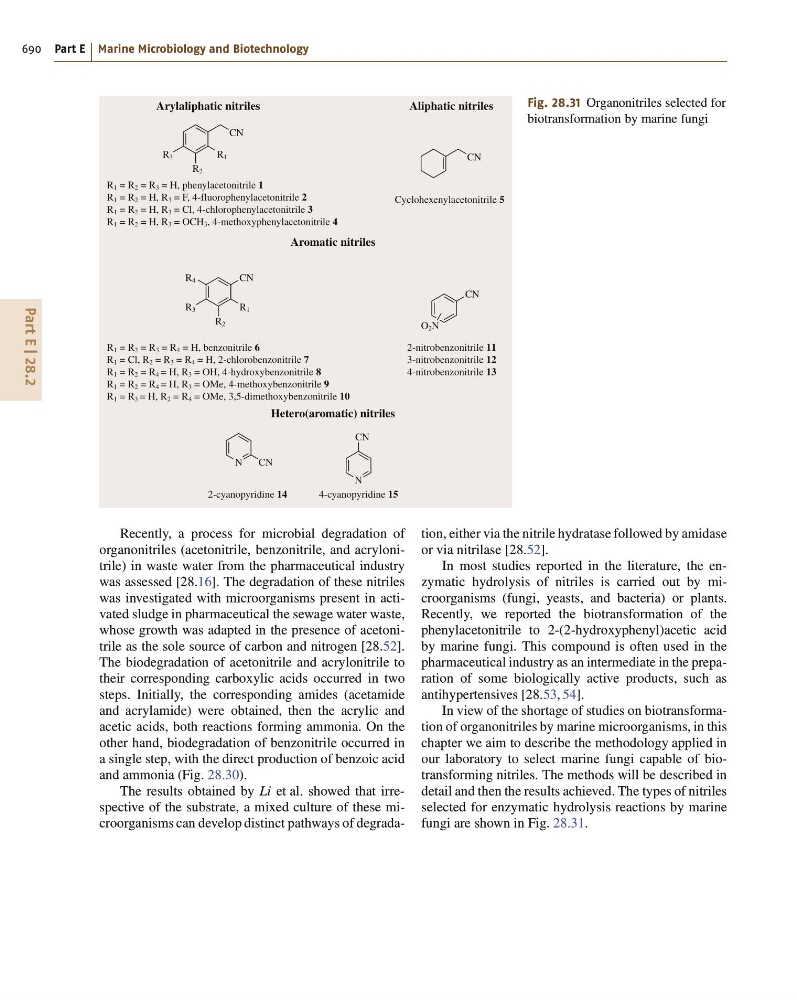
Fig. 28.31 Organonitriles selected for
biotransformation by marine fungi
Recently, a process for microbial degradation of
organonitriles (acetonitrile, benzonitrile, and acrylonitrile) in waste water from the pharmaceutical industry
was assessed [28.16]. The degradation of these nitriles
was investigated with microorganisms present in activated sludge in pharmaceutical the sewage water waste,
whose growth was adapted in the presence of acetonitrile as the sole source of carbon and nitrogen [28.52].
The biodegradation of acetonitrile and acrylonitrile to
their corresponding carboxylic acids occurred in two
steps. Initially, the corresponding amides (acetamide
and acrylamide) were obtained, then the acrylic and
acetic acids, both reactions forming ammonia. On the
other hand, biodegradation of benzonitrile occurred in
a single step, with the direct production of benzoic acid
and ammonia (Fig. 28.30).
The results obtained by Li et al. showed that irrespective of the substrate, a mixed culture of these microorganisms can develop distinct pathways of degradation, either via the nitrile hydratase followed by amidase
or via nitrilase [28.52].
In most studies reported in the literature, the enzymatic hydrolysis of nitriles is carried out by microorganisms (fungi, yeasts, and bacteria) or plants.
Recently, we reported the biotransformation of the
phenylacetonitrile to 2-(2-hydroxyphenyl)acetic acid
by marine fungi. This compound is often used in the
pharmaceutical industry as an intermediate in the preparation of some biologically active products, such as
antihypertensives [28.53, 54].
In view of the shortage of studies on biotransformation of organonitriles by marine microorganisms, in this
chapter we aim to describe the methodology applied in
our laboratory to select marine fungi capable of biotransforming nitriles. The methods will be described in
detail and then the results achieved. The types of nitriles
selected for enzymatic hydrolysis reactions by marine
fungi are shown in Fig. 28.31.