

Part E | 28.1
686 Part E Marine Microbiology and Biotechnology
O
S-doxazosin
Rhodococcus sp.
AJ270
O
O
(±)-nitrile
R-amide
50% yield
94% ee
S-acid
46% yield
99% ee
CN
O
O
CONH 2
O
O
CO 2 H
O
O
O
O
N
N
N
N
NH 2
+
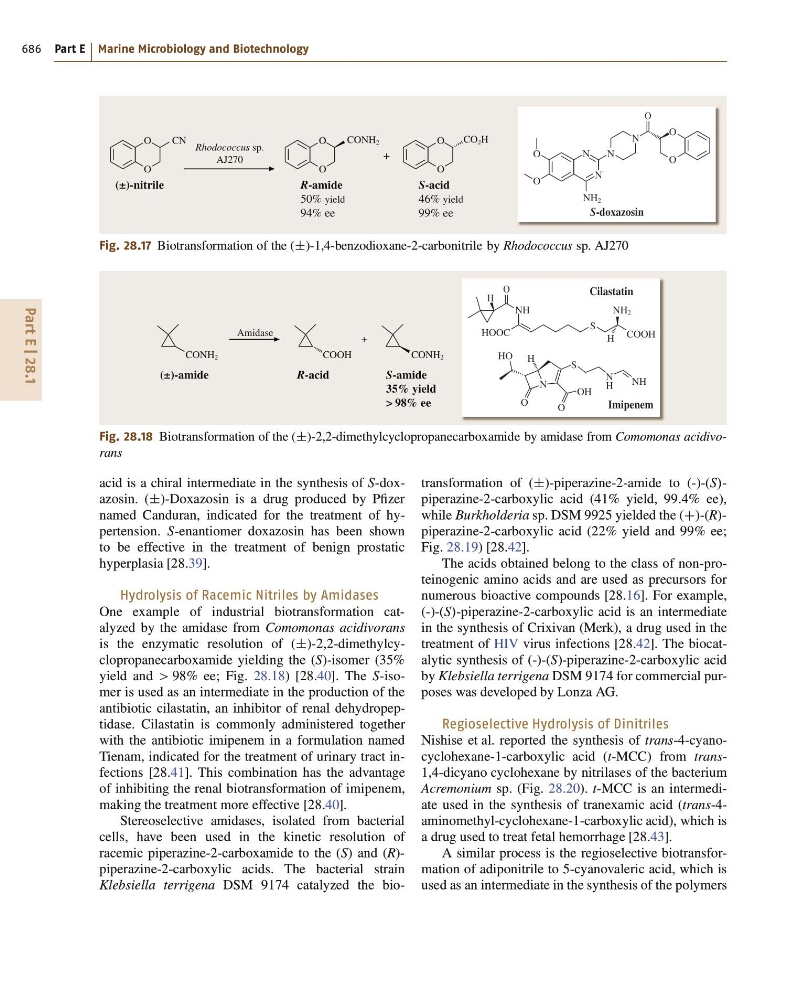
Fig. 28.17 Biotransformation of the (˙)-1,4-benzodioxane-2-carbonitrile by Rhodococcus sp. AJ270
Imipenem
Cilastatin
R-acid
S-amide
35% yield
> 98% ee
S
S
H COOH
HOOC
CONH 2
CONH 2
NH 2
NH
NH
HO H
N
O
O
OH
N
H
Amidase
(±)-amide
O
H
COOH
+
Fig. 28.18 Biotransformation of the (˙)-2,2-dimethylcyclopropanecarboxamide by amidase from Comomonas acidivorans
acid is a chiral intermediate in the synthesis of S-doxazosin. (˙)-Doxazosin is a drug produced by Pfizer
named Canduran, indicated for the treatment of hypertension. S-enantiomer doxazosin has been shown
to be effective in the treatment of benign prostatic
hyperplasia [28.39].
Hydrolysis of Racemic Nitriles by Amidases
One example of industrial biotransformation catalyzed by the amidase from Comomonas acidivorans
is the enzymatic resolution of (˙)-2,2-dimethylcyclopropanecarboxamide yielding the (S)-isomer (35%
yield and > 98% ee; Fig. 28.18) [28.40]. The S-isomer is used as an intermediate in the production of the
antibiotic cilastatin, an inhibitor of renal dehydropeptidase. Cilastatin is commonly administered together
with the antibiotic imipenem in a formulation named
Tienam, indicated for the treatment of urinary tract infections [28.41]. This combination has the advantage
of inhibiting the renal biotransformation of imipenem,
making the treatment more effective [28.40].
Stereoselective amidases, isolated from bacterial
cells, have been used in the kinetic resolution of
racemic piperazine-2-carboxamide to the (S) and (R)piperazine-2-carboxylic acids. The bacterial strain
Klebsiella terrigena DSM 9174 catalyzed the biotransformation of (˙)-piperazine-2-amide to (-)-(S/piperazine-2-carboxylic acid (41% yield, 99:4% ee),
while Burkholderia sp. DSM 9925 yielded the (C)-(R)piperazine-2-carboxylic acid (22% yield and 99% ee;
Fig. 28.19) [28.42].
The acids obtained belong to the class of non-proteinogenic amino acids and are used as precursors for
numerous bioactive compounds [28.16]. For example,
(-)-(S/-piperazine-2-carboxylic acid is an intermediate
in the synthesis of Crixivan (Merk), a drug used in the
treatment of HIV virus infections [28.42]. The biocatalytic synthesis of (-)-(S)-piperazine-2-carboxylic acid
by Klebsiella terrigena DSM 9174 for commercial purposes was developed by Lonza AG.
Regioselective Hydrolysis of Dinitriles
Nishise et al. reported the synthesis of trans-4-cyanocyclohexane-1-carboxylic acid (t-MCC) from trans1,4-dicyano cyclohexane by nitrilases of the bacterium
Acremonium sp. (Fig. 28.20). t-MCC is an intermediate used in the synthesis of tranexamic acid (trans-4aminomethyl-cyclohexane-1-carboxylic acid), which is
a drug used to treat fetal hemorrhage [28.43].
A similar process is the regioselective biotransformation of adiponitrile to 5-cyanovaleric acid, which is
used as an intermediate in the synthesis of the polymers