

Biotransformation of Nitriles by Marine Fungi 28.1 Overview 685
Part E | 28.1
CN
(±)-Ibu-CN
O
OH
HO
Prostaglandin
OH
O
O
HO
H
S-ibuprofen
45% yield
95% ee
Acinetobacter sp.
AK226
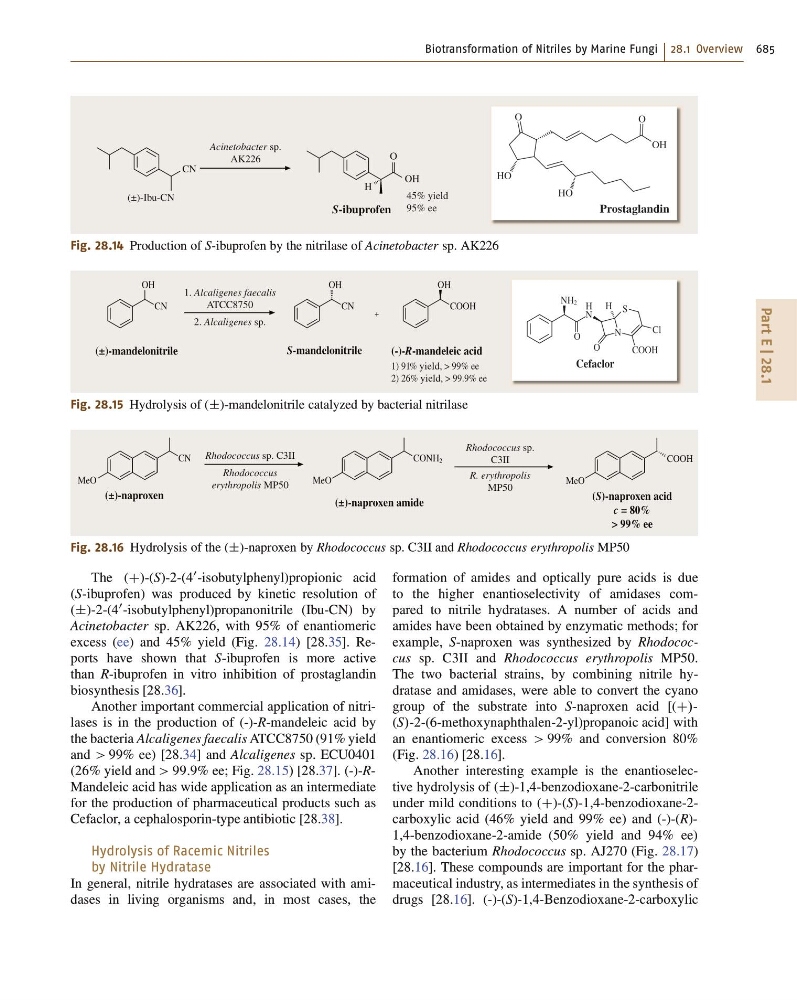
Fig. 28.14 Production of S-ibuprofen by the nitrilase of Acinetobacter sp. AK226
CN
OH
CN
+
OH
COOH
OH
O
O
S
N
Cl
H
NH 2 H
N
COOH
Cefaclor
(-)-R-mandeleic acid
S-mandelonitrile
(±)-mandelonitrile
1) 91% yield, > 99% ee
2) 26% yield, > 99.9% ee
1. Alcaligenes faecalis
ATCC8750
2. Alcaligenes sp.
Fig. 28.15 Hydrolysis of (˙)-mandelonitrile catalyzed by bacterial nitrilase
CN
MeO
CONH 2
COOH
MeO
MeO
(±)-naproxen amide
(S)-naproxen acid
c = 80%
> 99% ee
(±)-naproxen
Rhodococcus sp. C3II
Rhodococcus
erythropolis MP50
Rhodococcus sp.
C3II
R. erythropolis
MP50
Fig. 28.16 Hydrolysis of the (˙)-naproxen by Rhodococcus sp. C3II and Rhodococcus erythropolis MP50
The (C)-(S)-2-(4
0 -isobutylphenyl)propionic acid
(S-ibuprofen) was produced by kinetic resolution of
(˙)-2-(4
0 -isobutylphenyl)propanonitrile (Ibu-CN) by
Acinetobacter sp. AK226, with 95% of enantiomeric
excess (ee) and 45% yield (Fig. 28.14) [28.35]. Reports have shown that S-ibuprofen is more active
than R-ibuprofen in vitro inhibition of prostaglandin
biosynthesis [28.36].
Another important commercial application of nitrilases is in the production of (-)-R-mandeleic acid by
the bacteria Alcaligenes faecalis ATCC8750 (91% yield
and > 99% ee) [28.34] and Alcaligenes sp. ECU0401
(26% yield and > 99:9% ee; Fig. 28.15) [28.37]. (-)-RMandeleic acid has wide application as an intermediate
for the production of pharmaceutical products such as
Cefaclor, a cephalosporin-type antibiotic [28.38].
Hydrolysis of Racemic Nitriles
by Nitrile Hydratase
In general, nitrile hydratases are associated with amidases in living organisms and, in most cases, the
formation of amides and optically pure acids is due
to the higher enantioselectivity of amidases compared to nitrile hydratases. A number of acids and
amides have been obtained by enzymatic methods; for
example, S-naproxen was synthesized by Rhodococcus sp. C3II and Rhodococcus erythropolis MP50.
The two bacterial strains, by combining nitrile hydratase and amidases, were able to convert the cyano
group of the substrate into S-naproxen acid [(C/(S/-2-(6-methoxynaphthalen-2-yl)propanoic acid] with
an enantiomeric excess > 99% and conversion 80%
(Fig. 28.16) [28.16].
Another interesting example is the enantioselective hydrolysis of (˙)-1,4-benzodioxane-2-carbonitrile
under mild conditions to (C)-(S)-1,4-benzodioxane-2carboxylic acid (46% yield and 99% ee) and (-)-(R)1,4-benzodioxane-2-amide (50% yield and 94% ee)
by the bacterium Rhodococcus sp. AJ270 (Fig. 28.17)
[28.16]. These compounds are important for the pharmaceutical industry, as intermediates in the synthesis of
drugs [28.16]. (-)-(S)-1,4-Benzodioxane-2-carboxylic