

Part E | 28.1
684 Part E Marine Microbiology and Biotechnology
O
ESH
+ ESH
Acyl-enzyme
Tetrahedral
intermediate
NH 2
NH 3
NH 2
R
O
OH
R
O
SE
H 2 O
SE
R
H
O
R
R = aryl, alkyl
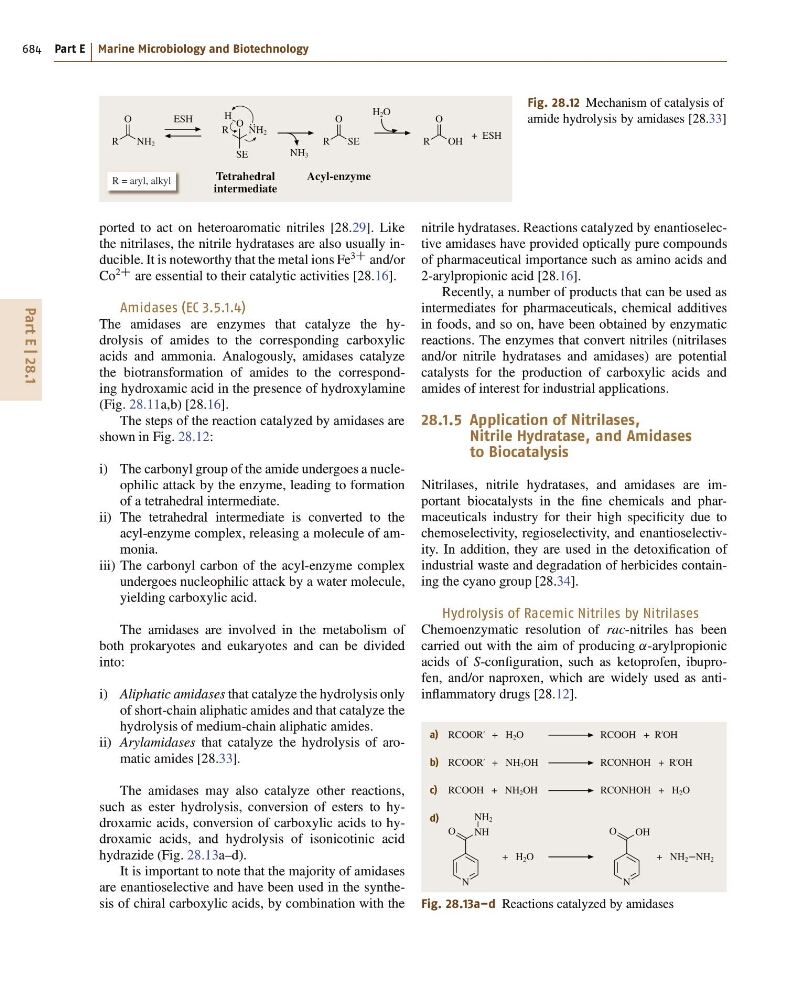
Fig. 28.12 Mechanism of catalysis of
amide hydrolysis by amidases [28.33]
ported to act on heteroaromatic nitriles [28.29]. Like
the nitrilases, the nitrile hydratases are also usually inducible. It is noteworthy that the metal ions Fe
3C and/or
Co
2C are essential to their catalytic activities [28.16].
Amidases (EC 3.5.1.4)
The amidases are enzymes that catalyze the hydrolysis of amides to the corresponding carboxylic
acids and ammonia. Analogously, amidases catalyze
the biotransformation of amides to the corresponding hydroxamic acid in the presence of hydroxylamine
(Fig. 28.11a,b) [28.16].
The steps of the reaction catalyzed by amidases are
shown in Fig. 28.12:
i) The carbonyl group of the amide undergoes a nucleophilic attack by the enzyme, leading to formation
of a tetrahedral intermediate.
ii) The tetrahedral intermediate is converted to the
acyl-enzyme complex, releasing a molecule of ammonia.
iii) The carbonyl carbon of the acyl-enzyme complex
undergoes nucleophilic attack by a water molecule,
yielding carboxylic acid.
The amidases are involved in the metabolism of
both prokaryotes and eukaryotes and can be divided
into:
i) Aliphatic amidases that catalyze the hydrolysis only
of short-chain aliphatic amides and that catalyze the
hydrolysis of medium-chain aliphatic amides.
ii) Arylamidases that catalyze the hydrolysis of aromatic amides [28.33].
The amidases may also catalyze other reactions,
such as ester hydrolysis, conversion of esters to hydroxamic acids, conversion of carboxylic acids to hydroxamic acids, and hydrolysis of isonicotinic acid
hydrazide (Fig. 28.13a–d).
It is important to note that the majority of amidases
are enantioselective and have been used in the synthesis of chiral carboxylic acids, by combination with the
nitrile hydratases. Reactions catalyzed by enantioselective amidases have provided optically pure compounds
of pharmaceutical importance such as amino acids and
2-arylpropionic acid [28.16].
Recently, a number of products that can be used as
intermediates for pharmaceuticals, chemical additives
in foods, and so on, have been obtained by enzymatic
reactions. The enzymes that convert nitriles (nitrilases
and/or nitrile hydratases and amidases) are potential
catalysts for the production of carboxylic acids and
amides of interest for industrial applications.
28.1.5 Application of Nitrilases,
Nitrile Hydratase, and Amidases
to Biocatalysis
Nitrilases, nitrile hydratases, and amidases are important biocatalysts in the fine chemicals and pharmaceuticals industry for their high specificity due to
chemoselectivity, regioselectivity, and enantioselectivity. In addition, they are used in the detoxification of
industrial waste and degradation of herbicides containing the cyano group [28.34].
Hydrolysis of Racemic Nitriles by Nitrilases
Chemoenzymatic resolution of rac-nitriles has been
carried out with the aim of producing ˛-arylpropionic
acids of S-configuration, such as ketoprofen, ibuprofen, and/or naproxen, which are widely used as antiinflammatory drugs [28.12].
RCOOR' + H 2 O
RCOOH + R'OH
a)
RCOOR' + NH 2 OH
RCONHOH + R'OH
b)
RCOOH + NH 2 OH
RCONHOH + H 2 O
+ H 2 O
+ NH 2 NH 2
c)
d)
O
N
NH
NH 2
O
N
OH
Fig. 28.13a–d Reactions catalyzed by amidases