

Part E | 28.1
682 Part E Marine Microbiology and Biotechnology
S
Cys
110
Cys
112
N
Ser
113
Cis
114
O
–
O
–
–
O
S
N
H
N
Mechanism I
Mechanism II
Inactive
Active
O
Fe
3+
C
C
O
–
S
NO
hv
S
Cys
110
Cys
112
N
Ser
113
Cis
114
O
–
O
–
–
O
S
NH
OH
HB:
H
O:
H
N
C
R
C
C
O
–
S
S
Cys
110
Cys
112
N
Ser
113
Cis
114
O
–
O
–
– O
S
NH
: OH
Fe
3+
C
C
O
–
S
S
Cys
110
Cys
112
N
Ser
113
Cis
114
O
–
O
–
– O
S
N
H
OH
M
x+
M
x+ = Fe
3+ or Co
2+
M
x+
C
NH
Imidate
Imidate
Amide
Tautomerism
Tautomerism
R
O H
+ HB
+ HB
+
+
C
O
–
S
S
Cys
110
Cys
112
N
Ser
113
Cis
114
O
–
O
–
–
O
S
NH
OH
HB
H
O:
C
C
O
–
S
H
N
C
R
S
Cys
110
Cys
112
N
Ser
113
Cis
114
O
–
O
–
– O
S
N
H
O
+
H
H
:B
–
M
x+
M
x+
C
C
O
–
S
O
R
N H 2
NH
R
O H
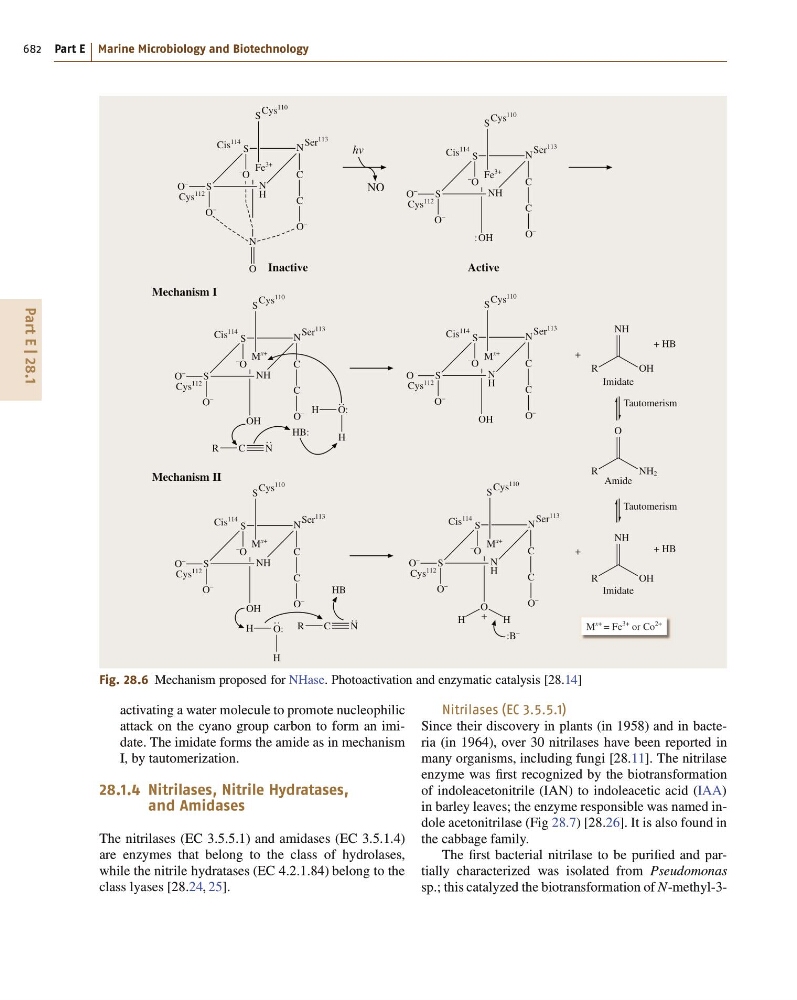
Fig. 28.6 Mechanism proposed for NHase. Photoactivation and enzymatic catalysis [28.14]
activating a water molecule to promote nucleophilic
attack on the cyano group carbon to form an imidate. The imidate forms the amide as in mechanism
I, by tautomerization.
28.1.4 Nitrilases, Nitrile Hydratases,
and Amidases
The nitrilases (EC 3.5.5.1) and amidases (EC 3.5.1.4)
are enzymes that belong to the class of hydrolases,
while the nitrile hydratases (EC 4.2.1.84) belong to the
class lyases [28.24, 25].
Nitrilases (EC 3.5.5.1)
Since their discovery in plants (in 1958) and in bacteria (in 1964), over 30 nitrilases have been reported in
many organisms, including fungi [28.11]. The nitrilase
enzyme was first recognized by the biotransformation
of indoleacetonitrile (IAN) to indoleacetic acid (IAA)
in barley leaves; the enzyme responsible was named indole acetonitrilase (Fig 28.7) [28.26]. It is also found in
the cabbage family.
The first bacterial nitrilase to be purified and partially characterized was isolated from Pseudomonas
sp.; this catalyzed the biotransformation of N-methyl-3-