

Biotransformation of Nitriles by Marine Fungi 28.1 Overview 681
Part E | 28.1
N
+
Lys
H
H
R C
+
N
–
O
H
H
H
Glu
H
S
Cys
O
δ –
O δ –
N
+
Lys
H
H
R
N
O
H
H
H
Glu
H
S
C
Cys
O
δ –
O δ –
O
δ –
O δ –
Thioimidate-enzyme
Thioester-enzyme
Tetrahedral
intermediate
N
+
Lys
H
R
O
O
O
+
+ Lys–NH 2 –H + H–S–Cys + NH 3
R
O H
H
H
H
H
Glu
–NH 3
S
Cys
O
δ –
O δ –
N
+
Lys
H
H
N
H
R
O
H
H
H
Glu
H
H
S
C
Cys
O
O
O
N
+
N
+
Lys
H
H
H
H
R
O
O
H
H
H
H
Glu
S
C
Cys
O
Glu
O
–
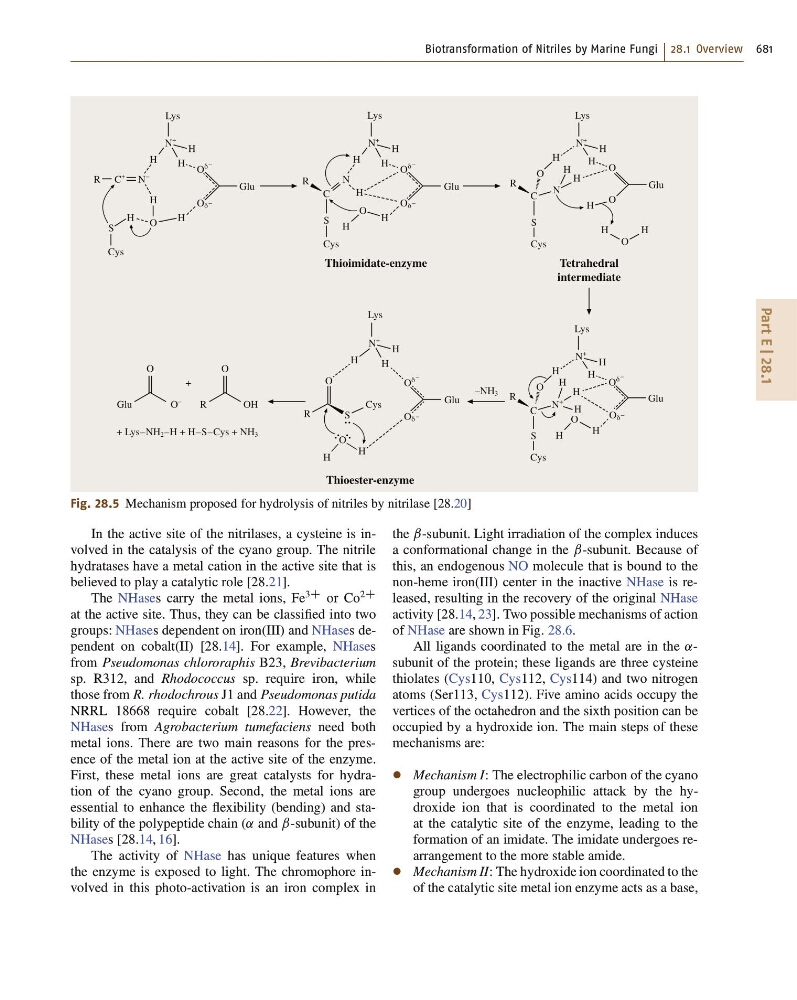
Fig. 28.5 Mechanism proposed for hydrolysis of nitriles by nitrilase [28.20]
In the active site of the nitrilases, a cysteine is involved in the catalysis of the cyano group. The nitrile
hydratases have a metal cation in the active site that is
believed to play a catalytic role [28.21].
The NHases carry the metal ions, Fe
3C or Co
2C
at the active site. Thus, they can be classified into two
groups: NHases dependent on iron(III) and NHases dependent on cobalt(II) [28.14]. For example, NHases
from Pseudomonas chlororaphis B23, Brevibacterium
sp. R312, and Rhodococcus sp. require iron, while
those from R. rhodochrous J1 and Pseudomonas putida
NRRL 18668 require cobalt [28.22]. However, the
NHases from Agrobacterium tumefaciens need both
metal ions. There are two main reasons for the presence of the metal ion at the active site of the enzyme.
First, these metal ions are great catalysts for hydration of the cyano group. Second, the metal ions are
essential to enhance the flexibility (bending) and stability of the polypeptide chain (˛ and ˇ-subunit) of the
NHases [28.14, 16].
The activity of NHase has unique features when
the enzyme is exposed to light. The chromophore involved in this photo-activation is an iron complex in
the ˇ-subunit. Light irradiation of the complex induces
a conformational change in the ˇ-subunit. Because of
this, an endogenous NO molecule that is bound to the
non-heme iron(III) center in the inactive NHase is released, resulting in the recovery of the original NHase
activity [28.14, 23]. Two possible mechanisms of action
of NHase are shown in Fig. 28.6.
All ligands coordinated to the metal are in the ˛subunit of the protein; these ligands are three cysteine
thiolates (Cys110, Cys112, Cys114) and two nitrogen
atoms (Ser113, Cys112). Five amino acids occupy the
vertices of the octahedron and the sixth position can be
occupied by a hydroxide ion. The main steps of these
mechanisms are:
Mechanism I: The electrophilic carbon of the cyano
group undergoes nucleophilic attack by the hydroxide ion that is coordinated to the metal ion
at the catalytic site of the enzyme, leading to the
formation of an imidate. The imidate undergoes rearrangement to the more stable amide.
Mechanism II: The hydroxide ion coordinated to the
of the catalytic site metal ion enzyme acts as a base,