

Part E | 28.1
680 Part E Marine Microbiology and Biotechnology
RCH 2 CONH 2
RCH 2 CH 3 + NH 3
RCH(OH)CN
RCHO + HCN
HCONH 2
CO 2 + NH 2
HCOOH + NH 3
Cyanide
dihydratase
Cyanide
hydratase
Cyanase
RCH 2 COOH
RCH 2 CN
Aldoxime
N
OH
H
R
Aldoxime
desydratase
H 2 O
Nitrogenase
Oxygenase
Oxynitrilase
Nitrile
hydratase
Nitrilase
Amidase
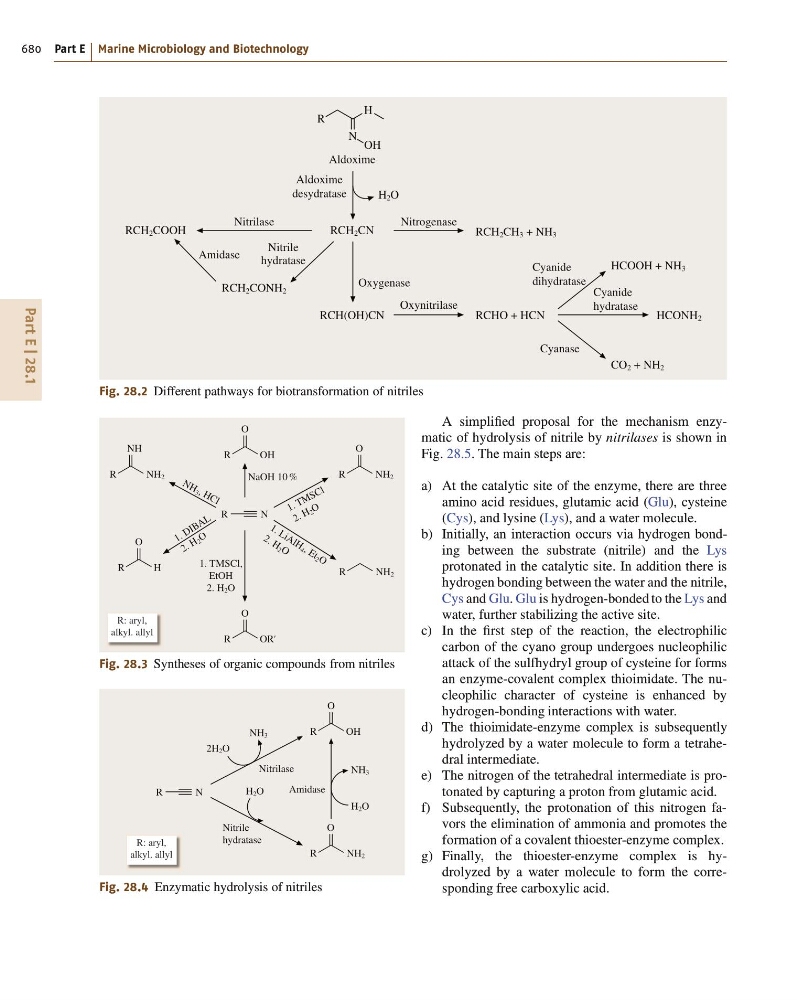
Fig. 28.2 Different pathways for biotransformation of nitriles
O
R
O H
R
N
NaOH 10 %
O
R
O R '
NH
R
N H 2
O
R
H
R
O
R
N H 2
NH 2
R: aryl,
alkyl. allyl
N H
3 , H C l
1 . D I B A L
2 . H 2 O
1. TMSCl,
EtOH
2. H 2 O
1 . T M S C l
2 . H 2 O
1 . L i A l H
4 , E t 2 O
2 . H
2 O
Fig. 28.3 Syntheses of organic compounds from nitriles
O
R
O H
H 2 O
NH 3
Nitrilase
Amidase
Nitrile
hydratase
H 2 O
2H 2 O
NH 3
R
N
O
R
N H 2
R: aryl,
alkyl. allyl
Fig. 28.4 Enzymatic hydrolysis of nitriles
A simplified proposal for the mechanism enzymatic of hydrolysis of nitrile by nitrilases is shown in
Fig. 28.5. The main steps are:
a) At the catalytic site of the enzyme, there are three
amino acid residues, glutamic acid (Glu), cysteine
(Cys), and lysine (Lys), and a water molecule.
b) Initially, an interaction occurs via hydrogen bonding between the substrate (nitrile) and the Lys
protonated in the catalytic site. In addition there is
hydrogen bonding between the water and the nitrile,
Cys and Glu. Glu is hydrogen-bonded to the Lys and
water, further stabilizing the active site.
c) In the first step of the reaction, the electrophilic
carbon of the cyano group undergoes nucleophilic
attack of the sulfhydryl group of cysteine for forms
an enzyme-covalent complex thioimidate. The nucleophilic character of cysteine is enhanced by
hydrogen-bonding interactions with water.
d) The thioimidate-enzyme complex is subsequently
hydrolyzed by a water molecule to form a tetrahedral intermediate.
e) The nitrogen of the tetrahedral intermediate is protonated by capturing a proton from glutamic acid.
f) Subsequently, the protonation of this nitrogen favors the elimination of ammonia and promotes the
formation of a covalent thioester-enzyme complex.
g) Finally, the thioester-enzyme complex is hydrolyzed by a water molecule to form the corresponding free carboxylic acid.