

Biotransformation of Nitriles by Marine Fungi 28.1 Overview 679
Part E | 28.1
a generalized expression marine-derived fungi has been
used [28.8].
Recently, studies were performed to assess methods
of isolating marine-derived fungi on various culture media, resulting in a set of 688 fungal strains isolated from
ascidians, sponges, and algae. In addition, with the advance of techniques in molecular biology, it has been
possible to isolate and identify obligate marine species
of bacteria and fungi from the oceans [28.9].
Marine microorganisms have specific biochemical
properties that can provide new enzymes with unique
characteristics, which can be more active and stable
than the corresponding enzymes of terrestrial organisms [28.10]. The complexity of the marine environment with its high salinity and pressure, low temperature, and special lighting may give rise to the significant
differences between the enzymes produced by marine
microorganisms and the homologous enzymes from
terrestrial microorganisms. Such differences boost the
technological potential of enzymes from marine microorganisms in the production of valuable compounds
of scientific and economic interest [28.10].
28.1.3 Nitriles
Organic compounds of various classes containing
the cyano group occur naturally in the environment
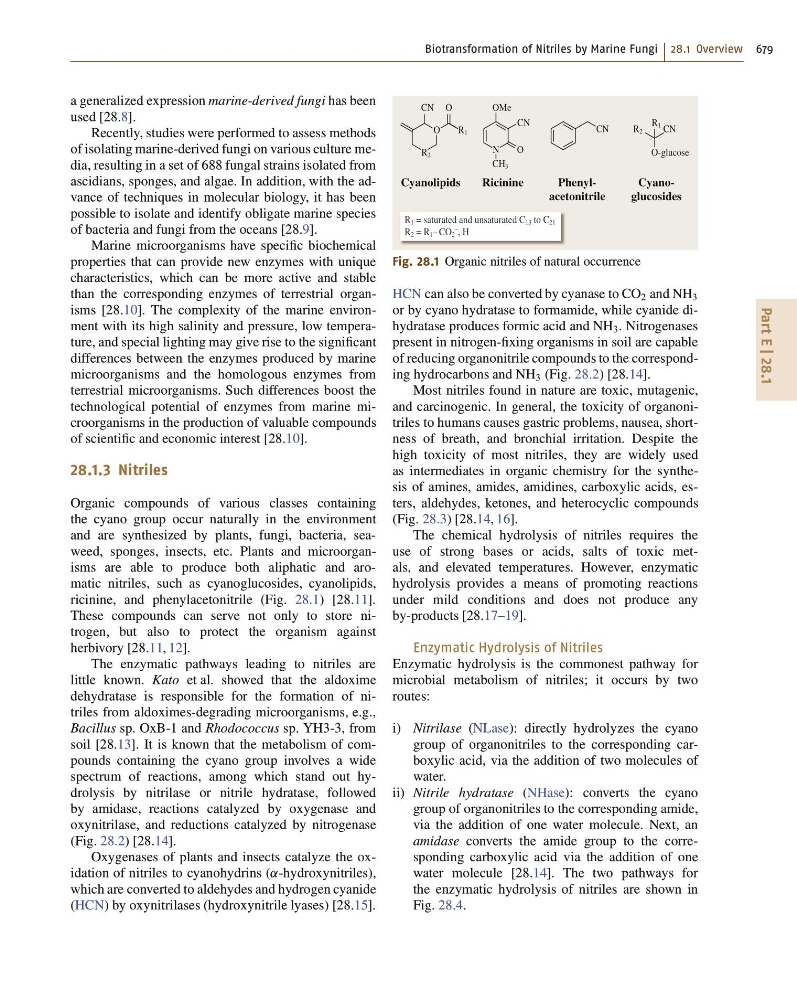
and are synthesized by plants, fungi, bacteria, seaweed, sponges, insects, etc. Plants and microorganisms are able to produce both aliphatic and aromatic nitriles, such as cyanoglucosides, cyanolipids,
ricinine, and phenylacetonitrile (Fig. 28.1) [28.11].
These compounds can serve not only to store nitrogen, but also to protect the organism against
herbivory [28.11, 12].
The enzymatic pathways leading to nitriles are
little known. Kato et al. showed that the aldoxime
dehydratase is responsible for the formation of nitriles from aldoximes-degrading microorganisms, e.g.,
Bacillus sp. OxB-1 and Rhodococcus sp. YH3-3, from
soil [28.13]. It is known that the metabolism of compounds containing the cyano group involves a wide
spectrum of reactions, among which stand out hydrolysis by nitrilase or nitrile hydratase, followed
by amidase, reactions catalyzed by oxygenase and
oxynitrilase, and reductions catalyzed by nitrogenase
(Fig. 28.2) [28.14].
Oxygenases of plants and insects catalyze the oxidation of nitriles to cyanohydrins (˛-hydroxynitriles),
which are converted to aldehydes and hydrogen cyanide
(HCN) by oxynitrilases (hydroxynitrile lyases) [28.15].
O
N
CH 3
O
CN
CN
R 2
R 1
O-glucose
CN
CN
OMe
O
R 2
R 1
Cyanolipids
R 1 = saturated and unsaturated C 13 to C 21
R 2 = R 1 – CO 2
–
, H
Ricinine
Phenylacetonitrile
Cyanoglucosides
Fig. 28.1 Organic nitriles of natural occurrence
HCN can also be converted by cyanase to CO 2 and NH 3
or by cyano hydratase to formamide, while cyanide dihydratase produces formic acid and NH 3 . Nitrogenases
present in nitrogen-fixing organisms in soil are capable
of reducing organonitrile compounds to the corresponding hydrocarbons and NH 3 (Fig. 28.2) [28.14].
Most nitriles found in nature are toxic, mutagenic,
and carcinogenic. In general, the toxicity of organonitriles to humans causes gastric problems, nausea, shortness of breath, and bronchial irritation. Despite the
high toxicity of most nitriles, they are widely used
as intermediates in organic chemistry for the synthesis of amines, amides, amidines, carboxylic acids, esters, aldehydes, ketones, and heterocyclic compounds
(Fig. 28.3) [28.14, 16].
The chemical hydrolysis of nitriles requires the
use of strong bases or acids, salts of toxic metals, and elevated temperatures. However, enzymatic
hydrolysis provides a means of promoting reactions
under mild conditions and does not produce any
by-products [28.17–19].
Enzymatic Hydrolysis of Nitriles
Enzymatic hydrolysis is the commonest pathway for
microbial metabolism of nitriles; it occurs by two
routes:
i) Nitrilase (NLase): directly hydrolyzes the cyano
group of organonitriles to the corresponding carboxylic acid, via the addition of two molecules of
water.
ii) Nitrile hydratase (NHase): converts the cyano
group of organonitriles to the corresponding amide,
via the addition of one water molecule. Next, an
amidase converts the amide group to the corresponding carboxylic acid via the addition of one
water molecule [28.14]. The two pathways for
the enzymatic hydrolysis of nitriles are shown in
Fig. 28.4.