

Part D | 25.4
622 Part D Marine Algal Biotechnology
Un-buffered solutions
Buffered solutions
1
pH = 4.0
2
pH = 5.0
3
pH = 6.0
a) q (mg/g)
pH
25
20
15
10
5
0
1
pH = 4.0
2
pH = 5.0
3
pH = 6.0
b) q (mg/g)
pH
6
5
4
3
2
1
0
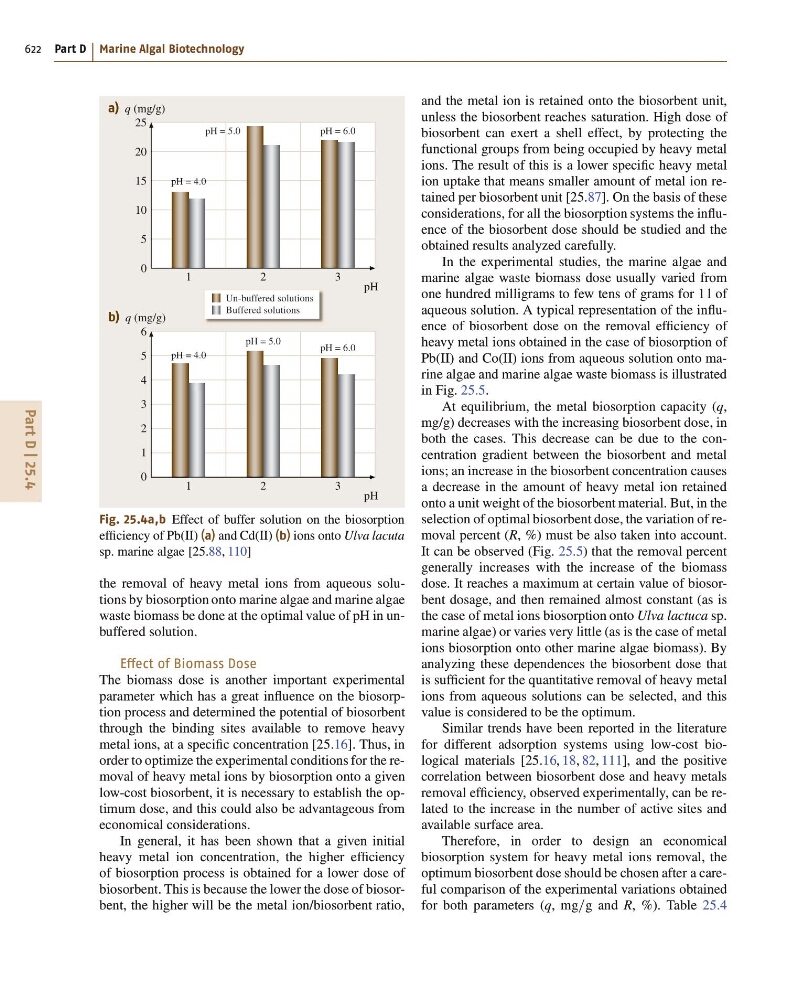
Fig. 25.4a,b Effect of buffer solution on the biosorption
efficiency of Pb(II) (a) and Cd(II) (b) ions onto Ulva lacuta
sp. marine algae [25.88, 110]
the removal of heavy metal ions from aqueous solutions by biosorption onto marine algae and marine algae
waste biomass be done at the optimal value of pH in unbuffered solution.
Effect of Biomass Dose
The biomass dose is another important experimental
parameter which has a great influence on the biosorption process and determined the potential of biosorbent
through the binding sites available to remove heavy
metal ions, at a specific concentration [25.16]. Thus, in
order to optimize the experimental conditions for the removal of heavy metal ions by biosorption onto a given
low-cost biosorbent, it is necessary to establish the optimum dose, and this could also be advantageous from
economical considerations.
In general, it has been shown that a given initial
heavy metal ion concentration, the higher efficiency
of biosorption process is obtained for a lower dose of
biosorbent. This is because the lower the dose of biosorbent, the higher will be the metal ion/biosorbent ratio,
and the metal ion is retained onto the biosorbent unit,
unless the biosorbent reaches saturation. High dose of
biosorbent can exert a shell effect, by protecting the
functional groups from being occupied by heavy metal
ions. The result of this is a lower specific heavy metal
ion uptake that means smaller amount of metal ion retained per biosorbent unit [25.87]. On the basis of these
considerations, for all the biosorption systems the influence of the biosorbent dose should be studied and the
obtained results analyzed carefully.
In the experimental studies, the marine algae and
marine algae waste biomass dose usually varied from
one hundred milligrams to few tens of grams for 1 l of
aqueous solution. A typical representation of the influence of biosorbent dose on the removal efficiency of
heavy metal ions obtained in the case of biosorption of
Pb(II) and Co(II) ions from aqueous solution onto marine algae and marine algae waste biomass is illustrated
in Fig. 25.5.
At equilibrium, the metal biosorption capacity (q,
mg/g) decreases with the increasing biosorbent dose, in
both the cases. This decrease can be due to the concentration gradient between the biosorbent and metal
ions; an increase in the biosorbent concentration causes
a decrease in the amount of heavy metal ion retained
onto a unit weight of the biosorbent material. But, in the
selection of optimal biosorbent dose, the variation of removal percent (R, %) must be also taken into account.
It can be observed (Fig. 25.5) that the removal percent
generally increases with the increase of the biomass
dose. It reaches a maximum at certain value of biosorbent dosage, and then remained almost constant (as is
the case of metal ions biosorption onto Ulva lactuca sp.
marine algae) or varies very little (as is the case of metal
ions biosorption onto other marine algae biomass). By
analyzing these dependences the biosorbent dose that
is sufficient for the quantitative removal of heavy metal
ions from aqueous solutions can be selected, and this
value is considered to be the optimum.
Similar trends have been reported in the literature
for different adsorption systems using low-cost biological materials [25.16, 18, 82, 111], and the positive
correlation between biosorbent dose and heavy metals
removal efficiency, observed experimentally, can be related to the increase in the number of active sites and
available surface area.
Therefore, in order to design an economical
biosorption system for heavy metal ions removal, the
optimum biosorbent dose should be chosen after a careful comparison of the experimental variations obtained
for both parameters (q, mg=g and R, %). Table 25.4