

Marine Algae Biomass for Removal of Heavy Metal Ions 25.4 Influence of Experimental Parameters 621
Part D | 25.4
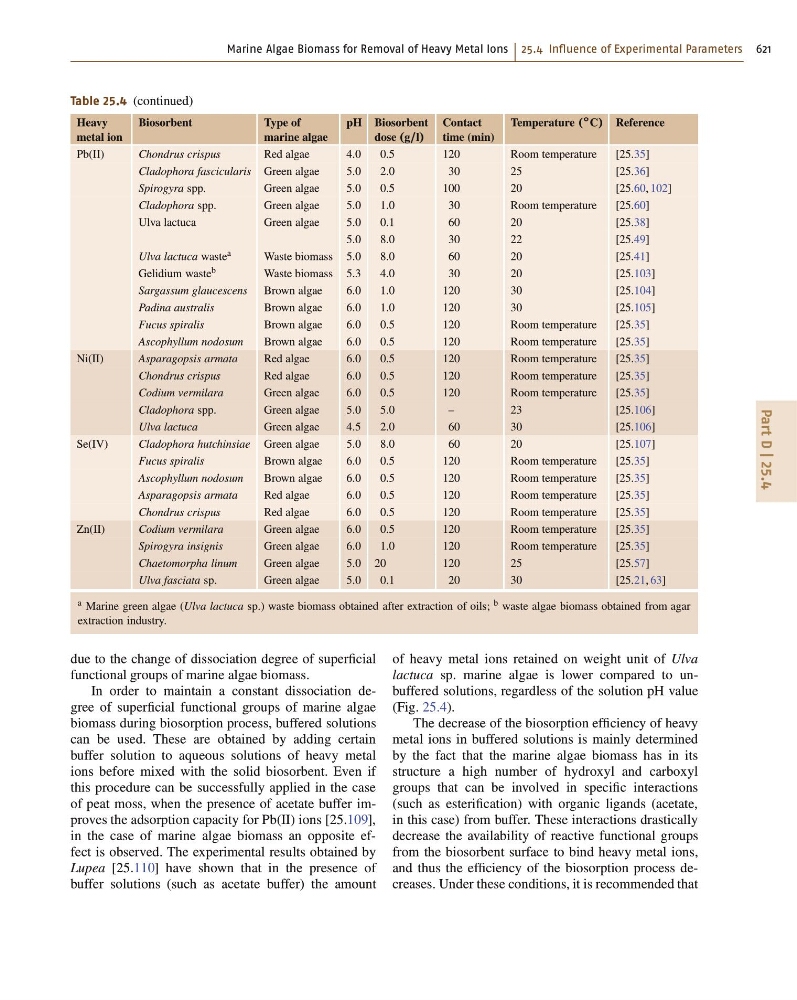
Table 25.4 (continued)
Heavy
metal ion
Biosorbent
Type of
marine algae
pH Biosorbent
dose .g=l/
Contact
time (min)
Temperature .
ı C/ Reference
Pb(II)
Chondrus crispus
Red algae
4.0
0.5
120
Room temperature
[25.35]
Cladophora fascicularis Green algae
5.0
2.0
30
25
[25.36]
Spirogyra spp.
Green algae
5.0
0.5
100
20
[25.60, 102]
Cladophora spp.
Green algae
5.0
1.0
30
Room temperature
[25.60]
Ulva lactuca
Green algae
5.0
0.1
60
20
[25.38]
5.0
8.0
30
22
[25.49]
Ulva lactuca waste a
Waste biomass 5.0
8.0
60
20
[25.41]
Gelidium waste b
Waste biomass 5.3
4.0
30
20
[25.103]
Sargassum glaucescens Brown algae
6.0
1.0
120
30
[25.104]
Padina australis
Brown algae
6.0
1.0
120
30
[25.105]
Fucus spiralis
Brown algae
6.0
0.5
120
Room temperature
[25.35]
Ascophyllum nodosum
Brown algae
6.0
0.5
120
Room temperature
[25.35]
Ni(II)
Asparagopsis armata
Red algae
6.0
0.5
120
Room temperature
[25.35]
Chondrus crispus
Red algae
6.0
0.5
120
Room temperature
[25.35]
Codium vermilara
Green algae
6.0
0.5
120
Room temperature
[25.35]
Cladophora spp.
Green algae
5.0
5.0
–
23
[25.106]
Ulva lactuca
Green algae
4.5
2.0
60
30
[25.106]
Se(IV)
Cladophora hutchinsiae Green algae
5.0
8.0
60
20
[25.107]
Fucus spiralis
Brown algae
6.0
0.5
120
Room temperature
[25.35]
Ascophyllum nodosum
Brown algae
6.0
0.5
120
Room temperature
[25.35]
Asparagopsis armata
Red algae
6.0
0.5
120
Room temperature
[25.35]
Chondrus crispus
Red algae
6.0
0.5
120
Room temperature
[25.35]
Zn(II)
Codium vermilara
Green algae
6.0
0.5
120
Room temperature
[25.35]
Spirogyra insignis
Green algae
6.0
1.0
120
Room temperature
[25.35]
Chaetomorpha linum
Green algae
5.0 20
120
25
[25.57]
Ulva fasciata sp.
Green algae
5.0
0.1
20
30
[25.21, 63]
a Marine green algae (Ulva lactuca sp.) waste biomass obtained after extraction of oils; b waste algae biomass obtained from agar
extraction industry.
due to the change of dissociation degree of superficial
functional groups of marine algae biomass.
In order to maintain a constant dissociation degree of superficial functional groups of marine algae
biomass during biosorption process, buffered solutions
can be used. These are obtained by adding certain
buffer solution to aqueous solutions of heavy metal
ions before mixed with the solid biosorbent. Even if
this procedure can be successfully applied in the case
of peat moss, when the presence of acetate buffer improves the adsorption capacity for Pb(II) ions [25.109],
in the case of marine algae biomass an opposite effect is observed. The experimental results obtained by
Lupea [25.110] have shown that in the presence of
buffer solutions (such as acetate buffer) the amount
of heavy metal ions retained on weight unit of Ulva
lactuca sp. marine algae is lower compared to unbuffered solutions, regardless of the solution pH value
(Fig. 25.4).
The decrease of the biosorption efficiency of heavy
metal ions in buffered solutions is mainly determined
by the fact that the marine algae biomass has in its
structure a high number of hydroxyl and carboxyl
groups that can be involved in specific interactions
(such as esterification) with organic ligands (acetate,
in this case) from buffer. These interactions drastically
decrease the availability of reactive functional groups
from the biosorbent surface to bind heavy metal ions,
and thus the efficiency of the biosorption process decreases. Under these conditions, it is recommended that