

Part C | 21.3
534 Part C Marine Genomics
of novel natural products and represents a strategy to
access tremendous sources of new, biologically active
metabolites [21.12]. The concept of genome mining for
the discovery of novel natural products appears to be
more suitable for vulnerable and sensitive natural environments like the coral reef ecosystem, the mangrove
ecosystem, etc., which are difficult to access, although
they have great potential as a repository of many novel
bioactive compounds.
21.3.2 Functional Metagenomics
A functional metagenomics approach is the most effective and suitable for the screening novel gene products
or genome mining from any sensitive ecosystem inExtraction of DNA
Insert into the plasmid
Plasmid library
Insert in suitable vector
Activity-based screening
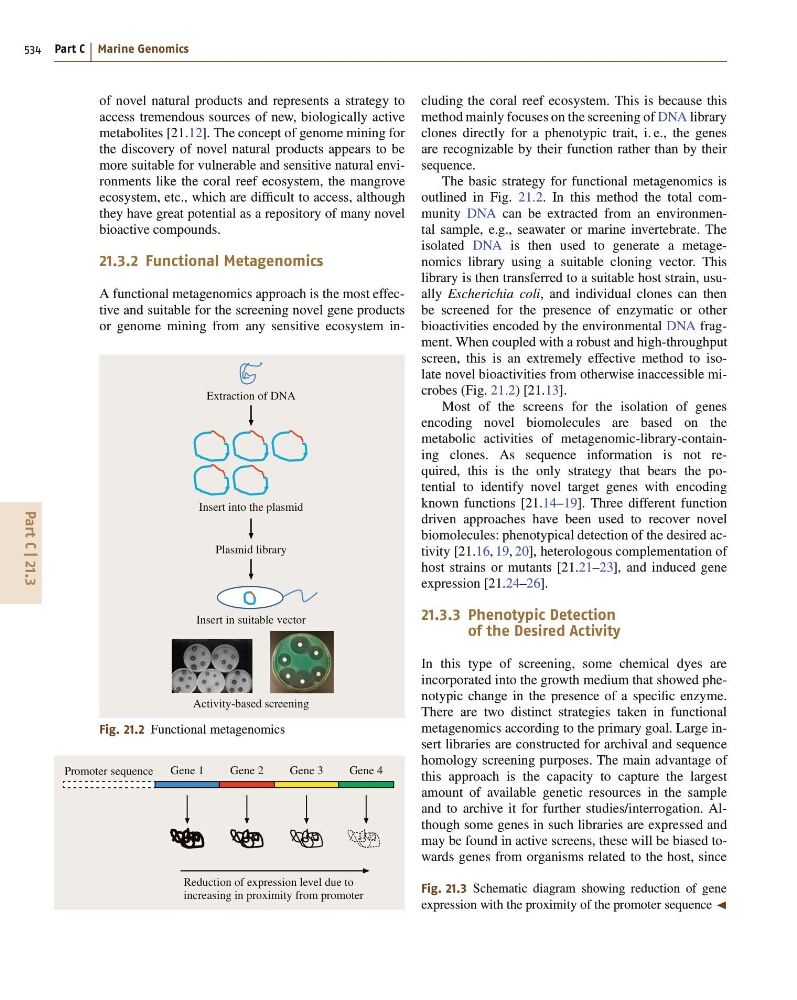
Fig. 21.2 Functional metagenomics
Promoter sequence Gene 1
Gene 2
Gene 3
Gene 4
Reduction of expression level due to
increasing in proximity from promoter
cluding the coral reef ecosystem. This is because this
method mainly focuses on the screening of DNA library
clones directly for a phenotypic trait, i. e., the genes
are recognizable by their function rather than by their
sequence.
The basic strategy for functional metagenomics is
outlined in Fig. 21.2. In this method the total community DNA can be extracted from an environmental sample, e.g., seawater or marine invertebrate. The
isolated DNA is then used to generate a metagenomics library using a suitable cloning vector. This
library is then transferred to a suitable host strain, usually Escherichia coli, and individual clones can then
be screened for the presence of enzymatic or other
bioactivities encoded by the environmental DNA fragment. When coupled with a robust and high-throughput
screen, this is an extremely effective method to isolate novel bioactivities from otherwise inaccessible microbes (Fig. 21.2) [21.13].
Most of the screens for the isolation of genes
encoding novel biomolecules are based on the
metabolic activities of metagenomic-library-containing clones. As sequence information is not required, this is the only strategy that bears the potential to identify novel target genes with encoding
known functions [21.14–19]. Three different function
driven approaches have been used to recover novel
biomolecules: phenotypical detection of the desired activity [21.16, 19, 20], heterologous complementation of
host strains or mutants [21.21–23], and induced gene
expression [21.24–26].
21.3.3 Phenotypic Detection
of the Desired Activity
In this type of screening, some chemical dyes are
incorporated into the growth medium that showed phenotypic change in the presence of a specific enzyme.
There are two distinct strategies taken in functional
metagenomics according to the primary goal. Large insert libraries are constructed for archival and sequence
homology screening purposes. The main advantage of
this approach is the capacity to capture the largest
amount of available genetic resources in the sample
and to archive it for further studies/interrogation. Although some genes in such libraries are expressed and
may be found in active screens, these will be biased towards genes from organisms related to the host, since
Fig. 21.3 Schematic diagram showing reduction of gene
expression with the proximity of the promoter sequence J
534 Part C Marine Genomics
of novel natural products and represents a strategy to
access tremendous sources of new, biologically active
metabolites [21.12]. The concept of genome mining for
the discovery of novel natural products appears to be
more suitable for vulnerable and sensitive natural environments like the coral reef ecosystem, the mangrove
ecosystem, etc., which are difficult to access, although
they have great potential as a repository of many novel
bioactive compounds.
21.3.2 Functional Metagenomics
A functional metagenomics approach is the most effective and suitable for the screening novel gene products
or genome mining from any sensitive ecosystem inExtraction of DNA
Insert into the plasmid
Plasmid library
Insert in suitable vector
Activity-based screening
Fig. 21.2 Functional metagenomics
Promoter sequence Gene 1
Gene 2
Gene 3
Gene 4
Reduction of expression level due to
increasing in proximity from promoter
cluding the coral reef ecosystem. This is because this
method mainly focuses on the screening of DNA library
clones directly for a phenotypic trait, i. e., the genes
are recognizable by their function rather than by their
sequence.
The basic strategy for functional metagenomics is
outlined in Fig. 21.2. In this method the total community DNA can be extracted from an environmental sample, e.g., seawater or marine invertebrate. The
isolated DNA is then used to generate a metagenomics library using a suitable cloning vector. This
library is then transferred to a suitable host strain, usually Escherichia coli, and individual clones can then
be screened for the presence of enzymatic or other
bioactivities encoded by the environmental DNA fragment. When coupled with a robust and high-throughput
screen, this is an extremely effective method to isolate novel bioactivities from otherwise inaccessible microbes (Fig. 21.2) [21.13].
Most of the screens for the isolation of genes
encoding novel biomolecules are based on the
metabolic activities of metagenomic-library-containing clones. As sequence information is not required, this is the only strategy that bears the potential to identify novel target genes with encoding
known functions [21.14–19]. Three different function
driven approaches have been used to recover novel
biomolecules: phenotypical detection of the desired activity [21.16, 19, 20], heterologous complementation of
host strains or mutants [21.21–23], and induced gene
expression [21.24–26].
21.3.3 Phenotypic Detection
of the Desired Activity
In this type of screening, some chemical dyes are
incorporated into the growth medium that showed phenotypic change in the presence of a specific enzyme.
There are two distinct strategies taken in functional
metagenomics according to the primary goal. Large insert libraries are constructed for archival and sequence
homology screening purposes. The main advantage of
this approach is the capacity to capture the largest
amount of available genetic resources in the sample
and to archive it for further studies/interrogation. Although some genes in such libraries are expressed and
may be found in active screens, these will be biased towards genes from organisms related to the host, since
Fig. 21.3 Schematic diagram showing reduction of gene
expression with the proximity of the promoter sequence J