

Genome Mining for Bioactive Compounds 21.3 Future Directions 535
Part C | 21.3
they generally lie far from vector expression signals
and, therefore, are expressed from their own expression signals (Fig. 21.3). On the other hand, small insert
expression libraries, especially those made in lambda
phage vectors, are constructed for activity screening.
The small size of the cloned fragments means that most
genes present in the appropriate orientation will be under the influence of extremely strong vector expression
signals and thus have a good chance of being expressed
and detected by activity screens [21.15].
Another function-driven screen is based on the principle of heterologous complementation of host strains
or their mutants, which requires the targeted genes
for growth under selective conditions. This technique
allows a simple and fast screening of complex metagenomic libraries comprising millions of clones [21.27].
Recently, Donato et al. [21.28] isolated genes that
confer resistance to tetracycline, ˇ-lactams or amino
glycoside antibiotics from a complementation-based
screen of 446 000 clones derived from specialized soil
samples.
Resistance genes were identified by subcloning
and/or in vitro transposon mutagenesis with the
Genome Priming System, GPS-1TM (New England
Biolabs). Subcloning was accomplished by partial digestion of plasmid DNA with Sau3AI, ligation into the
BamHI site of pUC19 (encoding ampicillin resistance)
and selection for subclones on Luria-Bertani (LB)
broth with the appropriate antibiotics. Subclones were
sized by gel electrophoresis after digestion with PvuII.
In vitro transposon mutagenesis inserts transposons
randomly into plasmid DNA, and antibiotic-susceptible
mutants were identified by patching cells onto media
containing the appropriate antibiotic. Sequencing reactions, using M13 forward and M13 reverse primers
or primers specific for the transposon ends, were performed on both DNA strands [21.18].
It is well known that marine invertebrates, including
corals, produce many secondary metabolites, including antimicrobials. Different functional metagenomic
approaches can be very useful tools to explore novel
bioactivities.
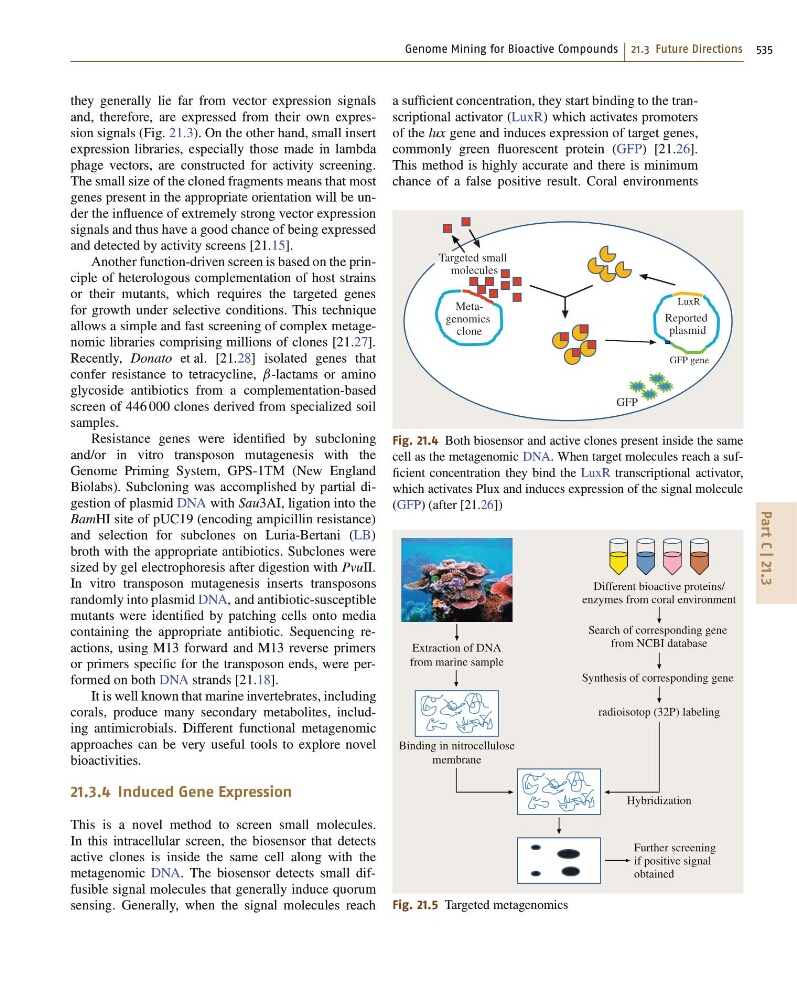
21.3.4 Induced Gene Expression
This is a novel method to screen small molecules.
In this intracellular screen, the biosensor that detects
active clones is inside the same cell along with the
metagenomic DNA. The biosensor detects small diffusible signal molecules that generally induce quorum
sensing. Generally, when the signal molecules reach
a sufficient concentration, they start binding to the transcriptional activator (LuxR) which activates promoters
of the lux gene and induces expression of target genes,
commonly green fluorescent protein (GFP) [21.26].
This method is highly accurate and there is minimum
chance of a false positive result. Coral environments
Metagenomics
clone
Targeted small
molecules
LuxR
Reported
plasmid
GFP gene
GFP
Fig. 21.4 Both biosensor and active clones present inside the same
cell as the metagenomic DNA. When target molecules reach a sufficient concentration they bind the LuxR transcriptional activator,
which activates Plux and induces expression of the signal molecule
(GFP) (after [21.26])
Extraction of DNA
from marine sample
Binding in nitrocellulose
membrane
Different bioactive proteins/
enzymes from coral environment
Search of corresponding gene
from NCBI database
Synthesis of corresponding gene
radioisotop (32P) labeling
Further screening
if positive signal
obtained
Hybridization
Fig. 21.5 Targeted metagenomics
Part C | 21.3
they generally lie far from vector expression signals
and, therefore, are expressed from their own expression signals (Fig. 21.3). On the other hand, small insert
expression libraries, especially those made in lambda
phage vectors, are constructed for activity screening.
The small size of the cloned fragments means that most
genes present in the appropriate orientation will be under the influence of extremely strong vector expression
signals and thus have a good chance of being expressed
and detected by activity screens [21.15].
Another function-driven screen is based on the principle of heterologous complementation of host strains
or their mutants, which requires the targeted genes
for growth under selective conditions. This technique
allows a simple and fast screening of complex metagenomic libraries comprising millions of clones [21.27].
Recently, Donato et al. [21.28] isolated genes that
confer resistance to tetracycline, ˇ-lactams or amino
glycoside antibiotics from a complementation-based
screen of 446 000 clones derived from specialized soil
samples.
Resistance genes were identified by subcloning
and/or in vitro transposon mutagenesis with the
Genome Priming System, GPS-1TM (New England
Biolabs). Subcloning was accomplished by partial digestion of plasmid DNA with Sau3AI, ligation into the
BamHI site of pUC19 (encoding ampicillin resistance)
and selection for subclones on Luria-Bertani (LB)
broth with the appropriate antibiotics. Subclones were
sized by gel electrophoresis after digestion with PvuII.
In vitro transposon mutagenesis inserts transposons
randomly into plasmid DNA, and antibiotic-susceptible
mutants were identified by patching cells onto media
containing the appropriate antibiotic. Sequencing reactions, using M13 forward and M13 reverse primers
or primers specific for the transposon ends, were performed on both DNA strands [21.18].
It is well known that marine invertebrates, including
corals, produce many secondary metabolites, including antimicrobials. Different functional metagenomic
approaches can be very useful tools to explore novel
bioactivities.
21.3.4 Induced Gene Expression
This is a novel method to screen small molecules.
In this intracellular screen, the biosensor that detects
active clones is inside the same cell along with the
metagenomic DNA. The biosensor detects small diffusible signal molecules that generally induce quorum
sensing. Generally, when the signal molecules reach
a sufficient concentration, they start binding to the transcriptional activator (LuxR) which activates promoters
of the lux gene and induces expression of target genes,
commonly green fluorescent protein (GFP) [21.26].
This method is highly accurate and there is minimum
chance of a false positive result. Coral environments
Metagenomics
clone
Targeted small
molecules
LuxR
Reported
plasmid
GFP gene
GFP
Fig. 21.4 Both biosensor and active clones present inside the same
cell as the metagenomic DNA. When target molecules reach a sufficient concentration they bind the LuxR transcriptional activator,
which activates Plux and induces expression of the signal molecule
(GFP) (after [21.26])
Extraction of DNA
from marine sample
Binding in nitrocellulose
membrane
Different bioactive proteins/
enzymes from coral environment
Search of corresponding gene
from NCBI database
Synthesis of corresponding gene
radioisotop (32P) labeling
Further screening
if positive signal
obtained
Hybridization
Fig. 21.5 Targeted metagenomics