

Genome Mining for Bioactive Compounds 21.3 Future Directions 533
Part C | 21.3
21.2 Temporary Halt in the Discovery of Bioactive Compounds
Koehn and Carter [21.2] accumulated the numbers
of natural products derived from small molecules for
which patents were granted between 19842003. According to report, increasing patent activity was observed throughout the 1980s, a flattening or even slight
decline between 19901999, and a pick up of activity
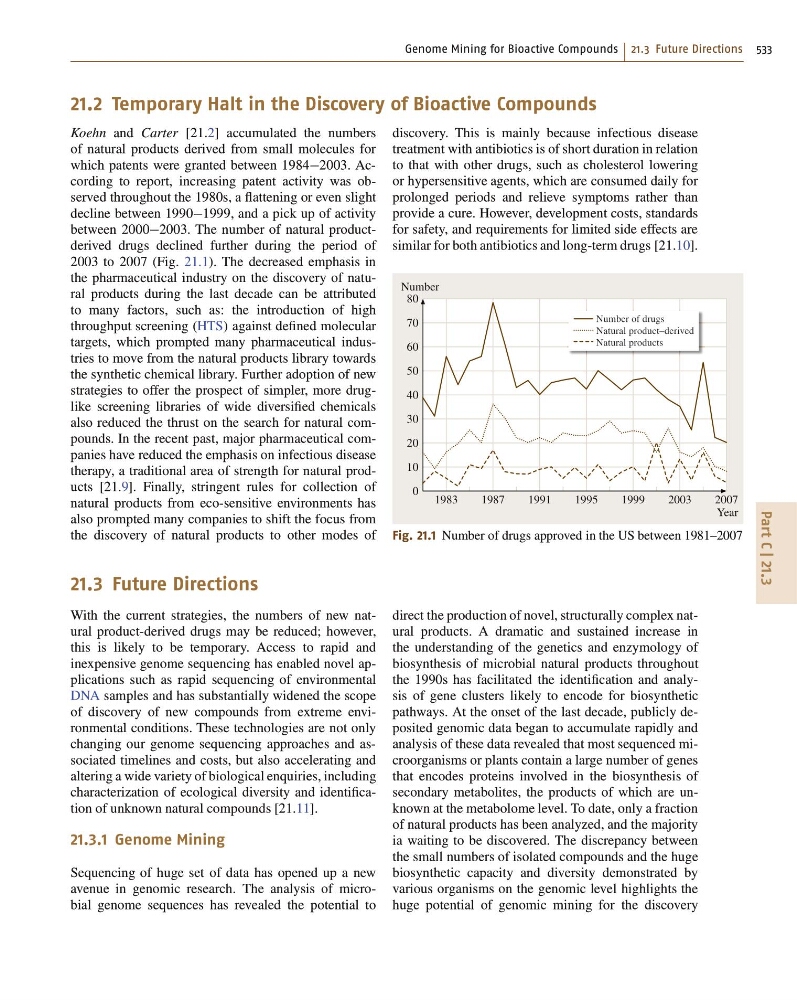
between 20002003. The number of natural productderived drugs declined further during the period of
2003 to 2007 (Fig. 21.1). The decreased emphasis in
the pharmaceutical industry on the discovery of natural products during the last decade can be attributed
to many factors, such as: the introduction of high
throughput screening (HTS) against defined molecular
targets, which prompted many pharmaceutical industries to move from the natural products library towards
the synthetic chemical library. Further adoption of new
strategies to offer the prospect of simpler, more druglike screening libraries of wide diversified chemicals
also reduced the thrust on the search for natural compounds. In the recent past, major pharmaceutical companies have reduced the emphasis on infectious disease
therapy, a traditional area of strength for natural products [21.9]. Finally, stringent rules for collection of
natural products from eco-sensitive environments has
also prompted many companies to shift the focus from
the discovery of natural products to other modes of
discovery. This is mainly because infectious disease
treatment with antibiotics is of short duration in relation
to that with other drugs, such as cholesterol lowering
or hypersensitive agents, which are consumed daily for
prolonged periods and relieve symptoms rather than
provide a cure. However, development costs, standards
for safety, and requirements for limited side effects are
similar for both antibiotics and long-term drugs [21.10].
Number of drugs
Natural product–derived
Natural products
1983
1987
1991
1995
1999
2003
2007
Number
Year
80
70
60
50
40
30
20
10
0
Fig. 21.1 Number of drugs approved in the US between 1981–2007
21.3 Future Directions
With the current strategies, the numbers of new natural product-derived drugs may be reduced; however,
this is likely to be temporary. Access to rapid and
inexpensive genome sequencing has enabled novel applications such as rapid sequencing of environmental
DNA samples and has substantially widened the scope
of discovery of new compounds from extreme environmental conditions. These technologies are not only
changing our genome sequencing approaches and associated timelines and costs, but also accelerating and
altering a wide variety of biological enquiries, including
characterization of ecological diversity and identification of unknown natural compounds [21.11].
21.3.1 Genome Mining
Sequencing of huge set of data has opened up a new
avenue in genomic research. The analysis of microbial genome sequences has revealed the potential to
direct the production of novel, structurally complex natural products. A dramatic and sustained increase in
the understanding of the genetics and enzymology of
biosynthesis of microbial natural products throughout
the 1990s has facilitated the identification and analysis of gene clusters likely to encode for biosynthetic
pathways. At the onset of the last decade, publicly deposited genomic data began to accumulate rapidly and
analysis of these data revealed that most sequenced microorganisms or plants contain a large number of genes
that encodes proteins involved in the biosynthesis of
secondary metabolites, the products of which are unknown at the metabolome level. To date, only a fraction
of natural products has been analyzed, and the majority
ia waiting to be discovered. The discrepancy between
the small numbers of isolated compounds and the huge
biosynthetic capacity and diversity demonstrated by
various organisms on the genomic level highlights the
huge potential of genomic mining for the discovery
Part C | 21.3
21.2 Temporary Halt in the Discovery of Bioactive Compounds
Koehn and Carter [21.2] accumulated the numbers
of natural products derived from small molecules for
which patents were granted between 19842003. According to report, increasing patent activity was observed throughout the 1980s, a flattening or even slight
decline between 19901999, and a pick up of activity
between 20002003. The number of natural productderived drugs declined further during the period of
2003 to 2007 (Fig. 21.1). The decreased emphasis in
the pharmaceutical industry on the discovery of natural products during the last decade can be attributed
to many factors, such as: the introduction of high
throughput screening (HTS) against defined molecular
targets, which prompted many pharmaceutical industries to move from the natural products library towards
the synthetic chemical library. Further adoption of new
strategies to offer the prospect of simpler, more druglike screening libraries of wide diversified chemicals
also reduced the thrust on the search for natural compounds. In the recent past, major pharmaceutical companies have reduced the emphasis on infectious disease
therapy, a traditional area of strength for natural products [21.9]. Finally, stringent rules for collection of
natural products from eco-sensitive environments has
also prompted many companies to shift the focus from
the discovery of natural products to other modes of
discovery. This is mainly because infectious disease
treatment with antibiotics is of short duration in relation
to that with other drugs, such as cholesterol lowering
or hypersensitive agents, which are consumed daily for
prolonged periods and relieve symptoms rather than
provide a cure. However, development costs, standards
for safety, and requirements for limited side effects are
similar for both antibiotics and long-term drugs [21.10].
Number of drugs
Natural product–derived
Natural products
1983
1987
1991
1995
1999
2003
2007
Number
Year
80
70
60
50
40
30
20
10
0
Fig. 21.1 Number of drugs approved in the US between 1981–2007
21.3 Future Directions
With the current strategies, the numbers of new natural product-derived drugs may be reduced; however,
this is likely to be temporary. Access to rapid and
inexpensive genome sequencing has enabled novel applications such as rapid sequencing of environmental
DNA samples and has substantially widened the scope
of discovery of new compounds from extreme environmental conditions. These technologies are not only
changing our genome sequencing approaches and associated timelines and costs, but also accelerating and
altering a wide variety of biological enquiries, including
characterization of ecological diversity and identification of unknown natural compounds [21.11].
21.3.1 Genome Mining
Sequencing of huge set of data has opened up a new
avenue in genomic research. The analysis of microbial genome sequences has revealed the potential to
direct the production of novel, structurally complex natural products. A dramatic and sustained increase in
the understanding of the genetics and enzymology of
biosynthesis of microbial natural products throughout
the 1990s has facilitated the identification and analysis of gene clusters likely to encode for biosynthetic
pathways. At the onset of the last decade, publicly deposited genomic data began to accumulate rapidly and
analysis of these data revealed that most sequenced microorganisms or plants contain a large number of genes
that encodes proteins involved in the biosynthesis of
secondary metabolites, the products of which are unknown at the metabolome level. To date, only a fraction
of natural products has been analyzed, and the majority
ia waiting to be discovered. The discrepancy between
the small numbers of isolated compounds and the huge
biosynthetic capacity and diversity demonstrated by
various organisms on the genomic level highlights the
huge potential of genomic mining for the discovery