

Marine Metagenome and Supporting Technology 19.2 Technologies Supporting Metagenomic Research 503
Part C | 19.2
Microfluidics technology
On-chip assay/
mixing
Droplet
detection
Generation of agarose gel droplets
and clone detection
Microfluidic device
Droplet
sort
On-chip
incubation
Bacteria
encapsulation
Oil
Oil
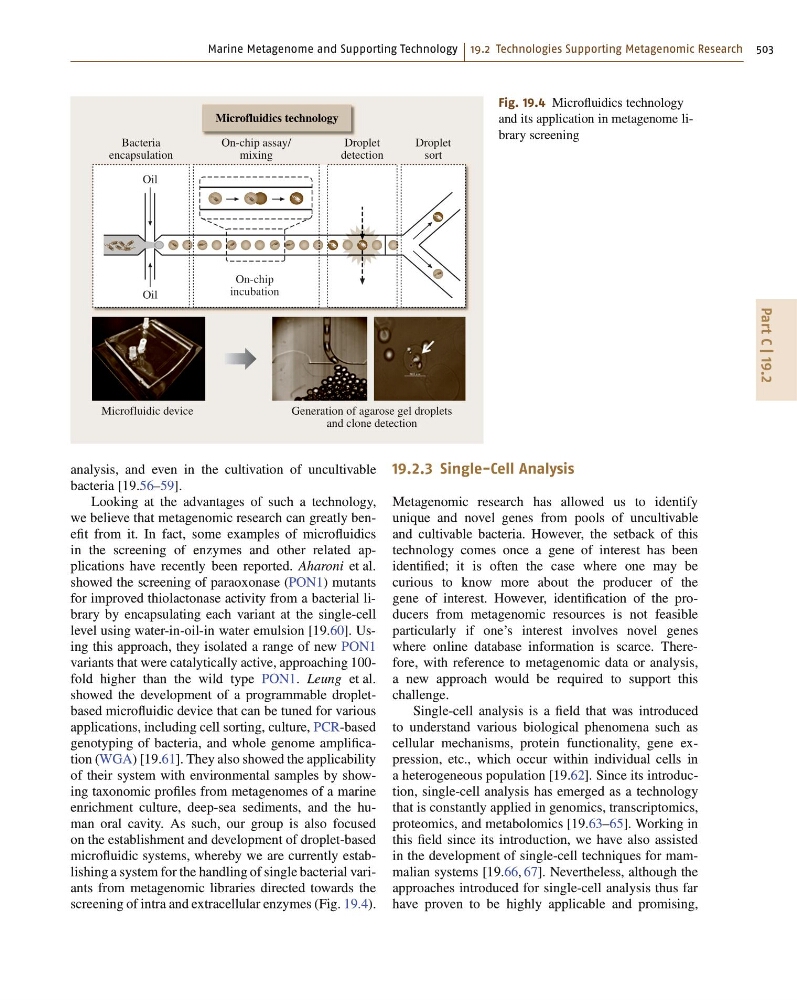
Fig. 19.4 Microfluidics technology
and its application in metagenome library screening
analysis, and even in the cultivation of uncultivable
bacteria [19.56–59].
Looking at the advantages of such a technology,
we believe that metagenomic research can greatly benefit from it. In fact, some examples of microfluidics
in the screening of enzymes and other related applications have recently been reported. Aharoni et al.
showed the screening of paraoxonase (PON1) mutants
for improved thiolactonase activity from a bacterial library by encapsulating each variant at the single-cell
level using water-in-oil-in water emulsion [19.60]. Using this approach, they isolated a range of new PON1
variants that were catalytically active, approaching 100fold higher than the wild type PON1. Leung et al.
showed the development of a programmable dropletbased microfluidic device that can be tuned for various
applications, including cell sorting, culture, PCR-based
genotyping of bacteria, and whole genome amplification (WGA) [19.61]. They also showed the applicability
of their system with environmental samples by showing taxonomic profiles from metagenomes of a marine
enrichment culture, deep-sea sediments, and the human oral cavity. As such, our group is also focused
on the establishment and development of droplet-based
microfluidic systems, whereby we are currently establishing a system for the handling of single bacterial variants from metagenomic libraries directed towards the
screening of intra and extracellular enzymes (Fig. 19.4).
19.2.3 Single-Cell Analysis
Metagenomic research has allowed us to identify
unique and novel genes from pools of uncultivable
and cultivable bacteria. However, the setback of this
technology comes once a gene of interest has been
identified; it is often the case where one may be
curious to know more about the producer of the
gene of interest. However, identification of the producers from metagenomic resources is not feasible
particularly if one’s interest involves novel genes
where online database information is scarce. Therefore, with reference to metagenomic data or analysis,
a new approach would be required to support this
challenge.
Single-cell analysis is a field that was introduced
to understand various biological phenomena such as
cellular mechanisms, protein functionality, gene expression, etc., which occur within individual cells in
a heterogeneous population [19.62]. Since its introduction, single-cell analysis has emerged as a technology
that is constantly applied in genomics, transcriptomics,
proteomics, and metabolomics [19.63–65]. Working in
this field since its introduction, we have also assisted
in the development of single-cell techniques for mammalian systems [19.66, 67]. Nevertheless, although the
approaches introduced for single-cell analysis thus far
have proven to be highly applicable and promising,
Part C | 19.2
Microfluidics technology
On-chip assay/
mixing
Droplet
detection
Generation of agarose gel droplets
and clone detection
Microfluidic device
Droplet
sort
On-chip
incubation
Bacteria
encapsulation
Oil
Oil
Fig. 19.4 Microfluidics technology
and its application in metagenome library screening
analysis, and even in the cultivation of uncultivable
bacteria [19.56–59].
Looking at the advantages of such a technology,
we believe that metagenomic research can greatly benefit from it. In fact, some examples of microfluidics
in the screening of enzymes and other related applications have recently been reported. Aharoni et al.
showed the screening of paraoxonase (PON1) mutants
for improved thiolactonase activity from a bacterial library by encapsulating each variant at the single-cell
level using water-in-oil-in water emulsion [19.60]. Using this approach, they isolated a range of new PON1
variants that were catalytically active, approaching 100fold higher than the wild type PON1. Leung et al.
showed the development of a programmable dropletbased microfluidic device that can be tuned for various
applications, including cell sorting, culture, PCR-based
genotyping of bacteria, and whole genome amplification (WGA) [19.61]. They also showed the applicability
of their system with environmental samples by showing taxonomic profiles from metagenomes of a marine
enrichment culture, deep-sea sediments, and the human oral cavity. As such, our group is also focused
on the establishment and development of droplet-based
microfluidic systems, whereby we are currently establishing a system for the handling of single bacterial variants from metagenomic libraries directed towards the
screening of intra and extracellular enzymes (Fig. 19.4).
19.2.3 Single-Cell Analysis
Metagenomic research has allowed us to identify
unique and novel genes from pools of uncultivable
and cultivable bacteria. However, the setback of this
technology comes once a gene of interest has been
identified; it is often the case where one may be
curious to know more about the producer of the
gene of interest. However, identification of the producers from metagenomic resources is not feasible
particularly if one’s interest involves novel genes
where online database information is scarce. Therefore, with reference to metagenomic data or analysis,
a new approach would be required to support this
challenge.
Single-cell analysis is a field that was introduced
to understand various biological phenomena such as
cellular mechanisms, protein functionality, gene expression, etc., which occur within individual cells in
a heterogeneous population [19.62]. Since its introduction, single-cell analysis has emerged as a technology
that is constantly applied in genomics, transcriptomics,
proteomics, and metabolomics [19.63–65]. Working in
this field since its introduction, we have also assisted
in the development of single-cell techniques for mammalian systems [19.66, 67]. Nevertheless, although the
approaches introduced for single-cell analysis thus far
have proven to be highly applicable and promising,