

Part C | 19.2
502 Part C Marine Genomics
19.2 Technologies Supporting Metagenomic Research
In the first part of this chapter, we described the advantages and new insights attained from metagenomic
research, whereby the technology has opened doors to
a new way to exploit environmental gene resources.
Nevertheless, metagenomic research has also provided
new challenges that will need to be addressed in order for us to use gene resources to their fullest. Two
major challenges that have arisen from metagenomic research are 1) the techniques required for the screening
of clones from large metagenomic libraries and 2) the
approaches required to process or analyze the metadata
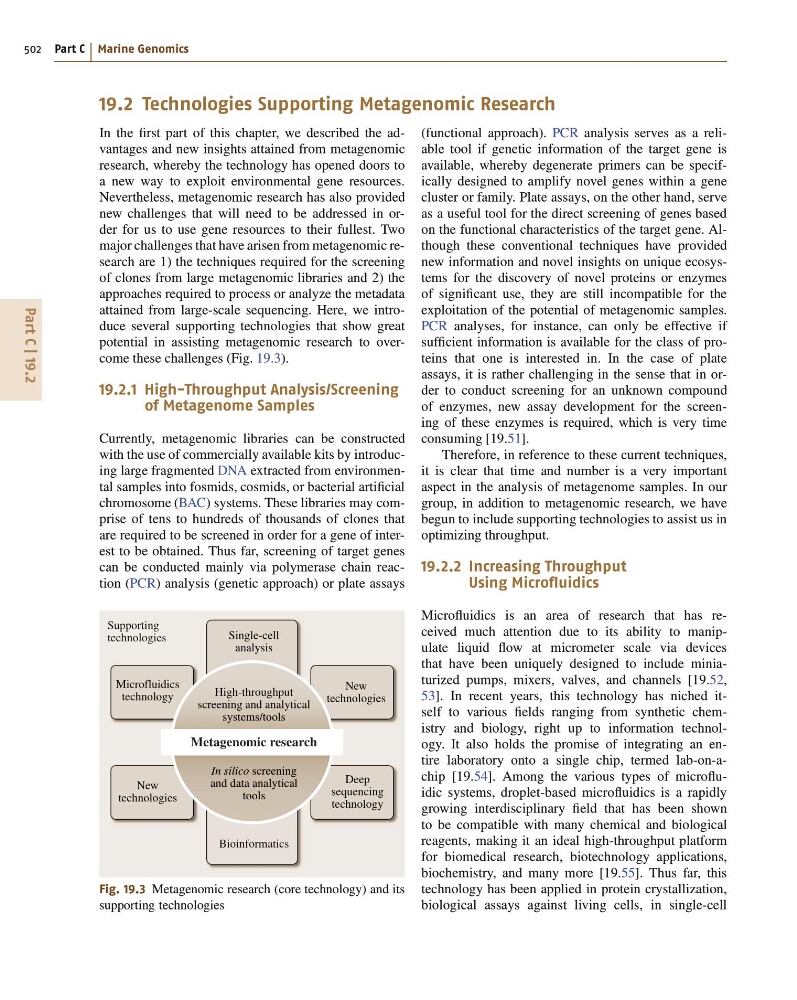
attained from large-scale sequencing. Here, we introduce several supporting technologies that show great
potential in assisting metagenomic research to overcome these challenges (Fig. 19.3).
19.2.1 High-Throughput Analysis/Screening
of Metagenome Samples
Currently, metagenomic libraries can be constructed
with the use of commercially available kits by introducing large fragmented DNA extracted from environmental samples into fosmids, cosmids, or bacterial artificial
chromosome (BAC) systems. These libraries may comprise of tens to hundreds of thousands of clones that
are required to be screened in order for a gene of interest to be obtained. Thus far, screening of target genes
can be conducted mainly via polymerase chain reaction (PCR) analysis (genetic approach) or plate assays
Bioinformatics
In silico screening
and data analytical
tools
High-throughput
screening and analytical
systems/tools
Metagenomic research
Single-cell
analysis
Deep
sequencing
technology
New
technologies
New
technologies
Microfluidics
technology
Supporting
technologies
Fig. 19.3 Metagenomic research (core technology) and its
supporting technologies
(functional approach). PCR analysis serves as a reliable tool if genetic information of the target gene is
available, whereby degenerate primers can be specifically designed to amplify novel genes within a gene
cluster or family. Plate assays, on the other hand, serve
as a useful tool for the direct screening of genes based
on the functional characteristics of the target gene. Although these conventional techniques have provided
new information and novel insights on unique ecosystems for the discovery of novel proteins or enzymes
of significant use, they are still incompatible for the
exploitation of the potential of metagenomic samples.
PCR analyses, for instance, can only be effective if
sufficient information is available for the class of proteins that one is interested in. In the case of plate
assays, it is rather challenging in the sense that in order to conduct screening for an unknown compound
of enzymes, new assay development for the screening of these enzymes is required, which is very time
consuming [19.51].
Therefore, in reference to these current techniques,
it is clear that time and number is a very important
aspect in the analysis of metagenome samples. In our
group, in addition to metagenomic research, we have
begun to include supporting technologies to assist us in
optimizing throughput.
19.2.2 Increasing Throughput
Using Microfluidics
Microfluidics is an area of research that has received much attention due to its ability to manipulate liquid flow at micrometer scale via devices
that have been uniquely designed to include miniaturized pumps, mixers, valves, and channels [19.52,
53]. In recent years, this technology has niched itself to various fields ranging from synthetic chemistry and biology, right up to information technology. It also holds the promise of integrating an entire laboratory onto a single chip, termed lab-on-achip [19.54]. Among the various types of microfluidic systems, droplet-based microfluidics is a rapidly
growing interdisciplinary field that has been shown
to be compatible with many chemical and biological
reagents, making it an ideal high-throughput platform
for biomedical research, biotechnology applications,
biochemistry, and many more [19.55]. Thus far, this
technology has been applied in protein crystallization,
biological assays against living cells, in single-cell
502 Part C Marine Genomics
19.2 Technologies Supporting Metagenomic Research
In the first part of this chapter, we described the advantages and new insights attained from metagenomic
research, whereby the technology has opened doors to
a new way to exploit environmental gene resources.
Nevertheless, metagenomic research has also provided
new challenges that will need to be addressed in order for us to use gene resources to their fullest. Two
major challenges that have arisen from metagenomic research are 1) the techniques required for the screening
of clones from large metagenomic libraries and 2) the
approaches required to process or analyze the metadata
attained from large-scale sequencing. Here, we introduce several supporting technologies that show great
potential in assisting metagenomic research to overcome these challenges (Fig. 19.3).
19.2.1 High-Throughput Analysis/Screening
of Metagenome Samples
Currently, metagenomic libraries can be constructed
with the use of commercially available kits by introducing large fragmented DNA extracted from environmental samples into fosmids, cosmids, or bacterial artificial
chromosome (BAC) systems. These libraries may comprise of tens to hundreds of thousands of clones that
are required to be screened in order for a gene of interest to be obtained. Thus far, screening of target genes
can be conducted mainly via polymerase chain reaction (PCR) analysis (genetic approach) or plate assays
Bioinformatics
In silico screening
and data analytical
tools
High-throughput
screening and analytical
systems/tools
Metagenomic research
Single-cell
analysis
Deep
sequencing
technology
New
technologies
New
technologies
Microfluidics
technology
Supporting
technologies
Fig. 19.3 Metagenomic research (core technology) and its
supporting technologies
(functional approach). PCR analysis serves as a reliable tool if genetic information of the target gene is
available, whereby degenerate primers can be specifically designed to amplify novel genes within a gene
cluster or family. Plate assays, on the other hand, serve
as a useful tool for the direct screening of genes based
on the functional characteristics of the target gene. Although these conventional techniques have provided
new information and novel insights on unique ecosystems for the discovery of novel proteins or enzymes
of significant use, they are still incompatible for the
exploitation of the potential of metagenomic samples.
PCR analyses, for instance, can only be effective if
sufficient information is available for the class of proteins that one is interested in. In the case of plate
assays, it is rather challenging in the sense that in order to conduct screening for an unknown compound
of enzymes, new assay development for the screening of these enzymes is required, which is very time
consuming [19.51].
Therefore, in reference to these current techniques,
it is clear that time and number is a very important
aspect in the analysis of metagenome samples. In our
group, in addition to metagenomic research, we have
begun to include supporting technologies to assist us in
optimizing throughput.
19.2.2 Increasing Throughput
Using Microfluidics
Microfluidics is an area of research that has received much attention due to its ability to manipulate liquid flow at micrometer scale via devices
that have been uniquely designed to include miniaturized pumps, mixers, valves, and channels [19.52,
53]. In recent years, this technology has niched itself to various fields ranging from synthetic chemistry and biology, right up to information technology. It also holds the promise of integrating an entire laboratory onto a single chip, termed lab-on-achip [19.54]. Among the various types of microfluidic systems, droplet-based microfluidics is a rapidly
growing interdisciplinary field that has been shown
to be compatible with many chemical and biological
reagents, making it an ideal high-throughput platform
for biomedical research, biotechnology applications,
biochemistry, and many more [19.55]. Thus far, this
technology has been applied in protein crystallization,
biological assays against living cells, in single-cell