

Part B | 13.4
398 Part B Tools and Methods in Marine Biotechnology
method [13.94] or a quantitative real-time RT-PCR
method [13.95].
13.3.4 Breeding Homozygous Transgenic
Organisms
Almost all transgenic marine organisms produced by
microinjection, electroporation, or transfection with
pantropic retroviral vector or lipofection are heterozygous with respect to transgenes. For practical application, the transgenic lines need to be bred to be
homozygous to maintain the brood stocks. This purpose can be achieved by self-crossing the heterozygous
transgenic individuals and identifying the genotypes
of the progeny by performing backcrosses. While this
approach may be time consuming, depending on the
length of the life cycle, it will obtain homozygous
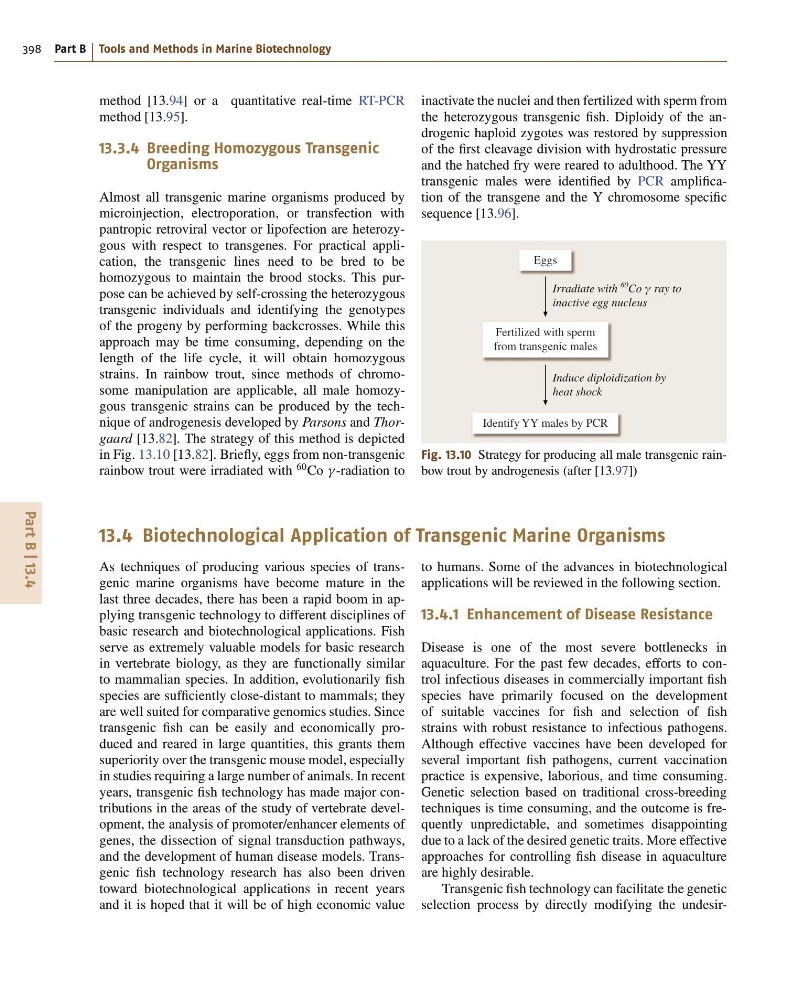
strains. In rainbow trout, since methods of chromosome manipulation are applicable, all male homozygous transgenic strains can be produced by the technique of androgenesis developed by Parsons and Thorgaard [13.82]. The strategy of this method is depicted
in Fig. 13.10 [13.82]. Briefly, eggs from non-transgenic
rainbow trout were irradiated with
60 Co -radiation to
inactivate the nuclei and then fertilized with sperm from
the heterozygous transgenic fish. Diploidy of the androgenic haploid zygotes was restored by suppression
of the first cleavage division with hydrostatic pressure
and the hatched fry were reared to adulthood. The YY
transgenic males were identified by PCR amplification of the transgene and the Y chromosome specific
sequence [13.96].
Identify YY males by PCR
Eggs
Fertilized with sperm
from transgenic males
Irradiate with
60 Co γ ray to
inactive egg nucleus
Induce diploidization by
heat shock
Fig. 13.10 Strategy for producing all male transgenic rainbow trout by androgenesis (after [13.97])
13.4 Biotechnological Application of Transgenic Marine Organisms
As techniques of producing various species of transgenic marine organisms have become mature in the
last three decades, there has been a rapid boom in applying transgenic technology to different disciplines of
basic research and biotechnological applications. Fish
serve as extremely valuable models for basic research
in vertebrate biology, as they are functionally similar
to mammalian species. In addition, evolutionarily fish
species are sufficiently close-distant to mammals; they
are well suited for comparative genomics studies. Since
transgenic fish can be easily and economically produced and reared in large quantities, this grants them
superiority over the transgenic mouse model, especially
in studies requiring a large number of animals. In recent
years, transgenic fish technology has made major contributions in the areas of the study of vertebrate development, the analysis of promoter/enhancer elements of
genes, the dissection of signal transduction pathways,
and the development of human disease models. Transgenic fish technology research has also been driven
toward biotechnological applications in recent years
and it is hoped that it will be of high economic value
to humans. Some of the advances in biotechnological
applications will be reviewed in the following section.
13.4.1 Enhancement of Disease Resistance
Disease is one of the most severe bottlenecks in
aquaculture. For the past few decades, efforts to control infectious diseases in commercially important fish
species have primarily focused on the development
of suitable vaccines for fish and selection of fish
strains with robust resistance to infectious pathogens.
Although effective vaccines have been developed for
several important fish pathogens, current vaccination
practice is expensive, laborious, and time consuming.
Genetic selection based on traditional cross-breeding
techniques is time consuming, and the outcome is frequently unpredictable, and sometimes disappointing
due to a lack of the desired genetic traits. More effective
approaches for controlling fish disease in aquaculture
are highly desirable.
Transgenic fish technology can facilitate the genetic
selection process by directly modifying the undesir-
398 Part B Tools and Methods in Marine Biotechnology
method [13.94] or a quantitative real-time RT-PCR
method [13.95].
13.3.4 Breeding Homozygous Transgenic
Organisms
Almost all transgenic marine organisms produced by
microinjection, electroporation, or transfection with
pantropic retroviral vector or lipofection are heterozygous with respect to transgenes. For practical application, the transgenic lines need to be bred to be
homozygous to maintain the brood stocks. This purpose can be achieved by self-crossing the heterozygous
transgenic individuals and identifying the genotypes
of the progeny by performing backcrosses. While this
approach may be time consuming, depending on the
length of the life cycle, it will obtain homozygous
strains. In rainbow trout, since methods of chromosome manipulation are applicable, all male homozygous transgenic strains can be produced by the technique of androgenesis developed by Parsons and Thorgaard [13.82]. The strategy of this method is depicted
in Fig. 13.10 [13.82]. Briefly, eggs from non-transgenic
rainbow trout were irradiated with
60 Co -radiation to
inactivate the nuclei and then fertilized with sperm from
the heterozygous transgenic fish. Diploidy of the androgenic haploid zygotes was restored by suppression
of the first cleavage division with hydrostatic pressure
and the hatched fry were reared to adulthood. The YY
transgenic males were identified by PCR amplification of the transgene and the Y chromosome specific
sequence [13.96].
Identify YY males by PCR
Eggs
Fertilized with sperm
from transgenic males
Irradiate with
60 Co γ ray to
inactive egg nucleus
Induce diploidization by
heat shock
Fig. 13.10 Strategy for producing all male transgenic rainbow trout by androgenesis (after [13.97])
13.4 Biotechnological Application of Transgenic Marine Organisms
As techniques of producing various species of transgenic marine organisms have become mature in the
last three decades, there has been a rapid boom in applying transgenic technology to different disciplines of
basic research and biotechnological applications. Fish
serve as extremely valuable models for basic research
in vertebrate biology, as they are functionally similar
to mammalian species. In addition, evolutionarily fish
species are sufficiently close-distant to mammals; they
are well suited for comparative genomics studies. Since
transgenic fish can be easily and economically produced and reared in large quantities, this grants them
superiority over the transgenic mouse model, especially
in studies requiring a large number of animals. In recent
years, transgenic fish technology has made major contributions in the areas of the study of vertebrate development, the analysis of promoter/enhancer elements of
genes, the dissection of signal transduction pathways,
and the development of human disease models. Transgenic fish technology research has also been driven
toward biotechnological applications in recent years
and it is hoped that it will be of high economic value
to humans. Some of the advances in biotechnological
applications will be reviewed in the following section.
13.4.1 Enhancement of Disease Resistance
Disease is one of the most severe bottlenecks in
aquaculture. For the past few decades, efforts to control infectious diseases in commercially important fish
species have primarily focused on the development
of suitable vaccines for fish and selection of fish
strains with robust resistance to infectious pathogens.
Although effective vaccines have been developed for
several important fish pathogens, current vaccination
practice is expensive, laborious, and time consuming.
Genetic selection based on traditional cross-breeding
techniques is time consuming, and the outcome is frequently unpredictable, and sometimes disappointing
due to a lack of the desired genetic traits. More effective
approaches for controlling fish disease in aquaculture
are highly desirable.
Transgenic fish technology can facilitate the genetic
selection process by directly modifying the undesir-