

Transgenic Technology in Marine Organisms 13.4 Biotechnological Application 399
Part B | 13.4
able genetic traits that confer vulnerability to pathogens
or introducing specific genes that are related to disease resistance into fish. The introduced transgenes can
be fish-originated or characterized genes from other
species. What genetic trait may confer resistance to
infection by bacterial or viral pathogens? Upon exposure to invading bacterial, viral, or parasitic pathogens,
fish, like higher vertebrates, will produce a family of
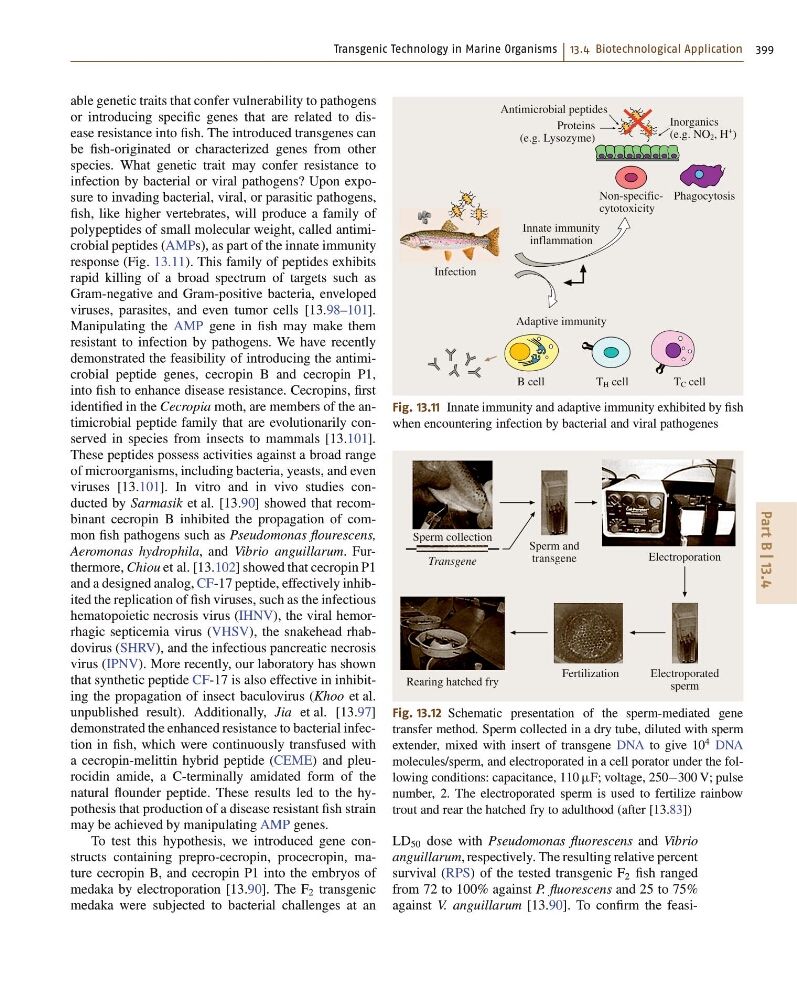
polypeptides of small molecular weight, called antimicrobial peptides (AMPs), as part of the innate immunity
response (Fig. 13.11). This family of peptides exhibits
rapid killing of a broad spectrum of targets such as
Gram-negative and Gram-positive bacteria, enveloped
viruses, parasites, and even tumor cells [13.98–101].
Manipulating the AMP gene in fish may make them
resistant to infection by pathogens. We have recently
demonstrated the feasibility of introducing the antimicrobial peptide genes, cecropin B and cecropin P1,
into fish to enhance disease resistance. Cecropins, first
identified in the Cecropia moth, are members of the antimicrobial peptide family that are evolutionarily conserved in species from insects to mammals [13.101].
These peptides possess activities against a broad range
of microorganisms, including bacteria, yeasts, and even
viruses [13.101]. In vitro and in vivo studies conducted by Sarmasik et al. [13.90] showed that recombinant cecropin B inhibited the propagation of common fish pathogens such as Pseudomonas flourescens,
Aeromonas hydrophila, and Vibrio anguillarum. Furthermore, Chiou et al. [13.102] showed that cecropin P1
and a designed analog, CF-17 peptide, effectively inhibited the replication of fish viruses, such as the infectious
hematopoietic necrosis virus (IHNV), the viral hemorrhagic septicemia virus (VHSV), the snakehead rhabdovirus (SHRV), and the infectious pancreatic necrosis
virus (IPNV). More recently, our laboratory has shown
that synthetic peptide CF-17 is also effective in inhibiting the propagation of insect baculovirus (Khoo et al.
unpublished result). Additionally, Jia et al. [13.97]
demonstrated the enhanced resistance to bacterial infection in fish, which were continuously transfused with
a cecropin-melittin hybrid peptide (CEME) and pleurocidin amide, a C-terminally amidated form of the
natural flounder peptide. These results led to the hypothesis that production of a disease resistant fish strain
may be achieved by manipulating AMP genes.
To test this hypothesis, we introduced gene constructs containing prepro-cecropin, procecropin, mature cecropin B, and cecropin P1 into the embryos of
medaka by electroporation [13.90]. The F 2 transgenic
medaka were subjected to bacterial challenges at an
B cell
T H cell
T C cell
Inorganics
(e.g. NO 2 , H
+ )
Non-specificcytotoxicity
Innate immunity
inflammation
Adaptive immunity
Infection
Phagocytosis
Proteins
(e.g. Lysozyme)
Antimicrobial peptides
Fig. 13.11 Innate immunity and adaptive immunity exhibited by fish
when encountering infection by bacterial and viral pathogenes
Sperm and
transgene
Electroporation
Electroporated
sperm
Fertilization
Rearing hatched fry
Sperm collection
Transgene
Fig. 13.12 Schematic presentation of the sperm-mediated gene
transfer method. Sperm collected in a dry tube, diluted with sperm
extender, mixed with insert of transgene DNA to give 10
4 DNA
molecules/sperm, and electroporated in a cell porator under the following conditions: capacitance, 110 F; voltage, 250300 V; pulse
number, 2. The electroporated sperm is used to fertilize rainbow
trout and rear the hatched fry to adulthood (after [13.83])
LD 50 dose with Pseudomonas fluorescens and Vibrio
anguillarum, respectively. The resulting relative percent
survival (RPS) of the tested transgenic F 2 fish ranged
from 72 to 100% against P. fluorescens and 25 to 75%
against V. anguillarum [13.90]. To confirm the feasi-
Part B | 13.4
able genetic traits that confer vulnerability to pathogens
or introducing specific genes that are related to disease resistance into fish. The introduced transgenes can
be fish-originated or characterized genes from other
species. What genetic trait may confer resistance to
infection by bacterial or viral pathogens? Upon exposure to invading bacterial, viral, or parasitic pathogens,
fish, like higher vertebrates, will produce a family of
polypeptides of small molecular weight, called antimicrobial peptides (AMPs), as part of the innate immunity
response (Fig. 13.11). This family of peptides exhibits
rapid killing of a broad spectrum of targets such as
Gram-negative and Gram-positive bacteria, enveloped
viruses, parasites, and even tumor cells [13.98–101].
Manipulating the AMP gene in fish may make them
resistant to infection by pathogens. We have recently
demonstrated the feasibility of introducing the antimicrobial peptide genes, cecropin B and cecropin P1,
into fish to enhance disease resistance. Cecropins, first
identified in the Cecropia moth, are members of the antimicrobial peptide family that are evolutionarily conserved in species from insects to mammals [13.101].
These peptides possess activities against a broad range
of microorganisms, including bacteria, yeasts, and even
viruses [13.101]. In vitro and in vivo studies conducted by Sarmasik et al. [13.90] showed that recombinant cecropin B inhibited the propagation of common fish pathogens such as Pseudomonas flourescens,
Aeromonas hydrophila, and Vibrio anguillarum. Furthermore, Chiou et al. [13.102] showed that cecropin P1
and a designed analog, CF-17 peptide, effectively inhibited the replication of fish viruses, such as the infectious
hematopoietic necrosis virus (IHNV), the viral hemorrhagic septicemia virus (VHSV), the snakehead rhabdovirus (SHRV), and the infectious pancreatic necrosis
virus (IPNV). More recently, our laboratory has shown
that synthetic peptide CF-17 is also effective in inhibiting the propagation of insect baculovirus (Khoo et al.
unpublished result). Additionally, Jia et al. [13.97]
demonstrated the enhanced resistance to bacterial infection in fish, which were continuously transfused with
a cecropin-melittin hybrid peptide (CEME) and pleurocidin amide, a C-terminally amidated form of the
natural flounder peptide. These results led to the hypothesis that production of a disease resistant fish strain
may be achieved by manipulating AMP genes.
To test this hypothesis, we introduced gene constructs containing prepro-cecropin, procecropin, mature cecropin B, and cecropin P1 into the embryos of
medaka by electroporation [13.90]. The F 2 transgenic
medaka were subjected to bacterial challenges at an
B cell
T H cell
T C cell
Inorganics
(e.g. NO 2 , H
+ )
Non-specificcytotoxicity
Innate immunity
inflammation
Adaptive immunity
Infection
Phagocytosis
Proteins
(e.g. Lysozyme)
Antimicrobial peptides
Fig. 13.11 Innate immunity and adaptive immunity exhibited by fish
when encountering infection by bacterial and viral pathogenes
Sperm and
transgene
Electroporation
Electroporated
sperm
Fertilization
Rearing hatched fry
Sperm collection
Transgene
Fig. 13.12 Schematic presentation of the sperm-mediated gene
transfer method. Sperm collected in a dry tube, diluted with sperm
extender, mixed with insert of transgene DNA to give 10
4 DNA
molecules/sperm, and electroporated in a cell porator under the following conditions: capacitance, 110 F; voltage, 250300 V; pulse
number, 2. The electroporated sperm is used to fertilize rainbow
trout and rear the hatched fry to adulthood (after [13.83])
LD 50 dose with Pseudomonas fluorescens and Vibrio
anguillarum, respectively. The resulting relative percent
survival (RPS) of the tested transgenic F 2 fish ranged
from 72 to 100% against P. fluorescens and 25 to 75%
against V. anguillarum [13.90]. To confirm the feasi-