

Part B | 13.3
396 Part B Tools and Methods in Marine Biotechnology
13.3 Characterization of Transgenic Marine Organisms
Once the gene transfer procedure has been conducted,
the resulting organisms need to be characterized by
i) identifying the presence of the transgene, ii) the expression of the transgene, and iii) the integration of the
transgene in the transgenic organisms.
13.3.1 Identification of Transgenic
Individuals
Identification of transgenic individuals is the most
time-consuming step in the production of transgenic
marine organisms. Traditionally, dot blot and Southern blot hybridization techniques were the common
methods used to detect the presence of transgenes
in presumptive transgenic individuals [13.89]. These
methods involve isolation of genomic DNA from tissues of presumptive transgenic individuals, digestion
of DNA samples with restriction enzymes, and Southern blot hybridization of the digested DNA products.
Although this method is expensive, laborious, and insensitive, it offers a definitive answer as to whether
or not a transgene has been integrated into the host
genome. Furthermore, it also reveals the pattern of
transgene integration if appropriate restriction enzymes
are employed in the Southern blot hybridization analysis. In order to handle a large number of samples
efficiently and economically, a polymerase chain reaction (PCR)-based assay has been adopted [13.13, 89].
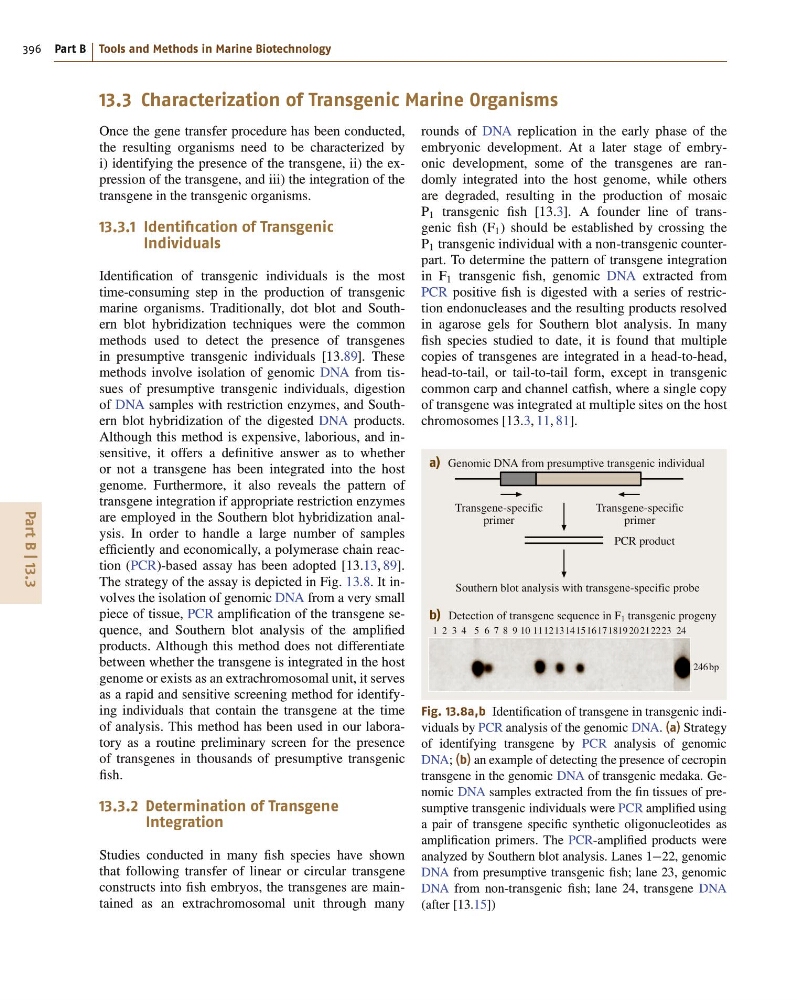
The strategy of the assay is depicted in Fig. 13.8. It involves the isolation of genomic DNA from a very small
piece of tissue, PCR amplification of the transgene sequence, and Southern blot analysis of the amplified
products. Although this method does not differentiate
between whether the transgene is integrated in the host
genome or exists as an extrachromosomal unit, it serves
as a rapid and sensitive screening method for identifying individuals that contain the transgene at the time
of analysis. This method has been used in our laboratory as a routine preliminary screen for the presence
of transgenes in thousands of presumptive transgenic
fish.
13.3.2 Determination of Transgene
Integration
Studies conducted in many fish species have shown
that following transfer of linear or circular transgene
constructs into fish embryos, the transgenes are maintained as an extrachromosomal unit through many
rounds of DNA replication in the early phase of the
embryonic development. At a later stage of embryonic development, some of the transgenes are randomly integrated into the host genome, while others
are degraded, resulting in the production of mosaic
P 1 transgenic fish [13.3]. A founder line of transgenic fish (F 1 ) should be established by crossing the
P 1 transgenic individual with a non-transgenic counterpart. To determine the pattern of transgene integration
in F 1 transgenic fish, genomic DNA extracted from
PCR positive fish is digested with a series of restriction endonucleases and the resulting products resolved
in agarose gels for Southern blot analysis. In many
fish species studied to date, it is found that multiple
copies of transgenes are integrated in a head-to-head,
head-to-tail, or tail-to-tail form, except in transgenic
common carp and channel catfish, where a single copy
of transgene was integrated at multiple sites on the host
chromosomes [13.3, 11, 81].
Southern blot analysis with transgene-specific probe
1 2 3 4 5 6 7 8 9 10 111213141516171819 20 212223 24
Transgene-specific
primer
Transgene-specific
primer
PCR product
246 bp
b) Detection of transgene sequence in F 1 transgenic progeny
a) Genomic DNA from presumptive transgenic individual
Fig. 13.8a,b Identification of transgene in transgenic individuals by PCR analysis of the genomic DNA. (a) Strategy
of identifying transgene by PCR analysis of genomic
DNA; (b) an example of detecting the presence of cecropin
transgene in the genomic DNA of transgenic medaka. Genomic DNA samples extracted from the fin tissues of presumptive transgenic individuals were PCR amplified using
a pair of transgene specific synthetic oligonucleotides as
amplification primers. The PCR-amplified products were
analyzed by Southern blot analysis. Lanes 122, genomic
DNA from presumptive transgenic fish; lane 23, genomic
DNA from non-transgenic fish; lane 24, transgene DNA
(after [13.15])
396 Part B Tools and Methods in Marine Biotechnology
13.3 Characterization of Transgenic Marine Organisms
Once the gene transfer procedure has been conducted,
the resulting organisms need to be characterized by
i) identifying the presence of the transgene, ii) the expression of the transgene, and iii) the integration of the
transgene in the transgenic organisms.
13.3.1 Identification of Transgenic
Individuals
Identification of transgenic individuals is the most
time-consuming step in the production of transgenic
marine organisms. Traditionally, dot blot and Southern blot hybridization techniques were the common
methods used to detect the presence of transgenes
in presumptive transgenic individuals [13.89]. These
methods involve isolation of genomic DNA from tissues of presumptive transgenic individuals, digestion
of DNA samples with restriction enzymes, and Southern blot hybridization of the digested DNA products.
Although this method is expensive, laborious, and insensitive, it offers a definitive answer as to whether
or not a transgene has been integrated into the host
genome. Furthermore, it also reveals the pattern of
transgene integration if appropriate restriction enzymes
are employed in the Southern blot hybridization analysis. In order to handle a large number of samples
efficiently and economically, a polymerase chain reaction (PCR)-based assay has been adopted [13.13, 89].
The strategy of the assay is depicted in Fig. 13.8. It involves the isolation of genomic DNA from a very small
piece of tissue, PCR amplification of the transgene sequence, and Southern blot analysis of the amplified
products. Although this method does not differentiate
between whether the transgene is integrated in the host
genome or exists as an extrachromosomal unit, it serves
as a rapid and sensitive screening method for identifying individuals that contain the transgene at the time
of analysis. This method has been used in our laboratory as a routine preliminary screen for the presence
of transgenes in thousands of presumptive transgenic
fish.
13.3.2 Determination of Transgene
Integration
Studies conducted in many fish species have shown
that following transfer of linear or circular transgene
constructs into fish embryos, the transgenes are maintained as an extrachromosomal unit through many
rounds of DNA replication in the early phase of the
embryonic development. At a later stage of embryonic development, some of the transgenes are randomly integrated into the host genome, while others
are degraded, resulting in the production of mosaic
P 1 transgenic fish [13.3]. A founder line of transgenic fish (F 1 ) should be established by crossing the
P 1 transgenic individual with a non-transgenic counterpart. To determine the pattern of transgene integration
in F 1 transgenic fish, genomic DNA extracted from
PCR positive fish is digested with a series of restriction endonucleases and the resulting products resolved
in agarose gels for Southern blot analysis. In many
fish species studied to date, it is found that multiple
copies of transgenes are integrated in a head-to-head,
head-to-tail, or tail-to-tail form, except in transgenic
common carp and channel catfish, where a single copy
of transgene was integrated at multiple sites on the host
chromosomes [13.3, 11, 81].
Southern blot analysis with transgene-specific probe
1 2 3 4 5 6 7 8 9 10 111213141516171819 20 212223 24
Transgene-specific
primer
Transgene-specific
primer
PCR product
246 bp
b) Detection of transgene sequence in F 1 transgenic progeny
a) Genomic DNA from presumptive transgenic individual
Fig. 13.8a,b Identification of transgene in transgenic individuals by PCR analysis of the genomic DNA. (a) Strategy
of identifying transgene by PCR analysis of genomic
DNA; (b) an example of detecting the presence of cecropin
transgene in the genomic DNA of transgenic medaka. Genomic DNA samples extracted from the fin tissues of presumptive transgenic individuals were PCR amplified using
a pair of transgene specific synthetic oligonucleotides as
amplification primers. The PCR-amplified products were
analyzed by Southern blot analysis. Lanes 122, genomic
DNA from presumptive transgenic fish; lane 23, genomic
DNA from non-transgenic fish; lane 24, transgene DNA
(after [13.15])