

Transgenic Technology in Marine Organisms 13.2 Production of Transgenic Marine Organisms 395
Part B | 13.2
increasing numbers of publications appearing in the literature that report transfer of foreign genes into micro
and macroalgal species by electroporation with good
success [13.7, 74, 75].
By microinjection or electroporation, plasmidencoded transgenes can be introduced into many fish
species to produce transgenic offspring with satisfactory efficiency. However, the resulting P 1 transgenic
individuals are almost always mosaics as a result of
delayed transgene integration. In addition, neither
methods is applicable for transfer of foreign DNA into
embryos of life-bearing fish. In order to increase the
efficiency of gene transfer by microinjection or electroporation, Hsiao et al. [13.76] and Thermes et al. [13.77]
took the following approaches: i) using the inverted
terminal repeat DNA from the Adeno-associated virus
to increase the stability of transgene integration; and
ii) employing I-SceI meganuclease to mediate high
transportation efficiency of the transgene into the
nucleus. While these modifications have resulted in
improved efficiency of transgene integration, they are
still not applicable for the production of transgenic
life-bearing fish species.
Transfection with the Pantropic Retroviral
Vector
A replication-defective pantropic retroviral vector containing the long terminal repeat (LTR) sequence of
Moloney murine leukemia virus (MoMLV) and transgenes in a viral envelop with the G-protein of vesicular stomatitis virus (VSV) was developed by Burns
et al. [13.78]. Since entry of VSV into host cells is
mediated by interaction of the VSV-G protein with
a phospholipid component of the host cell membrane,
this pseudotyped retroviral vector has a very broad
host range and is able to transfer transgenes into many
different cell types. Using the pantropic pseudotyped
defective retrovirus as a gene transfer vector, transgenes containing neo
R or ˇ-galactosidase have been
transferred into zebrafish [13.79], medaka [13.80, 81],
and dwarf surf clams [13.5]. More recently, Sarmasik
et al. [13.80, 81] and Chen et al. (unpublished results)
also used a pantropic retroviral vector to transfer genes
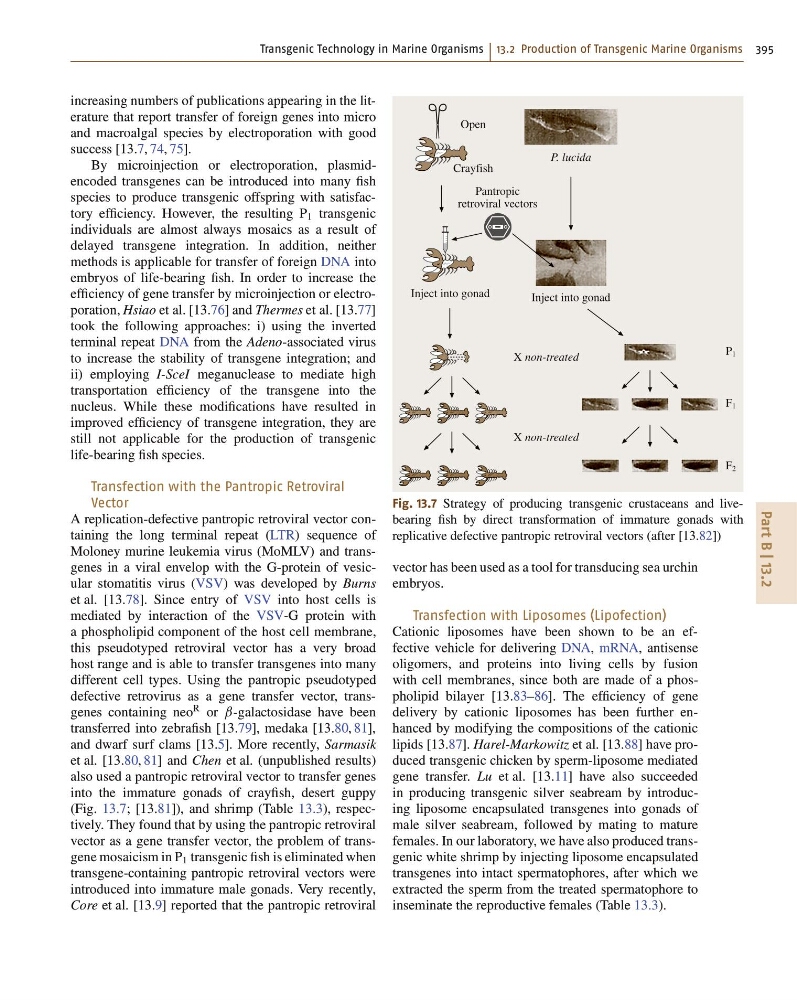
into the immature gonads of crayfish, desert guppy
(Fig. 13.7; [13.81]), and shrimp (Table 13.3), respectively. They found that by using the pantropic retroviral
vector as a gene transfer vector, the problem of transgene mosaicism in P 1 transgenic fish is eliminated when
transgene-containing pantropic retroviral vectors were
introduced into immature male gonads. Very recently,
Core et al. [13.9] reported that the pantropic retroviral
Inject into gonad
P 1
F 1
F 2
X non-treated
X non-treated
Pantropic
retroviral vectors
Open
Crayfish
Inject into gonad
P. lucida
Fig. 13.7 Strategy of producing transgenic crustaceans and livebearing fish by direct transformation of immature gonads with
replicative defective pantropic retroviral vectors (after [13.82])
vector has been used as a tool for transducing sea urchin
embryos.
Transfection with Liposomes (Lipofection)
Cationic liposomes have been shown to be an effective vehicle for delivering DNA, mRNA, antisense
oligomers, and proteins into living cells by fusion
with cell membranes, since both are made of a phospholipid bilayer [13.83–86]. The efficiency of gene
delivery by cationic liposomes has been further enhanced by modifying the compositions of the cationic
lipids [13.87]. Harel-Markowitz et al. [13.88] have produced transgenic chicken by sperm-liposome mediated
gene transfer. Lu et al. [13.11] have also succeeded
in producing transgenic silver seabream by introducing liposome encapsulated transgenes into gonads of
male silver seabream, followed by mating to mature
females. In our laboratory, we have also produced transgenic white shrimp by injecting liposome encapsulated
transgenes into intact spermatophores, after which we
extracted the sperm from the treated spermatophore to
inseminate the reproductive females (Table 13.3).
Part B | 13.2
increasing numbers of publications appearing in the literature that report transfer of foreign genes into micro
and macroalgal species by electroporation with good
success [13.7, 74, 75].
By microinjection or electroporation, plasmidencoded transgenes can be introduced into many fish
species to produce transgenic offspring with satisfactory efficiency. However, the resulting P 1 transgenic
individuals are almost always mosaics as a result of
delayed transgene integration. In addition, neither
methods is applicable for transfer of foreign DNA into
embryos of life-bearing fish. In order to increase the
efficiency of gene transfer by microinjection or electroporation, Hsiao et al. [13.76] and Thermes et al. [13.77]
took the following approaches: i) using the inverted
terminal repeat DNA from the Adeno-associated virus
to increase the stability of transgene integration; and
ii) employing I-SceI meganuclease to mediate high
transportation efficiency of the transgene into the
nucleus. While these modifications have resulted in
improved efficiency of transgene integration, they are
still not applicable for the production of transgenic
life-bearing fish species.
Transfection with the Pantropic Retroviral
Vector
A replication-defective pantropic retroviral vector containing the long terminal repeat (LTR) sequence of
Moloney murine leukemia virus (MoMLV) and transgenes in a viral envelop with the G-protein of vesicular stomatitis virus (VSV) was developed by Burns
et al. [13.78]. Since entry of VSV into host cells is
mediated by interaction of the VSV-G protein with
a phospholipid component of the host cell membrane,
this pseudotyped retroviral vector has a very broad
host range and is able to transfer transgenes into many
different cell types. Using the pantropic pseudotyped
defective retrovirus as a gene transfer vector, transgenes containing neo
R or ˇ-galactosidase have been
transferred into zebrafish [13.79], medaka [13.80, 81],
and dwarf surf clams [13.5]. More recently, Sarmasik
et al. [13.80, 81] and Chen et al. (unpublished results)
also used a pantropic retroviral vector to transfer genes
into the immature gonads of crayfish, desert guppy
(Fig. 13.7; [13.81]), and shrimp (Table 13.3), respectively. They found that by using the pantropic retroviral
vector as a gene transfer vector, the problem of transgene mosaicism in P 1 transgenic fish is eliminated when
transgene-containing pantropic retroviral vectors were
introduced into immature male gonads. Very recently,
Core et al. [13.9] reported that the pantropic retroviral
Inject into gonad
P 1
F 1
F 2
X non-treated
X non-treated
Pantropic
retroviral vectors
Open
Crayfish
Inject into gonad
P. lucida
Fig. 13.7 Strategy of producing transgenic crustaceans and livebearing fish by direct transformation of immature gonads with
replicative defective pantropic retroviral vectors (after [13.82])
vector has been used as a tool for transducing sea urchin
embryos.
Transfection with Liposomes (Lipofection)
Cationic liposomes have been shown to be an effective vehicle for delivering DNA, mRNA, antisense
oligomers, and proteins into living cells by fusion
with cell membranes, since both are made of a phospholipid bilayer [13.83–86]. The efficiency of gene
delivery by cationic liposomes has been further enhanced by modifying the compositions of the cationic
lipids [13.87]. Harel-Markowitz et al. [13.88] have produced transgenic chicken by sperm-liposome mediated
gene transfer. Lu et al. [13.11] have also succeeded
in producing transgenic silver seabream by introducing liposome encapsulated transgenes into gonads of
male silver seabream, followed by mating to mature
females. In our laboratory, we have also produced transgenic white shrimp by injecting liposome encapsulated
transgenes into intact spermatophores, after which we
extracted the sperm from the treated spermatophore to
inseminate the reproductive females (Table 13.3).