

Transgenic Technology in Marine Organisms 13.2 Production of Transgenic Marine Organisms 389
Part B | 13.2
erly in the transgenic individuals. The coding region of
the transgenes is usually homologous or heterologous
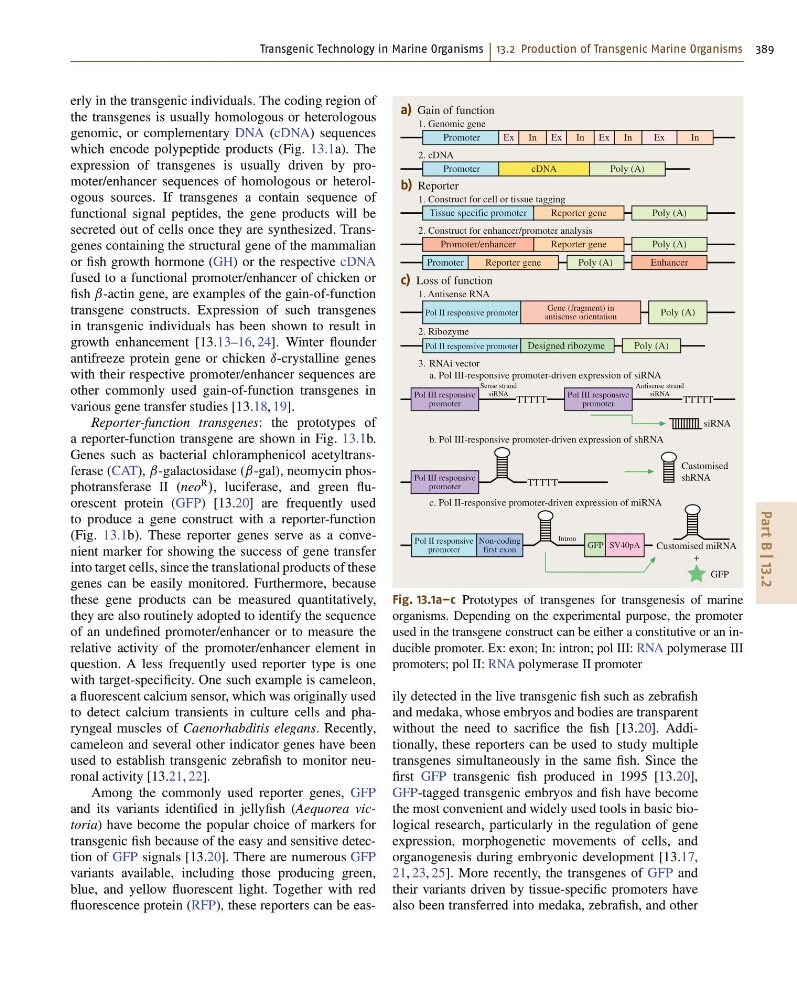
genomic, or complementary DNA (cDNA) sequences
which encode polypeptide products (Fig. 13.1a). The
expression of transgenes is usually driven by promoter/enhancer sequences of homologous or heterologous sources. If transgenes a contain sequence of
functional signal peptides, the gene products will be
secreted out of cells once they are synthesized. Transgenes containing the structural gene of the mammalian
or fish growth hormone (GH) or the respective cDNA
fused to a functional promoter/enhancer of chicken or
fish ˇ-actin gene, are examples of the gain-of-function
transgene constructs. Expression of such transgenes
in transgenic individuals has been shown to result in
growth enhancement [13.13–16, 24]. Winter flounder
antifreeze protein gene or chicken ı-crystalline genes
with their respective promoter/enhancer sequences are
other commonly used gain-of-function transgenes in
various gene transfer studies [13.18, 19].
Reporter-function transgenes: the prototypes of
a reporter-function transgene are shown in Fig. 13.1b.
Genes such as bacterial chloramphenicol acetyltransferase (CAT), ˇ-galactosidase (ˇ-gal), neomycin phosphotransferase II (neo
R
/, luciferase, and green fluorescent protein (GFP) [13.20] are frequently used
to produce a gene construct with a reporter-function
(Fig. 13.1b). These reporter genes serve as a convenient marker for showing the success of gene transfer
into target cells, since the translational products of these
genes can be easily monitored. Furthermore, because
these gene products can be measured quantitatively,
they are also routinely adopted to identify the sequence
of an undefined promoter/enhancer or to measure the
relative activity of the promoter/enhancer element in
question. A less frequently used reporter type is one
with target-specificity. One such example is cameleon,
a fluorescent calcium sensor, which was originally used
to detect calcium transients in culture cells and pharyngeal muscles of Caenorhabditis elegans. Recently,
cameleon and several other indicator genes have been
used to establish transgenic zebrafish to monitor neuronal activity [13.21, 22].
Among the commonly used reporter genes, GFP
and its variants identified in jellyfish (Aequorea victoria) have become the popular choice of markers for
transgenic fish because of the easy and sensitive detection of GFP signals [13.20]. There are numerous GFP
variants available, including those producing green,
blue, and yellow fluorescent light. Together with red
fluorescence protein (RFP), these reporters can be easa) Gain of function
Promoter
Ex
Ex
In
Ex
In
Ex
In
In
1. Genomic gene
Promoter
cDNA
Poly (A)
2. cDNA
c) Loss of function
Pol II responsive promoter
Pol III responsive
promoter
Sense strand
siRNA
Intron
Pol II responsive promoter
Gene (fragment) in
antisense orientation
1. Antisense RNA
Designed ribozyme
TTTTT
Pol III responsive
promoter
TTTTT
Pol III responsive
promoter
Antisense strand
siRNA
TTTTT
siRNA
Customised
shRNA
GFP
Customised miRNA
+
2. Ribozyme
3. RNAi vector
a. Pol III-responsive promoter-driven expression of siRNA
b. Pol III-responsive promoter-driven expression of shRNA
Pol II responsive
promoter
Non-coding
first exon
GFP SV40pA
c. Pol II-responsive promoter-driven expression of miRNA
b) Reporter
Tissue specific promoter
Reporter gene
Poly (A)
Reporter gene
Poly (A)
Poly (A)
Poly (A)
1. Construct for cell or tissue tagging
Promoter/enhancer
Reporter gene
Enhancer
Poly (A)
Promoter
2. Construct for enhancer/promoter analysis
Fig. 13.1a–c Prototypes of transgenes for transgenesis of marine
organisms. Depending on the experimental purpose, the promoter
used in the transgene construct can be either a constitutive or an inducible promoter. Ex: exon; In: intron; pol III: RNA polymerase III
promoters; pol II: RNA polymerase II promoter
ily detected in the live transgenic fish such as zebrafish
and medaka, whose embryos and bodies are transparent
without the need to sacrifice the fish [13.20]. Additionally, these reporters can be used to study multiple
transgenes simultaneously in the same fish. Since the
first GFP transgenic fish produced in 1995 [13.20],
GFP-tagged transgenic embryos and fish have become
the most convenient and widely used tools in basic biological research, particularly in the regulation of gene
expression, morphogenetic movements of cells, and
organogenesis during embryonic development [13.17,
21, 23, 25]. More recently, the transgenes of GFP and
their variants driven by tissue-specific promoters have
also been transferred into medaka, zebrafish, and other
Part B | 13.2
erly in the transgenic individuals. The coding region of
the transgenes is usually homologous or heterologous
genomic, or complementary DNA (cDNA) sequences
which encode polypeptide products (Fig. 13.1a). The
expression of transgenes is usually driven by promoter/enhancer sequences of homologous or heterologous sources. If transgenes a contain sequence of
functional signal peptides, the gene products will be
secreted out of cells once they are synthesized. Transgenes containing the structural gene of the mammalian
or fish growth hormone (GH) or the respective cDNA
fused to a functional promoter/enhancer of chicken or
fish ˇ-actin gene, are examples of the gain-of-function
transgene constructs. Expression of such transgenes
in transgenic individuals has been shown to result in
growth enhancement [13.13–16, 24]. Winter flounder
antifreeze protein gene or chicken ı-crystalline genes
with their respective promoter/enhancer sequences are
other commonly used gain-of-function transgenes in
various gene transfer studies [13.18, 19].
Reporter-function transgenes: the prototypes of
a reporter-function transgene are shown in Fig. 13.1b.
Genes such as bacterial chloramphenicol acetyltransferase (CAT), ˇ-galactosidase (ˇ-gal), neomycin phosphotransferase II (neo
R
/, luciferase, and green fluorescent protein (GFP) [13.20] are frequently used
to produce a gene construct with a reporter-function
(Fig. 13.1b). These reporter genes serve as a convenient marker for showing the success of gene transfer
into target cells, since the translational products of these
genes can be easily monitored. Furthermore, because
these gene products can be measured quantitatively,
they are also routinely adopted to identify the sequence
of an undefined promoter/enhancer or to measure the
relative activity of the promoter/enhancer element in
question. A less frequently used reporter type is one
with target-specificity. One such example is cameleon,
a fluorescent calcium sensor, which was originally used
to detect calcium transients in culture cells and pharyngeal muscles of Caenorhabditis elegans. Recently,
cameleon and several other indicator genes have been
used to establish transgenic zebrafish to monitor neuronal activity [13.21, 22].
Among the commonly used reporter genes, GFP
and its variants identified in jellyfish (Aequorea victoria) have become the popular choice of markers for
transgenic fish because of the easy and sensitive detection of GFP signals [13.20]. There are numerous GFP
variants available, including those producing green,
blue, and yellow fluorescent light. Together with red
fluorescence protein (RFP), these reporters can be easa) Gain of function
Promoter
Ex
Ex
In
Ex
In
Ex
In
In
1. Genomic gene
Promoter
cDNA
Poly (A)
2. cDNA
c) Loss of function
Pol II responsive promoter
Pol III responsive
promoter
Sense strand
siRNA
Intron
Pol II responsive promoter
Gene (fragment) in
antisense orientation
1. Antisense RNA
Designed ribozyme
TTTTT
Pol III responsive
promoter
TTTTT
Pol III responsive
promoter
Antisense strand
siRNA
TTTTT
siRNA
Customised
shRNA
GFP
Customised miRNA
+
2. Ribozyme
3. RNAi vector
a. Pol III-responsive promoter-driven expression of siRNA
b. Pol III-responsive promoter-driven expression of shRNA
Pol II responsive
promoter
Non-coding
first exon
GFP SV40pA
c. Pol II-responsive promoter-driven expression of miRNA
b) Reporter
Tissue specific promoter
Reporter gene
Poly (A)
Reporter gene
Poly (A)
Poly (A)
Poly (A)
1. Construct for cell or tissue tagging
Promoter/enhancer
Reporter gene
Enhancer
Poly (A)
Promoter
2. Construct for enhancer/promoter analysis
Fig. 13.1a–c Prototypes of transgenes for transgenesis of marine
organisms. Depending on the experimental purpose, the promoter
used in the transgene construct can be either a constitutive or an inducible promoter. Ex: exon; In: intron; pol III: RNA polymerase III
promoters; pol II: RNA polymerase II promoter
ily detected in the live transgenic fish such as zebrafish
and medaka, whose embryos and bodies are transparent
without the need to sacrifice the fish [13.20]. Additionally, these reporters can be used to study multiple
transgenes simultaneously in the same fish. Since the
first GFP transgenic fish produced in 1995 [13.20],
GFP-tagged transgenic embryos and fish have become
the most convenient and widely used tools in basic biological research, particularly in the regulation of gene
expression, morphogenetic movements of cells, and
organogenesis during embryonic development [13.17,
21, 23, 25]. More recently, the transgenes of GFP and
their variants driven by tissue-specific promoters have
also been transferred into medaka, zebrafish, and other