

Part B | 13.2
388 Part B Tools and Methods in Marine Biotechnology
ity. Second, a specific gene construct must be designed,
based on the special requirement of each study. For example, the gene construct may contain an open reading
frame encoding, a gene product of interest, and regulatory elements that regulate the expression of the gene in
a temporal, spatial, and/or developmental stage-specific
manner. Third, the gene construct must be introduced
into sperm or embryos in order for the transgene to be
stably integrated into the genome of embryonic cells.
Fourth, since not all instances of gene transfer are efficient, a screening method must be adopted to identify
transgenic individuals.
Since the development of the first transgenic fish in
the mid-1980s, techniques to produce transgenic marine organisms have improved tremendously, resulting
in the production of many GM marine species. In recent
years, transgenic marine organisms have been established as valuable models for different disciplines of
biological research, as well as human disease modeling.
In addition, the application of transgenic technology to
produce fish and other marine organisms with beneficial traits, such as enhanced somatic growth, disease
resistance, and production of products for biotechnological applications, is also rising. In this chapter, the
principle of producing transgenic marine organisms, especially transgenic fish, as well as the application of the
technology to produce GM marine organisms to benefit
humans will be critically reviewed.
13.2 Production of Transgenic Marine Organisms
13.2.1 Transgene Constructs
A transgene is a piece of DNA containing a nonself-origin or self-origin gene that is introduced into
marine organisms for the production of transgenic marine organisms. Transgenes are usually constructed in
plasmids that contain the desired structural genes and
appropriate promoter/enhancer elements for proper expression of transgenes in marine organisms. At the
beginning of the development of the technology for producing GM marine organisms, a variety of promoters
from non-marine species were employed to control the
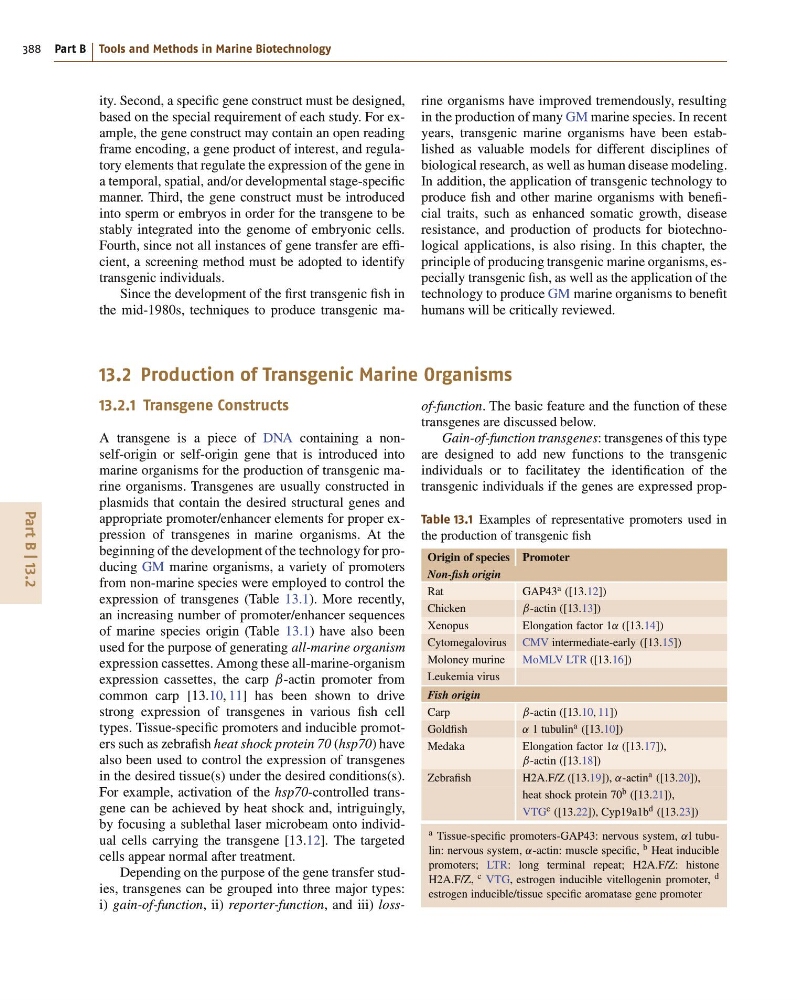
expression of transgenes (Table 13.1). More recently,
an increasing number of promoter/enhancer sequences
of marine species origin (Table 13.1) have also been
used for the purpose of generating all-marine organism
expression cassettes. Among these all-marine-organism
expression cassettes, the carp ˇ-actin promoter from
common carp [13.10, 11] has been shown to drive
strong expression of transgenes in various fish cell
types. Tissue-specific promoters and inducible promoters such as zebrafish heat shock protein 70 (hsp70) have
also been used to control the expression of transgenes
in the desired tissue(s) under the desired conditions(s).
For example, activation of the hsp70-controlled transgene can be achieved by heat shock and, intriguingly,
by focusing a sublethal laser microbeam onto individual cells carrying the transgene [13.12]. The targeted
cells appear normal after treatment.
Depending on the purpose of the gene transfer studies, transgenes can be grouped into three major types:
i) gain-of-function, ii) reporter-function, and iii) lossof-function. The basic feature and the function of these
transgenes are discussed below.
Gain-of-function transgenes: transgenes of this type
are designed to add new functions to the transgenic
individuals or to facilitatey the identification of the
transgenic individuals if the genes are expressed propTable 13.1 Examples of representative promoters used in
the production of transgenic fish
Origin of species Promoter
Non-fish origin
Rat
GAP43 a ([13.12])
Chicken
ˇ-actin ([13.13])
Xenopus
Elongation factor 1˛ ([13.14])
Cytomegalovirus CMV intermediate-early ([13.15])
Moloney murine
MoMLV LTR ([13.16])
Leukemia virus
Fish origin
Carp
ˇ-actin ([13.10, 11])
Goldfish
˛ 1 tubulin a ([13.10])
Medaka
Elongation factor 1˛ ([13.17]),
ˇ-actin ([13.18])
Zebrafish
H2A.F/Z ([13.19]), ˛-actin a ([13.20]),
heat shock protein 70 b ([13.21]),
VTG c ([13.22]), Cyp19a1b d ([13.23])
a Tissue-specific promoters-GAP43: nervous system, ˛l tubulin: nervous system, ˛-actin: muscle specific, b Heat inducible
promoters; LTR: long terminal repeat; H2A.F/Z: histone
H2A.F/Z, c VTG, estrogen inducible vitellogenin promoter, d
estrogen inducible/tissue specific aromatase gene promoter
388 Part B Tools and Methods in Marine Biotechnology
ity. Second, a specific gene construct must be designed,
based on the special requirement of each study. For example, the gene construct may contain an open reading
frame encoding, a gene product of interest, and regulatory elements that regulate the expression of the gene in
a temporal, spatial, and/or developmental stage-specific
manner. Third, the gene construct must be introduced
into sperm or embryos in order for the transgene to be
stably integrated into the genome of embryonic cells.
Fourth, since not all instances of gene transfer are efficient, a screening method must be adopted to identify
transgenic individuals.
Since the development of the first transgenic fish in
the mid-1980s, techniques to produce transgenic marine organisms have improved tremendously, resulting
in the production of many GM marine species. In recent
years, transgenic marine organisms have been established as valuable models for different disciplines of
biological research, as well as human disease modeling.
In addition, the application of transgenic technology to
produce fish and other marine organisms with beneficial traits, such as enhanced somatic growth, disease
resistance, and production of products for biotechnological applications, is also rising. In this chapter, the
principle of producing transgenic marine organisms, especially transgenic fish, as well as the application of the
technology to produce GM marine organisms to benefit
humans will be critically reviewed.
13.2 Production of Transgenic Marine Organisms
13.2.1 Transgene Constructs
A transgene is a piece of DNA containing a nonself-origin or self-origin gene that is introduced into
marine organisms for the production of transgenic marine organisms. Transgenes are usually constructed in
plasmids that contain the desired structural genes and
appropriate promoter/enhancer elements for proper expression of transgenes in marine organisms. At the
beginning of the development of the technology for producing GM marine organisms, a variety of promoters
from non-marine species were employed to control the
expression of transgenes (Table 13.1). More recently,
an increasing number of promoter/enhancer sequences
of marine species origin (Table 13.1) have also been
used for the purpose of generating all-marine organism
expression cassettes. Among these all-marine-organism
expression cassettes, the carp ˇ-actin promoter from
common carp [13.10, 11] has been shown to drive
strong expression of transgenes in various fish cell
types. Tissue-specific promoters and inducible promoters such as zebrafish heat shock protein 70 (hsp70) have
also been used to control the expression of transgenes
in the desired tissue(s) under the desired conditions(s).
For example, activation of the hsp70-controlled transgene can be achieved by heat shock and, intriguingly,
by focusing a sublethal laser microbeam onto individual cells carrying the transgene [13.12]. The targeted
cells appear normal after treatment.
Depending on the purpose of the gene transfer studies, transgenes can be grouped into three major types:
i) gain-of-function, ii) reporter-function, and iii) lossof-function. The basic feature and the function of these
transgenes are discussed below.
Gain-of-function transgenes: transgenes of this type
are designed to add new functions to the transgenic
individuals or to facilitatey the identification of the
transgenic individuals if the genes are expressed propTable 13.1 Examples of representative promoters used in
the production of transgenic fish
Origin of species Promoter
Non-fish origin
Rat
GAP43 a ([13.12])
Chicken
ˇ-actin ([13.13])
Xenopus
Elongation factor 1˛ ([13.14])
Cytomegalovirus CMV intermediate-early ([13.15])
Moloney murine
MoMLV LTR ([13.16])
Leukemia virus
Fish origin
Carp
ˇ-actin ([13.10, 11])
Goldfish
˛ 1 tubulin a ([13.10])
Medaka
Elongation factor 1˛ ([13.17]),
ˇ-actin ([13.18])
Zebrafish
H2A.F/Z ([13.19]), ˛-actin a ([13.20]),
heat shock protein 70 b ([13.21]),
VTG c ([13.22]), Cyp19a1b d ([13.23])
a Tissue-specific promoters-GAP43: nervous system, ˛l tubulin: nervous system, ˛-actin: muscle specific, b Heat inducible
promoters; LTR: long terminal repeat; H2A.F/Z: histone
H2A.F/Z, c VTG, estrogen inducible vitellogenin promoter, d
estrogen inducible/tissue specific aromatase gene promoter