

Part B | 12.8
378 Part B Tools and Methods in Marine Biotechnology
Sampling system
Manual sampling valve
Computerized
metering valve
Fluid reservoir
Band
heaters
On/off
valve
Effluent
Vent to plastic bottle
Thermocouple
Temperature
monitor
PEEK HPLC
column bioreactor
Pump
constant flow
H 2 O
H 2 O Media + dissolved gas
PEEK separator
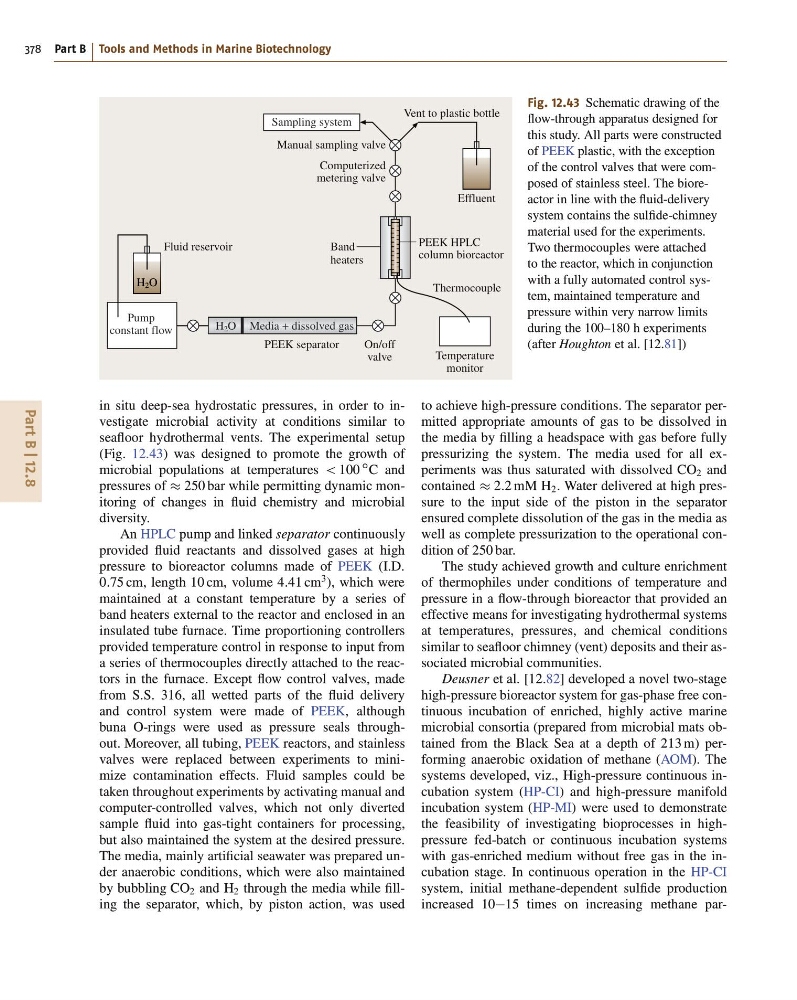
Fig. 12.43 Schematic drawing of the
flow-through apparatus designed for
this study. All parts were constructed
of PEEK plastic, with the exception
of the control valves that were composed of stainless steel. The bioreactor in line with the fluid-delivery
system contains the sulfide-chimney
material used for the experiments.
Two thermocouples were attached
to the reactor, which in conjunction
with a fully automated control system, maintained temperature and
pressure within very narrow limits
during the 100–180 h experiments
(after Houghton et al. [12.81])
in situ deep-sea hydrostatic pressures, in order to investigate microbial activity at conditions similar to
seafloor hydrothermal vents. The experimental setup
(Fig. 12.43) was designed to promote the growth of
microbial populations at temperatures < 100
ı C and
pressures of 250 bar while permitting dynamic monitoring of changes in fluid chemistry and microbial
diversity.
An HPLC pump and linked separator continuously
provided fluid reactants and dissolved gases at high
pressure to bioreactor columns made of PEEK (I.D.
0:75 cm, length 10 cm, volume 4:41 cm
3 ), which were
maintained at a constant temperature by a series of
band heaters external to the reactor and enclosed in an
insulated tube furnace. Time proportioning controllers
provided temperature control in response to input from
a series of thermocouples directly attached to the reactors in the furnace. Except flow control valves, made
from S.S. 316, all wetted parts of the fluid delivery
and control system were made of PEEK, although
buna O-rings were used as pressure seals throughout. Moreover, all tubing, PEEK reactors, and stainless
valves were replaced between experiments to minimize contamination effects. Fluid samples could be
taken throughout experiments by activating manual and
computer-controlled valves, which not only diverted
sample fluid into gas-tight containers for processing,
but also maintained the system at the desired pressure.
The media, mainly artificial seawater was prepared under anaerobic conditions, which were also maintained
by bubbling CO 2 and H 2 through the media while filling the separator, which, by piston action, was used
to achieve high-pressure conditions. The separator permitted appropriate amounts of gas to be dissolved in
the media by filling a headspace with gas before fully
pressurizing the system. The media used for all experiments was thus saturated with dissolved CO 2 and
contained 2:2 mM H 2 . Water delivered at high pressure to the input side of the piston in the separator
ensured complete dissolution of the gas in the media as
well as complete pressurization to the operational condition of 250 bar.
The study achieved growth and culture enrichment
of thermophiles under conditions of temperature and
pressure in a flow-through bioreactor that provided an
effective means for investigating hydrothermal systems
at temperatures, pressures, and chemical conditions
similar to seafloor chimney (vent) deposits and their associated microbial communities.
Deusner et al. [12.82] developed a novel two-stage
high-pressure bioreactor system for gas-phase free continuous incubation of enriched, highly active marine
microbial consortia (prepared from microbial mats obtained from the Black Sea at a depth of 213 m) performing anaerobic oxidation of methane (AOM). The
systems developed, viz., High-pressure continuous incubation system (HP-CI) and high-pressure manifold
incubation system (HP-MI) were used to demonstrate
the feasibility of investigating bioprocesses in highpressure fed-batch or continuous incubation systems
with gas-enriched medium without free gas in the incubation stage. In continuous operation in the HP-CI
system, initial methane-dependent sulfide production
increased 1015 times on increasing methane par-
378 Part B Tools and Methods in Marine Biotechnology
Sampling system
Manual sampling valve
Computerized
metering valve
Fluid reservoir
Band
heaters
On/off
valve
Effluent
Vent to plastic bottle
Thermocouple
Temperature
monitor
PEEK HPLC
column bioreactor
Pump
constant flow
H 2 O
H 2 O Media + dissolved gas
PEEK separator
Fig. 12.43 Schematic drawing of the
flow-through apparatus designed for
this study. All parts were constructed
of PEEK plastic, with the exception
of the control valves that were composed of stainless steel. The bioreactor in line with the fluid-delivery
system contains the sulfide-chimney
material used for the experiments.
Two thermocouples were attached
to the reactor, which in conjunction
with a fully automated control system, maintained temperature and
pressure within very narrow limits
during the 100–180 h experiments
(after Houghton et al. [12.81])
in situ deep-sea hydrostatic pressures, in order to investigate microbial activity at conditions similar to
seafloor hydrothermal vents. The experimental setup
(Fig. 12.43) was designed to promote the growth of
microbial populations at temperatures < 100
ı C and
pressures of 250 bar while permitting dynamic monitoring of changes in fluid chemistry and microbial
diversity.
An HPLC pump and linked separator continuously
provided fluid reactants and dissolved gases at high
pressure to bioreactor columns made of PEEK (I.D.
0:75 cm, length 10 cm, volume 4:41 cm
3 ), which were
maintained at a constant temperature by a series of
band heaters external to the reactor and enclosed in an
insulated tube furnace. Time proportioning controllers
provided temperature control in response to input from
a series of thermocouples directly attached to the reactors in the furnace. Except flow control valves, made
from S.S. 316, all wetted parts of the fluid delivery
and control system were made of PEEK, although
buna O-rings were used as pressure seals throughout. Moreover, all tubing, PEEK reactors, and stainless
valves were replaced between experiments to minimize contamination effects. Fluid samples could be
taken throughout experiments by activating manual and
computer-controlled valves, which not only diverted
sample fluid into gas-tight containers for processing,
but also maintained the system at the desired pressure.
The media, mainly artificial seawater was prepared under anaerobic conditions, which were also maintained
by bubbling CO 2 and H 2 through the media while filling the separator, which, by piston action, was used
to achieve high-pressure conditions. The separator permitted appropriate amounts of gas to be dissolved in
the media by filling a headspace with gas before fully
pressurizing the system. The media used for all experiments was thus saturated with dissolved CO 2 and
contained 2:2 mM H 2 . Water delivered at high pressure to the input side of the piston in the separator
ensured complete dissolution of the gas in the media as
well as complete pressurization to the operational condition of 250 bar.
The study achieved growth and culture enrichment
of thermophiles under conditions of temperature and
pressure in a flow-through bioreactor that provided an
effective means for investigating hydrothermal systems
at temperatures, pressures, and chemical conditions
similar to seafloor chimney (vent) deposits and their associated microbial communities.
Deusner et al. [12.82] developed a novel two-stage
high-pressure bioreactor system for gas-phase free continuous incubation of enriched, highly active marine
microbial consortia (prepared from microbial mats obtained from the Black Sea at a depth of 213 m) performing anaerobic oxidation of methane (AOM). The
systems developed, viz., High-pressure continuous incubation system (HP-CI) and high-pressure manifold
incubation system (HP-MI) were used to demonstrate
the feasibility of investigating bioprocesses in highpressure fed-batch or continuous incubation systems
with gas-enriched medium without free gas in the incubation stage. In continuous operation in the HP-CI
system, initial methane-dependent sulfide production
increased 1015 times on increasing methane par-